
Oppo Reno12 Pro vs ZTE nubia Z60 Ultra: A Deep Dive into Flagship Performance
| Phones Images | |||||
|---|---|---|---|---|---|
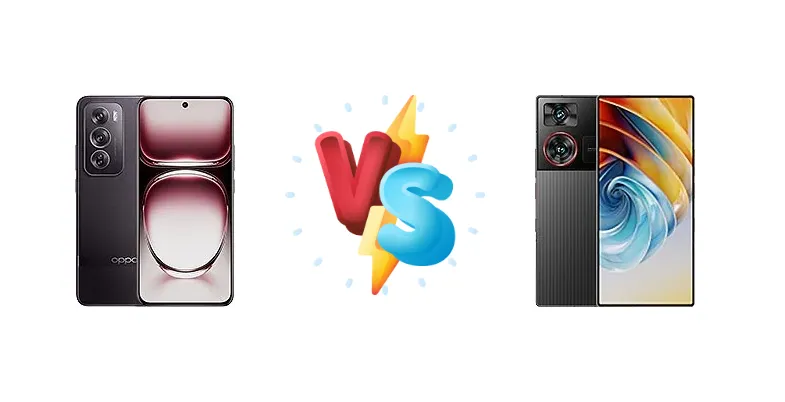
|
🏆 Quick Verdict
For the average user prioritizing all-around performance and a potentially more polished software experience, the ZTE nubia Z60 Ultra Leading emerges as the stronger contender. Its Snapdragon 8 Gen 3 chipset delivers a significant performance leap over the Reno12 Pro’s Dimensity 9200+, coupled with exceptional battery endurance.
| PHONES | ||
|---|---|---|
| Phone Names | Oppo Reno12 Pro (China) | ZTE nubia Z60 Ultra Leading |
| Network | ||
|---|---|---|
| 2G bands | GSM 850 / 900 / 1800 / 1900 | GSM 850 / 900 / 1800 / 1900 |
| 3G bands | HSDPA 850 / 1700(AWS) / 2100 | HSDPA 850 / 900 / 1700(AWS) / 1900 / 2100 |
| 4G bands | 1, 3, 4, 5, 8, 18, 19, 26, 28, 34, 38, 39, 40, 41 | 1, 2, 3, 4, 5, 7, 8, 12, 17, 18, 19, 20, 26, 28, 34, 38, 39, 40, 41, 66 - International |
| 5G bands | 1, 3, 5, 8, 28, 41, 77, 78 SA/NSA | 1, 2, 3, 5, 7, 8, 28, 38, 40, 41, 66, 77, 78 SA/NSA - International |
| Speed | HSPA, LTE, 5G | HSPA, LTE, 5G |
| Technology | GSM / CDMA / HSPA / LTE / 5G | GSM / CDMA / HSPA / CDMA2000 / LTE / 5G |
| Launch | ||
|---|---|---|
| Announced | 2024, May 23 | 2024, July 23 |
| Status | Available. Released 2024, May 31 | Available. Released 2024, August 12 |
| Body | ||
|---|---|---|
| Build | - | Glass front, aluminum frame, glass back |
| Dimensions | 161.4 x 74.8 x 7.6 mm (6.35 x 2.94 x 0.30 in) | 164 x 76.4 x 8.8 mm (6.46 x 3.01 x 0.35 in) |
| SIM | Nano-SIM + Nano-SIM | Nano-SIM + Nano-SIM |
| Weight | 183 g (6.46 oz) | 246 g (8.68 oz) |
| Display | ||
|---|---|---|
| Protection | Corning Gorilla Glass (unspecified version) | - |
| Resolution | 1080 x 2412 pixels, 20:9 ratio (~394 ppi density) | 1116 x 2480 pixels, 20:9 ratio (~400 ppi density) |
| Size | 6.7 inches, 108.0 cm2 (~89.5% screen-to-body ratio) | 6.8 inches, 111.6 cm2 (~89.1% screen-to-body ratio) |
| Type | AMOLED, 1B colors, 120Hz, HDR10+, 1200 nits (peak) | AMOLED, 1B colors, 120Hz, HDR10, 1500 nits (peak) |
| Platform | ||
|---|---|---|
| CPU | Octa-core (1x3.35 GHz Cortex-X3 & 3x3.0 GHz Cortex-A715 & 4x2.0 GHz Cortex-A510) | Octa-core (1x3.4 GHz Cortex-X4 & 3x3.2 GHz Cortex-A720 & 2x3.0 GHz Cortex-A720 & 2x2.3 GHz Cortex-A520) |
| Chipset | Mediatek Dimensity 9200+ (4 nm) | Qualcomm SM8650-AC Snapdragon 8 Gen 3 (4 nm) |
| GPU | Immortalis-G715 MC11 | Adreno 750 (1 GHz) |
| OS | Android 14, ColorOS 14.1 | Android 14, MyOS 14 (International), MyOS 14.5 (China) |
| Memory | ||
|---|---|---|
| Card slot | No | No |
| Internal | 256GB 12GB RAM, 256GB 16GB RAM, 512GB 16GB RAM | 256GB 8GB RAM, 256GB 12GB RAM, 512GB 16GB RAM, 1TB 16GB RAM, 1TB 24GB RAM |
| Main Camera | ||
|---|---|---|
| Features | LED flash, HDR, panorama | Laser AF, color spectrum sensor, Ring-LED, dual-tone flash, panorama, HDR |
| Triple | 50 MP, f/1.8, 24mm (wide), 1/1.56", 1.0µm, multi-directional PDAF, OIS 50 MP, f/2.0, 47mm (telephoto), PDAF, 2x optical zoom 8 MP, f/2.2, 16mm, 112˚ (ultrawide), 1/4.0", 1.12µm | 50 MP, f/1.6, 35mm (standard), 1/1.56", 1.0µm, PDAF, OIS 64 MP, f/3.3, 85mm (periscope telephoto), 1/2.0", PDAF, OIS, 3.3x optical zoom (vs. 26mm cam) 50 MP, f/1.8, 18mm, 100˚ (ultrawide), 1/1.55", 1.0µm, PDAF, OIS |
| Video | 4K@30/60fps, 1080p@30/60/120/240fps, 720p@480fps, gyro-EIS, HDR | 8K@30fps, 4K@30/60/120fps, 1080p@30/60fps, gyro-EIS, HDR10, 10‑bit video |
| Selfie camera | ||
|---|---|---|
| Features | Panorama, HDR | HDR |
| Single | 50 MP, f/2.0, (wide), AF | 12 MP, under display |
| Video | 4K@30/60fps, 1080p@30/60fps, gyro-EIS | 1080p@30fps |
| Sound | ||
|---|---|---|
| 35mm jack | No | No |
| Loudspeaker | Yes | Yes, with stereo speakers |
| Comms | ||
|---|---|---|
| Bluetooth | 5.4, A2DP, LE, aptX HD, LHDC | 5.4, A2DP, LE, aptX HD, aptX Adaptive, aptX Lossless |
| Infrared port | Yes | Yes |
| NFC | Yes | Yes (market/region dependent) |
| Positioning | GPS, GLONASS, GALILEO, BDS, QZSS | GPS (L1+L2+L5), GLONASS (G1+G5), BDS (B1I+B1C+B2a+B2b), GALILEO (E1+E5a), QZSS (L1+L5) |
| Radio | No | No |
| USB | USB Type-C 2.0, OTG | USB Type-C 3.1, OTG |
| WLAN | Wi-Fi 802.11 a/b/g/n/ac/6, dual-band | Wi-Fi 802.11 a/b/g/n/ac/6e/7, dual-band, Wi-Fi Direct |
| Features | ||
|---|---|---|
| Sensors | Fingerprint (under display, optical), accelerometer, gyro, proximity, compass | Fingerprint (under display, optical), accelerometer, gyro, proximity, compass |
| Battery | ||
|---|---|---|
| Charging | 80W wired, PD Reverse wired | 80W wired, PD3.0, QC4 |
| Type | 5000 mAh | Li-Po 6000 mAh |
| Misc | ||
|---|---|---|
| Colors | Black, Purple, Rose Gold | Black, Silver |
| Models | PJW110 | - |
| Price | About 440 EUR | About 730 EUR |
Oppo Reno12 Pro (China)
- Fast 80W wired charging with PD support
- Potentially more refined software experience (Oppo's ColorOS)
- Balanced feature set
- Inferior chipset performance compared to Snapdragon 8 Gen 3
- Likely shorter battery life than nubia Z60 Ultra
ZTE nubia Z60 Ultra Leading
- Significantly more powerful Snapdragon 8 Gen 3 chipset
- Exceptional battery life (14:04h active use)
- Supports PD3.0 and QC4 fast charging standards
- Software experience may be less polished than Oppo's ColorOS
- Gaming-focused design may not appeal to all users
Display Comparison
While specific display details are missing for the Reno12 Pro, both devices support fast charging. The nubia Z60 Ultra’s longevity is a key advantage. The Reno12 Pro’s display likely targets a balance of color accuracy and power efficiency, typical of Oppo’s approach. The nubia, geared towards gamers, may prioritize refresh rates and response times, though this is speculative without further data.
Camera Comparison
Without detailed camera specifications for either device, a direct comparison is limited. However, ZTE’s nubia line often emphasizes camera capabilities, and the ‘Ultra’ designation suggests a focus on high-resolution sensors and advanced image processing. The Reno12 Pro, while likely offering a competent camera system, may prioritize a more balanced approach. The absence of information on sensor sizes and lens apertures makes a definitive judgment impossible, but the nubia’s branding hints at a more ambitious camera setup.
Performance
The core difference lies in the chipsets. The ZTE nubia Z60 Ultra Leading boasts the Qualcomm Snapdragon 8 Gen 3 (4nm), featuring an octa-core configuration with a peak clock speed of 3.4 GHz on its Cortex-X4 prime core. This is a substantial upgrade over the Oppo Reno12 Pro’s MediaTek Dimensity 9200+ (4nm), which tops out at 3.35 GHz with a Cortex-X3 core. The Snapdragon 8 Gen 3’s newer architecture (Cortex-A720 cores vs A715) and improved process node translate to superior CPU and GPU performance, and potentially better thermal management under sustained load. The nubia’s chipset will demonstrably outperform the Reno12 Pro in graphically intensive tasks like gaming and video editing.
Battery Life
The ZTE nubia Z60 Ultra Leading clearly excels in battery life, achieving an active use score of 14:04 hours. While the Oppo Reno12 Pro’s battery capacity is unknown, its 80W wired charging (with PD) is matched by the nubia, which also supports PD3.0 and QC4. The nubia’s significantly longer runtime suggests a larger battery capacity and/or more efficient power management, making it ideal for users who demand all-day battery life. Both devices offer fast charging, but the nubia’s endurance is a major differentiator.
Buying Guide
Buy the Oppo Reno12 Pro (China) if you need a well-rounded device with fast 80W charging and a potentially more refined user interface. Buy the ZTE nubia Z60 Ultra Leading if you prioritize maximum performance for gaming and demanding tasks, and require exceptional battery life exceeding 14 hours of active use. The nubia is the clear choice for power users.