
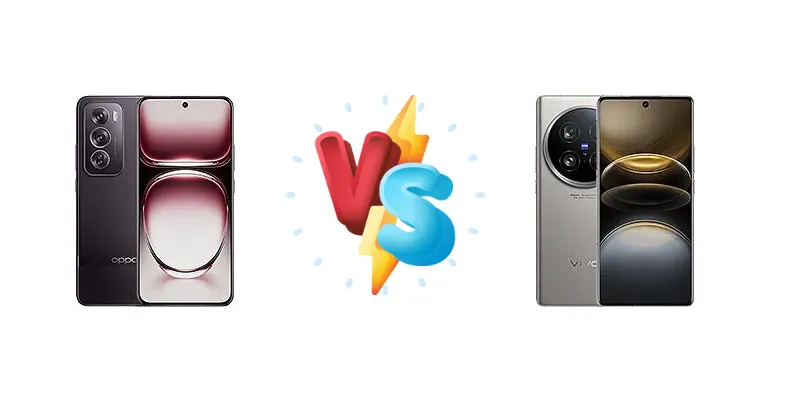
Oppo Reno12 Pro vs vivo X100 Ultra: Which Flagship Reigns Supreme?
| Phones Images | |||||
|---|---|---|---|---|---|
|
🏆 Quick Verdict
For the average user prioritizing raw performance and a more robust feature set, the vivo X100 Ultra is the clear winner. Its Snapdragon 8 Gen 3 chipset provides a noticeable performance advantage, complemented by a brighter display and longer battery life. However, the Reno12 Pro offers a compelling value proposition for those seeking flagship features at a potentially lower price point.
| PHONES | ||
|---|---|---|
| Phone Names | Oppo Reno12 Pro (China) | vivo X100 Ultra |
| Network | ||
|---|---|---|
| 2G bands | GSM 850 / 900 / 1800 / 1900 | GSM 850 / 900 / 1800 / 1900 |
| 3G bands | HSDPA 850 / 1700(AWS) / 2100 | HSDPA 800 / 850 / 900 / 1700(AWS) / 1900 / 2100 |
| 4G bands | 1, 3, 4, 5, 8, 18, 19, 26, 28, 34, 38, 39, 40, 41 | 1, 2, 3, 4, 5, 7, 8, 12, 17, 18, 19, 20, 25, 26, 28, 34, 38, 39, 40, 41, 42, 66 |
| 5G bands | 1, 3, 5, 8, 28, 41, 77, 78 SA/NSA | 1, 2, 3, 5, 7, 8, 12, 20, 25, 26, 28, 38, 40, 41, 66, 77, 78, 79 SA/NSA |
| Speed | HSPA, LTE, 5G | HSPA, LTE, 5G |
| Technology | GSM / CDMA / HSPA / LTE / 5G | GSM / CDMA / HSPA / LTE / 5G |
| Launch | ||
|---|---|---|
| Announced | 2024, May 23 | 2024, May 13 |
| Status | Available. Released 2024, May 31 | Available. Released 2024, May 28 |
| Body | ||
|---|---|---|
| Build | - | Glass front, glass back, aluminum frame |
| Dimensions | 161.4 x 74.8 x 7.6 mm (6.35 x 2.94 x 0.30 in) | 164.1 x 75.6 x 9.2 mm (6.46 x 2.98 x 0.36 in) |
| SIM | Nano-SIM + Nano-SIM | Nano-SIM + Nano-SIM |
| Weight | 183 g (6.46 oz) | 229 g (8.08 oz) |
| Display | ||
|---|---|---|
| Protection | Corning Gorilla Glass (unspecified version) | - |
| Resolution | 1080 x 2412 pixels, 20:9 ratio (~394 ppi density) | 1440 x 3200 pixels, 20:9 ratio (~517 ppi density) |
| Size | 6.7 inches, 108.0 cm2 (~89.5% screen-to-body ratio) | 6.78 inches, 111.4 cm2 (~89.8% screen-to-body ratio) |
| Type | AMOLED, 1B colors, 120Hz, HDR10+, 1200 nits (peak) | LTPO AMOLED, 1B colors, 120Hz, Dolby Vision, HDR, 3000 nits (peak) |
| Platform | ||
|---|---|---|
| CPU | Octa-core (1x3.35 GHz Cortex-X3 & 3x3.0 GHz Cortex-A715 & 4x2.0 GHz Cortex-A510) | Octa-core (1x3.3 GHz Cortex-X4 & 3x3.2 GHz Cortex-A720 & 2x3.0 GHz Cortex-A720 & 2x2.3 GHz Cortex-A520) |
| Chipset | Mediatek Dimensity 9200+ (4 nm) | Qualcomm SM8650-AB Snapdragon 8 Gen 3 (4 nm) |
| GPU | Immortalis-G715 MC11 | Adreno 750 |
| OS | Android 14, ColorOS 14.1 | Android 14, upgradable to Android 15, OriginOS 5 |
| Memory | ||
|---|---|---|
| Card slot | No | No |
| Internal | 256GB 12GB RAM, 256GB 16GB RAM, 512GB 16GB RAM | 256GB 12GB RAM, 512GB 16GB RAM, 1TB 16GB RAM |
| Main Camera | ||
|---|---|---|
| Features | LED flash, HDR, panorama | Laser AF, color spectrum sensor, Zeiss optics, Zeiss T* lens coating, LED flash, panorama, HDR, 3D LUT import |
| Triple | 50 MP, f/1.8, 24mm (wide), 1/1.56", 1.0µm, multi-directional PDAF, OIS 50 MP, f/2.0, 47mm (telephoto), PDAF, 2x optical zoom 8 MP, f/2.2, 16mm, 112˚ (ultrawide), 1/4.0", 1.12µm | 50 MP, f/1.8, 23mm (wide), 1/0.98", 1.6µm, dual pixel PDAF, gimbal OIS 200 MP, f/2.7, 85mm (periscope telephoto), 1/1.4", 0.56µm, multi-directional PDAF, OIS, 3.7x optical zoom, macro 3.4:1 50 MP, f/2.2, 14mm, 116˚ (ultrawide), 1/2.0", 0.8µm, AF |
| Video | 4K@30/60fps, 1080p@30/60/120/240fps, 720p@480fps, gyro-EIS, HDR | 8K@30fps, 4K@30/60/120fps, 1080p@30/60/120/240fps, gyro-EIS, Dolby Vision HDR |
| Selfie camera | ||
|---|---|---|
| Features | Panorama, HDR | HDR |
| Single | 50 MP, f/2.0, (wide), AF | 50 MP, f/2.5, 24mm (wide), 1/2.76", 0.64µm, AF |
| Video | 4K@30/60fps, 1080p@30/60fps, gyro-EIS | 4K@30/60fps, 1080p@30/60fps |
| Sound | ||
|---|---|---|
| 35mm jack | No | No |
| Loudspeaker | Yes | Yes, with stereo speakers |
| Comms | ||
|---|---|---|
| Bluetooth | 5.4, A2DP, LE, aptX HD, LHDC | 5.4, A2DP, LE, aptX HD, aptX Adaptive, aptX Lossless, LHDC |
| Infrared port | Yes | Yes |
| NFC | Yes | Yes |
| Positioning | GPS, GLONASS, GALILEO, BDS, QZSS | GPS (L1+L5), BDS (B1I+B1c+B2a), GALILEO (E1+E5a), QZSS (L1+L5), GLONASS |
| Radio | No | No |
| USB | USB Type-C 2.0, OTG | USB Type-C 3.2, OTG, DisplayPort |
| WLAN | Wi-Fi 802.11 a/b/g/n/ac/6, dual-band | Wi-Fi 802.11 a/b/g/n/ac/6/7, dual-band |
| Features | ||
|---|---|---|
| Sensors | Fingerprint (under display, optical), accelerometer, gyro, proximity, compass | Fingerprint (under display, ultrasonic), accelerometer, gyro, proximity, compass |
| Battery | ||
|---|---|---|
| Charging | 80W wired, PD Reverse wired | 80W wired, PD, PPS, QC, UFCS 30W wireless Reverse wired Reverse wireless |
| Type | 5000 mAh | Si/C Li-Ion 5500 mAh |
| Misc | ||
|---|---|---|
| Colors | Black, Purple, Rose Gold | Titanium, White, Grey |
| Models | PJW110 | V2366GA, V2366HA |
| Price | About 440 EUR | About 980 EUR |
Oppo Reno12 Pro (China)
- Potentially more affordable price point
- Excellent performance with Dimensity 9200+
- 80W fast wired charging
- China-specific model may have software limitations
- Likely inferior display brightness compared to X100 Ultra
vivo X100 Ultra
- Superior performance with Snapdragon 8 Gen 3
- Brighter display with potentially LTPO technology
- Longer battery life and versatile charging options (wired & wireless)
- Higher price tag
- Potential for thermal throttling under extreme load (though mitigated by Snapdragon's efficiency)
Display Comparison
The vivo X100 Ultra boasts a significantly brighter display, reaching a measured peak of 1801 nits, ensuring excellent visibility even in direct sunlight. While the Reno12 Pro’s display specifications are not provided, it’s unlikely to match this peak brightness. The X100 Ultra’s panel likely utilizes LTPO technology for adaptive refresh rates, contributing to power efficiency. Bezels and color accuracy are unknown for the Reno12 Pro, but the X100 Ultra is expected to deliver a top-tier visual experience.
Camera Comparison
Without detailed camera specifications for either device, a direct comparison is limited. However, the X100 Ultra is positioned as an 'Ultra' flagship, suggesting a more advanced camera system. The Reno12 Pro likely features a capable camera setup, but the X100 Ultra is expected to have larger sensors, wider apertures, and more sophisticated image processing algorithms. The X100 Ultra’s focus on photography is a key differentiator, potentially including features like advanced computational photography and enhanced low-light performance.
Performance
The core difference lies in the chipsets: the vivo X100 Ultra’s Snapdragon 8 Gen 3 (4nm) versus the Oppo Reno12 Pro’s Mediatek Dimensity 9200+ (4nm). The Snapdragon 8 Gen 3, with its Cortex-X4 prime core clocked at 3.3 GHz, offers a generational performance leap over the Dimensity 9200+'s Cortex-X3 at 3.35 GHz. The X100 Ultra’s CPU configuration (1+3+2+2) is also more balanced than the Reno12 Pro’s (1+3+4). Both utilize a 4nm process, but Qualcomm’s architecture generally provides better sustained performance due to superior thermal management. The X100 Ultra’s LPDDR5x RAM further enhances its performance capabilities.
Battery Life
The vivo X100 Ultra demonstrates impressive battery life, achieving 12 hours and 55 minutes of active use. While the Reno12 Pro’s battery capacity is unknown, the X100 Ultra’s endurance is a significant advantage. Both support 80W wired charging, but the X100 Ultra adds 30W wireless charging, PPS, QC, and UFCS, offering greater charging flexibility. The X100 Ultra’s charging ecosystem is more comprehensive, and its longer battery life reduces the need for frequent top-ups.
Buying Guide
Buy the Oppo Reno12 Pro (China) if you need a well-rounded flagship experience without breaking the bank, and are comfortable with importing a China-specific model. Its Dimensity 9200+ offers excellent performance for most tasks. Buy the vivo X100 Ultra if you demand the absolute best in performance, display quality, and battery endurance, and are willing to pay a premium for it. It's the ideal choice for power users, gamers, and photography enthusiasts.