
Oppo Reno12 Pro vs vivo iQOO 12 Pro: A Deep Dive into Flagship Performance
| Phones Images | |||||
|---|---|---|---|---|---|
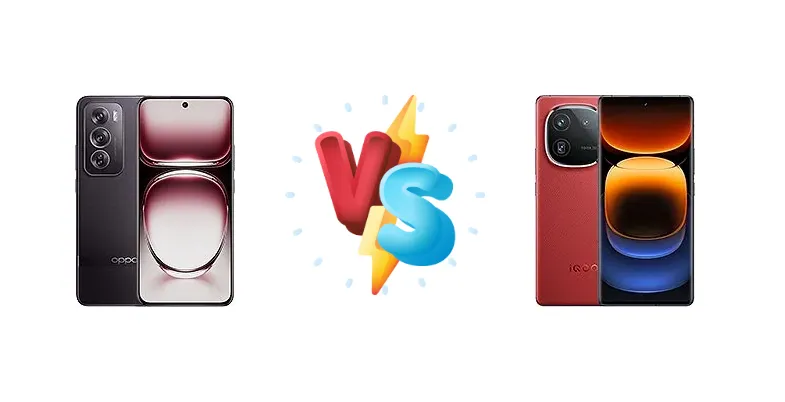
|
🏆 Quick Verdict
For the average user prioritizing all-around performance and faster charging, the vivo iQOO 12 Pro emerges as the winner. Its Snapdragon 8 Gen 3 chipset delivers a significant performance leap over the Reno12 Pro’s Dimensity 9200+, and the 120W charging is substantially quicker than Oppo’s 80W solution.
| PHONES | ||
|---|---|---|
| Phone Names | Oppo Reno12 Pro (China) | vivo iQOO 12 Pro |
| Network | ||
|---|---|---|
| 2G bands | GSM 850 / 900 / 1800 / 1900 | GSM 850 / 900 / 1800 / 1900 |
| 3G bands | HSDPA 850 / 1700(AWS) / 2100 | HSDPA 800 / 850 / 900 / 1700(AWS) / 1900 / 2100 |
| 4G bands | 1, 3, 4, 5, 8, 18, 19, 26, 28, 34, 38, 39, 40, 41 | 1, 2, 3, 4, 5, 7, 8, 12, 17, 18, 19, 20, 25, 26, 28, 34, 38, 39, 40, 41, 42, 66 |
| 5G bands | 1, 3, 5, 8, 28, 41, 77, 78 SA/NSA | 1, 2, 3, 5, 7, 8, 12, 20, 25, 26, 28, 66, 38, 40, 41, 77, 78 SA/NSA |
| Speed | HSPA, LTE, 5G | HSPA, LTE, 5G |
| Technology | GSM / CDMA / HSPA / LTE / 5G | GSM / CDMA / HSPA / CDMA2000 / LTE / 5G |
| Launch | ||
|---|---|---|
| Announced | 2024, May 23 | 2023, November 07 |
| Status | Available. Released 2024, May 31 | Available. Released 2023, November 14 |
| Body | ||
|---|---|---|
| Dimensions | 161.4 x 74.8 x 7.6 mm (6.35 x 2.94 x 0.30 in) | 164.6 x 75.4 x 8.6 mm or 8.8 mm |
| SIM | Nano-SIM + Nano-SIM | Nano-SIM + Nano-SIM |
| Weight | 183 g (6.46 oz) | 205 g or 210 g (7.23 oz) |
| Display | ||
|---|---|---|
| Protection | Corning Gorilla Glass (unspecified version) | - |
| Resolution | 1080 x 2412 pixels, 20:9 ratio (~394 ppi density) | 1440 x 3200 pixels, 20:9 ratio (~518 ppi density) |
| Size | 6.7 inches, 108.0 cm2 (~89.5% screen-to-body ratio) | 6.78 inches, 111.0 cm2 (~89.4% screen-to-body ratio) |
| Type | AMOLED, 1B colors, 120Hz, HDR10+, 1200 nits (peak) | LTPO AMOLED, 1B colors, 144Hz, HDR10+, 1600 nits (HBM), 3000 nits (peak) |
| Platform | ||
|---|---|---|
| CPU | Octa-core (1x3.35 GHz Cortex-X3 & 3x3.0 GHz Cortex-A715 & 4x2.0 GHz Cortex-A510) | Octa-core (1x3.3 GHz Cortex-X4 & 3x3.2 GHz Cortex-A720 & 2x3.0 GHz Cortex-A720 & 2x2.3 GHz Cortex-A520) |
| Chipset | Mediatek Dimensity 9200+ (4 nm) | Qualcomm SM8650-AB Snapdragon 8 Gen 3 (4 nm) |
| GPU | Immortalis-G715 MC11 | Adreno 750 |
| OS | Android 14, ColorOS 14.1 | Android 14, up to 2 major Android upgrades, Funtouch 14 (International), OriginOS 4 (China) |
| Memory | ||
|---|---|---|
| Card slot | No | No |
| Internal | 256GB 12GB RAM, 256GB 16GB RAM, 512GB 16GB RAM | 256GB 16GB RAM, 512GB 16GB RAM, 1TB 16GB RAM |
| Main Camera | ||
|---|---|---|
| Features | LED flash, HDR, panorama | Color spectrum sensor, Dual-LED flash, HDR, panorama |
| Triple | 50 MP, f/1.8, 24mm (wide), 1/1.56", 1.0µm, multi-directional PDAF, OIS 50 MP, f/2.0, 47mm (telephoto), PDAF, 2x optical zoom 8 MP, f/2.2, 16mm, 112˚ (ultrawide), 1/4.0", 1.12µm | 50 MP, f/1.7, 23mm (wide), 1/1.3", 1.2µm, ulti-directional PDAF, OIS 64 MP, f/2.6, 70mm (periscope telephoto), 1/2.0", PDAF, OIS, 3x optical zoom 50 MP, f/2.0, 15mm, 119˚ (ultrawide), AF |
| Video | 4K@30/60fps, 1080p@30/60/120/240fps, 720p@480fps, gyro-EIS, HDR | 8K@30fps, 4K@24/30/60fps, 1080p@30/60/120/240fps, gyro-EIS |
| Selfie camera | ||
|---|---|---|
| Features | Panorama, HDR | HDR |
| Single | 50 MP, f/2.0, (wide), AF | 16 MP, f/2.5, (wide) |
| Video | 4K@30/60fps, 1080p@30/60fps, gyro-EIS | 1080p@30fps, gyro-EIS |
| Sound | ||
|---|---|---|
| 35mm jack | No | No |
| Loudspeaker | Yes | Yes, with stereo speakers |
| Comms | ||
|---|---|---|
| Bluetooth | 5.4, A2DP, LE, aptX HD, LHDC | 5.4, A2DP, LE, aptX HD, aptX Adaptive, aptX Lossless |
| Infrared port | Yes | Yes |
| NFC | Yes | Yes |
| Positioning | GPS, GLONASS, GALILEO, BDS, QZSS | GPS (L1+L5), GLONASS (G1), BDS (B1I+B1c+B2a), GALILEO (E1+E5a), QZSS (L1+L5) |
| Radio | No | No |
| USB | USB Type-C 2.0, OTG | USB Type-C 2.0, OTG |
| WLAN | Wi-Fi 802.11 a/b/g/n/ac/6, dual-band | Wi-Fi 802.11 a/b/g/n/ac/6/7, tri-band, Wi-Fi Direct |
| Features | ||
|---|---|---|
| Sensors | Fingerprint (under display, optical), accelerometer, gyro, proximity, compass | Fingerprint (under display, ultrasonic), accelerometer, gyro, proximity, compass |
| Battery | ||
|---|---|---|
| Charging | 80W wired, PD Reverse wired | 120W wired 50W wireless 10W reverse wireless |
| Type | 5000 mAh | 5100 mAh |
| Misc | ||
|---|---|---|
| Colors | Black, Purple, Rose Gold | Black, Red, White (BMW M branding) |
| Models | PJW110 | V2329A |
| Price | About 440 EUR | About 650 EUR |
Oppo Reno12 Pro (China)
- Potentially more refined software experience (Oppo's ColorOS)
- Stylish design and build quality
- 80W fast charging is still very respectable
- Dimensity 9200+ is outperformed by Snapdragon 8 Gen 3
- Lacks wireless charging
- May not be as optimized for gaming
vivo iQOO 12 Pro
- Snapdragon 8 Gen 3 delivers top-tier performance
- 120W wired and 50W wireless charging are incredibly fast
- Likely optimized for gaming with advanced cooling
- Software (Funtouch OS) may be less polished than ColorOS
- Potential for thermal throttling under sustained load
- May have a more aggressive, less subtle design
Display Comparison
While both devices likely feature high-quality AMOLED panels, specific details like peak brightness and refresh rate are missing. However, the iQOO 12 Pro, being a gaming-focused device, is more likely to incorporate features like a higher touch sampling rate and potentially LTPO technology for variable refresh rates, improving both visual fidelity and power efficiency during gaming. The Reno12 Pro, while still excellent, will likely focus more on color accuracy for media viewing.
Camera Comparison
Without detailed camera specs, a direct comparison is difficult. However, iQOO phones often prioritize camera hardware, and the 12 Pro is likely to feature a larger main sensor and more advanced image processing algorithms. The Reno12 Pro, while capable, may lean towards a more balanced camera system focused on versatility. The presence of Optical Image Stabilization (OIS) on both devices is expected, but the effectiveness will depend on the implementation and sensor size. We can expect the iQOO 12 Pro to offer more aggressive computational photography for vibrant, shareable images.
Performance
The core difference lies in the chipsets. The iQOO 12 Pro’s Snapdragon 8 Gen 3 (4nm) boasts a newer CPU architecture – Cortex-X4 – compared to the Reno12 Pro’s Dimensity 9200+ (4nm) with its Cortex-X3. This translates to a noticeable performance advantage for the iQOO 12 Pro in CPU-intensive tasks and gaming. The Snapdragon 8 Gen 3’s Adreno 750 GPU also surpasses the Mali-G715 MC11 in the Dimensity 9200+, offering superior graphics performance. The iQOO 12 Pro also benefits from potentially faster LPDDR5x RAM, further enhancing responsiveness. Thermal management will be crucial; the Snapdragon 8 Gen 3, while powerful, can generate significant heat, requiring robust cooling solutions – a likely focus for iQOO.
Battery Life
The iQOO 12 Pro’s 120W wired charging is a game-changer, capable of fully charging the battery in under 20 minutes. The Reno12 Pro’s 80W charging is still fast, but significantly slower. The iQOO 12 Pro also adds 50W wireless charging, a feature absent in the Reno12 Pro. While battery capacity isn’t specified, the iQOO 12 Pro’s faster charging mitigates the impact of a potentially smaller battery, offering more convenient top-ups throughout the day. The Reno12 Pro’s reverse wired charging is a useful addition for topping up accessories.
Buying Guide
Buy the Oppo Reno12 Pro (China) if you need a stylish, well-rounded flagship with a focus on everyday tasks and media consumption, and prefer a potentially more refined software experience. Buy the vivo iQOO 12 Pro if you prioritize maximum gaming performance, incredibly fast charging speeds, and are willing to trade some software polish for raw power.