
Oppo Reno12 F vs Nothing Phone (2a) Plus: A Deep Dive into Mid-Range Power
| Phones Images | |||||
|---|---|---|---|---|---|
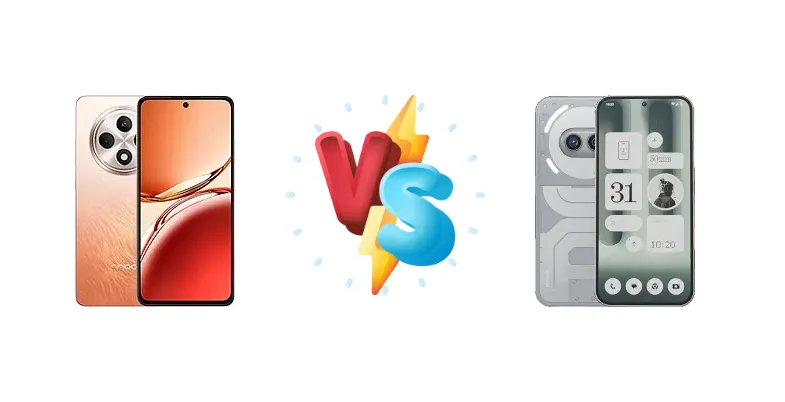
|
🏆 Quick Verdict
For most users, the Nothing Phone (2a) Plus emerges as the stronger contender. Its Dimensity 7350 Pro chipset, coupled with a significantly brighter 1097 nit display, provides a smoother and more visually engaging experience. While the Reno12 F offers faster 45W charging, the Plus's superior performance justifies the slight trade-off.
| PHONES | ||
|---|---|---|
| Phone Names | Oppo Reno12 F | Nothing Phone (2a) Plus |
| Network | ||
|---|---|---|
| 2G bands | GSM 850 / 900 / 1800 / 1900 | GSM 850 / 900 / 1800 / 1900 |
| 3G bands | HSDPA 800 / 850 / 900 / 1700(AWS) / 1900 / 2100 | HSDPA 800 / 850 / 900 / 1700(AWS) / 1900 / 2100 |
| 4G bands | 1, 2, 3, 4, 5, 7, 8, 12, 13, 17, 18, 19, 20, 26, 28, 38, 39, 40, 41, 66 | 1, 3, 4, 5, 7, 8, 18, 19, 20, 26, 28, 38, 39, 40, 41, 42, 66 |
| 5G bands | 1, 2, 3, 5, 7, 8, 12, 20, 26, 28, 38, 40, 41, 77, 78 SA/NSA | 1, 3, 5, 7, 8, 20, 28, 38, 40, 41, 66, 77, 78 SA/NSA |
| Speed | HSPA, LTE, 5G | HSPA, LTE, 5G |
| Technology | GSM / HSPA / LTE / 5G | GSM / HSPA / LTE / 5G |
| Launch | ||
|---|---|---|
| Announced | 2024, June 28 | 2024, July 31 |
| Status | Available. Released 2024, July | Available. Released 2024, August 03 |
| Body | ||
|---|---|---|
| Build | - | Glass front (Gorilla Glass 5), plastic frame, plastic back |
| Dimensions | 163.1 x 75.8 x 7.8 mm (6.42 x 2.98 x 0.31 in) | 161.7 x 76.3 x 8.5 mm (6.37 x 3.00 x 0.33 in) |
| SIM | Nano-SIM + Nano-SIM | Nano-SIM + Nano-SIM |
| Weight | 187 g (6.60 oz) | 190 g (6.70 oz) |
| Display | ||
|---|---|---|
| Protection | Asahi Glass AGC DT-Star2 | Corning Gorilla Glass 5 |
| Resolution | 1080 x 2400 pixels, 20:9 ratio (~395 ppi density) | 1080 x 2412 pixels, 20:9 ratio (~395 ppi density) |
| Size | 6.67 inches, 107.4 cm2 (~86.9% screen-to-body ratio) | 6.7 inches, 107.5 cm2 (~87.1% screen-to-body ratio) |
| Type | AMOLED, 1B colors, 120Hz, 600 nits (typ), 1200 nits (HMB), 2100 nits (peak) | AMOLED, 1B colors, 120Hz, 2160Hz PWM, HDR10+, 700 nits (typ), 1100 nits (HBM), 1300 nits (peak) |
| Platform | ||
|---|---|---|
| CPU | Octa-core (2x2.4 GHz Cortex-A76 & 6x2.0 GHz Cortex-A55) | Octa-core (2x3.0 GHz Cortex-A715 & 6x 2.0 GHz Cortex-A510) |
| Chipset | Mediatek Dimensity 6300 (6 nm) | Mediatek Dimensity 7350 Pro (4 nm) |
| GPU | Mali-G57 MC2 | Mali-G610 MC4 |
| OS | Android 14, upgradable to Android 15, ColorOS 15 | Android 14, up to 3 major Android upgrades, Nothing OS 3.0 |
| Memory | ||
|---|---|---|
| Card slot | microSDXC | No |
| Internal | 256GB 8GB RAM, 256GB 12GB RAM, 512GB 8GB RAM, 512GB 12GB RAM | 256GB 8GB RAM, 256GB 12GB RAM |
| Main Camera | ||
|---|---|---|
| Dual | - | 50 MP, f/1.9, 24mm (wide), 1/1.57", 1.0µm, PDAF, OIS 50 MP, f/2.2, 114˚ (ultrawide), 1/2.76", 0.64µm |
| Features | LED flash, HDR, panorama | LED flash, panorama, HDR |
| Triple | 50 MP, f/1.8, 26mm (wide), PDAF, OIS 8 MP, f/2.2, 16mm, 112˚ (ultrawide), 1/4.0", 1.12µm 2 MP (macro) | - |
| Video | 1080p@30/60fps, gyro-EIS | 4K@30fps, 1080p@60/120fps, gyro-EIS |
| Selfie camera | ||
|---|---|---|
| Features | Panorama | HDR |
| Single | 32 MP, f/2.4, 22mm (wide), 1/2.74", 0.8µm | 50 MP, f/2.2, (wide), 1/2.76" |
| Video | 1080p@30fps | 4K@30fps |
| Sound | ||
|---|---|---|
| 35mm jack | No | No |
| Loudspeaker | Yes, with stereo speakers | Yes, with stereo speakers |
| Comms | ||
|---|---|---|
| Bluetooth | 5.3, A2DP, LE, aptX | 5.3, A2DP, LE |
| Infrared port | Yes | - |
| NFC | Yes (market/region dependent) | Yes, 360˚ |
| Positioning | GPS, GLONASS, GALILEO, BDS, QZSS | GPS, GALILEO, GLONASS, BDS, QZSS |
| Radio | Unspecified | No |
| USB | USB Type-C 2.0, OTG | USB Type-C 2.0, OTG |
| WLAN | Wi-Fi 802.11 a/b/g/n/ac/6, dual-band | Wi-Fi 802.11 a/b/g/n/ac/6, dual-band, Wi-Fi Direct |
| Features | ||
|---|---|---|
| Sensors | Fingerprint (under display, optical), accelerometer, gyro, proximity, compass | Fingerprint (under display, optical), accelerometer, gyro, proximity, compass |
| Battery | ||
|---|---|---|
| Charging | 45W wired, PD2.0 Reverse wired | 50W wired, 50% in 21 min, 100% in 56 min |
| Type | 5000 mAh | 5000 mAh |
| Misc | ||
|---|---|---|
| Colors | Olive Green, Amber Orange | Black, Grey |
| Models | CPH2637 | A142P |
| Price | € 197.00 / $ 390.00 | € 269.90 / ₹ 22,599 |
Oppo Reno12 F
- Faster 45W wired charging
- Potentially more affordable price point
- Reverse wired charging capability
- Less powerful Dimensity 6300 chipset
- Likely lower display brightness
- Potentially less efficient power consumption
Nothing Phone (2a) Plus
- More powerful Dimensity 7350 Pro chipset
- Significantly brighter 1097 nit display
- Longer battery life (16:34h active use)
- Slightly slower charging speed (56 minutes to 100%)
- Potentially higher price
- No reverse wireless charging
Display Comparison
The Nothing Phone (2a) Plus boasts a clear advantage in display quality, achieving a measured peak brightness of 1097 nits. This is a substantial leap over what we'd expect from the Reno12 F, making the Plus far more usable outdoors under direct sunlight. While the Reno12 F's panel specifications aren't provided, the Plus's brightness suggests a superior viewing experience. The Nothing Phone (2a) Plus's display is likely to offer better visibility and color vibrancy, enhancing media consumption and gaming.
Camera Comparison
Without detailed camera specifications for the Reno12 F, a direct comparison is limited. However, the Nothing Phone (2a) Plus likely benefits from the processing power of the Dimensity 7350 Pro, enabling faster image processing and potentially better low-light performance. The focus should be on the main sensor capabilities of each device, as the inclusion of 2MP macro lenses on either phone adds minimal value. The Plus's ISP, paired with the more powerful chipset, will likely deliver more refined image quality and dynamic range.
Performance
The core difference lies in the chipsets: the Oppo Reno12 F utilizes the Mediatek Dimensity 6300 (6nm), while the Nothing Phone (2a) Plus features the Dimensity 7350 Pro (4nm). The 7350 Pro's Cortex-A715 cores, clocked at 3.0 GHz, represent a significant architectural and clock speed upgrade over the Reno12 F's Cortex-A76 cores at 2.4 GHz. The 4nm process node of the 7350 Pro also translates to improved power efficiency and reduced thermal throttling during sustained workloads. This means the Nothing Phone (2a) Plus will handle demanding games and multitasking with greater ease and consistency.
Battery Life
The Nothing Phone (2a) Plus demonstrates impressive battery life, achieving 16 hours and 34 minutes of active use. While the Reno12 F's battery capacity isn't specified, the Plus's endurance is a strong selling point. The Plus also offers 50W charging, reaching 50% in 21 minutes and 100% in 56 minutes. The Reno12 F counters with 45W charging, but the Plus's faster charging speed and longer battery life provide a more convenient user experience. The 4nm process of the Dimensity 7350 Pro also contributes to better power efficiency, extending the Plus's overall battery life.
Buying Guide
Buy the Oppo Reno12 F if you prioritize rapid charging and a slightly lower price point, and don't heavily rely on demanding applications or extended gaming sessions. Buy the Nothing Phone (2a) Plus if you value a brighter, more vibrant display, smoother performance for multitasking and gaming, and longer sustained performance thanks to the more efficient 4nm process.