
Oppo Reno12 F vs. Motorola Moto G Stylus 5G (2024): A Detailed Comparison
| Phones Images | |||||
|---|---|---|---|---|---|
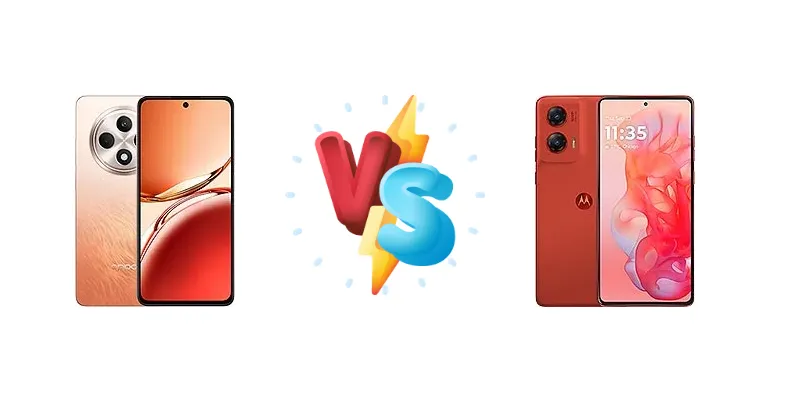
|
🏆 Quick Verdict
For the average user prioritizing a balance of performance and aesthetics, the Oppo Reno12 F emerges as the winner. Its Dimensity 6300 chipset, coupled with 45W charging, offers a smoother experience and quicker top-ups than the Moto G Stylus 5G (2024). However, the Motorola excels in battery life, making it ideal for heavy users.
| PHONES | ||
|---|---|---|
| Phone Names | Oppo Reno12 F | Motorola Moto G Stylus 5G (2024) |
| Network | ||
|---|---|---|
| 2G bands | GSM 850 / 900 / 1800 / 1900 | GSM 850 / 900 / 1800 / 1900 |
| 3G bands | HSDPA 800 / 850 / 900 / 1700(AWS) / 1900 / 2100 | HSDPA 850 / 900 / 1700(AWS) / 1900 / 2100 |
| 4G bands | 1, 2, 3, 4, 5, 7, 8, 12, 13, 17, 18, 19, 20, 26, 28, 38, 39, 40, 41, 66 | 1, 2, 3, 4, 5, 7, 8, 12, 13, 14, 17, 18, 19, 20, 25, 26, 28, 29, 30, 38, 39, 40, 41, 48, 66, 71 |
| 5G bands | 1, 2, 3, 5, 7, 8, 12, 20, 26, 28, 38, 40, 41, 77, 78 SA/NSA | 1, 2, 3, 5, 7, 12, 14, 20, 25, 26, 28, 29, 30, 38, 40, 41, 48, 66, 70, 71, 77, 78 SA/NSA/Sub6 |
| Speed | HSPA, LTE, 5G | HSPA, LTE, 5G |
| Technology | GSM / HSPA / LTE / 5G | GSM / HSPA / LTE / 5G |
| Launch | ||
|---|---|---|
| Announced | 2024, June 28 | 2024, May 10 |
| Status | Available. Released 2024, July | Available. Released 2024, May 30 |
| Body | ||
|---|---|---|
| Build | - | Glass front, silicone polymer (eco leather) back, plastic frame |
| Dimensions | 163.1 x 75.8 x 7.8 mm (6.42 x 2.98 x 0.31 in) | 162.6 x 74.8 x 8.3 mm (6.40 x 2.94 x 0.33 in) |
| SIM | Nano-SIM + Nano-SIM | Nano-SIM + eSIM |
| Weight | 187 g (6.60 oz) | 190 g (6.70 oz) |
| Display | ||
|---|---|---|
| Protection | Asahi Glass AGC DT-Star2 | - |
| Resolution | 1080 x 2400 pixels, 20:9 ratio (~395 ppi density) | 1080 x 2400 pixels, 20:9 ratio (~395 ppi density) |
| Size | 6.67 inches, 107.4 cm2 (~86.9% screen-to-body ratio) | 6.7 inches, 107.3 cm2 (~88.2% screen-to-body ratio) |
| Type | AMOLED, 1B colors, 120Hz, 600 nits (typ), 1200 nits (HMB), 2100 nits (peak) | P-OLED, 1B colors, 120Hz, 1200 nits (peak) |
| Platform | ||
|---|---|---|
| CPU | Octa-core (2x2.4 GHz Cortex-A76 & 6x2.0 GHz Cortex-A55) | Octa-core (4x2.2 GHz Cortex-A78 & 4x1.8 GHz Cortex-A55) |
| Chipset | Mediatek Dimensity 6300 (6 nm) | Qualcomm SM6450 Snapdragon 6 Gen 1 (4 nm) |
| GPU | Mali-G57 MC2 | Adreno 710 |
| OS | Android 14, upgradable to Android 15, ColorOS 15 | Android 14, up to 1 major Android upgrades |
| Memory | ||
|---|---|---|
| Card slot | microSDXC | microSDXC (dedicated slot) |
| Internal | 256GB 8GB RAM, 256GB 12GB RAM, 512GB 8GB RAM, 512GB 12GB RAM | 128GB 4GB RAM, 128GB 8GB RAM, 256GB 8GB RAM |
| Main Camera | ||
|---|---|---|
| Dual | - | 50 MP, f/1.8, 24mm (wide), 1/1.57", 1.0µm, dual-pixel PDAF, OIS 13 MP, f/2.2, 16mm, 120˚ (ultrawide), 1/3.0", 1.12µm, AF |
| Features | LED flash, HDR, panorama | LED flash, HDR, panorama |
| Triple | 50 MP, f/1.8, 26mm (wide), PDAF, OIS 8 MP, f/2.2, 16mm, 112˚ (ultrawide), 1/4.0", 1.12µm 2 MP (macro) | - |
| Video | 1080p@30/60fps, gyro-EIS | 4K@30fps, 1080p@30/60/120fps |
| Selfie camera | ||
|---|---|---|
| Features | Panorama | HDR |
| Single | 32 MP, f/2.4, 22mm (wide), 1/2.74", 0.8µm | 32 MP, f/2.4, 25mm (wide), 1/3.14", 0.7µm |
| Video | 1080p@30fps | 4K@30fps, 1080p@30/60fps |
| Sound | ||
|---|---|---|
| 35mm jack | No | Yes |
| Loudspeaker | Yes, with stereo speakers | Yes, with stereo speakers |
| Comms | ||
|---|---|---|
| Bluetooth | 5.3, A2DP, LE, aptX | 5.1, A2DP, LE |
| Infrared port | Yes | - |
| NFC | Yes (market/region dependent) | Yes |
| Positioning | GPS, GLONASS, GALILEO, BDS, QZSS | GPS, GLONASS, GALILEO |
| Radio | Unspecified | FM radio (market/region dependent) |
| USB | USB Type-C 2.0, OTG | USB Type-C 2.0 |
| WLAN | Wi-Fi 802.11 a/b/g/n/ac/6, dual-band | Wi-Fi 802.11 a/b/g/n/ac, dual-band |
| Features | ||
|---|---|---|
| Sensors | Fingerprint (under display, optical), accelerometer, gyro, proximity, compass | Fingerprint (under display, optical), accelerometer, gyro, proximity, compass, barometer |
| Battery | ||
|---|---|---|
| Charging | 45W wired, PD2.0 Reverse wired | 30W wired 15W wireless |
| Type | 5000 mAh | 5000 mAh |
| Misc | ||
|---|---|---|
| Colors | Olive Green, Amber Orange | Caramel Latte, Scarlet Wave |
| Models | CPH2637 | XT2419-2, XT2419-1, XT2419 |
| Price | € 197.00 / $ 390.00 | $ 68.66 / C$ 202.25 |
Oppo Reno12 F
- Faster 45W charging with PD2.0 support
- Potentially smoother performance with Cortex-A76 cores
- Sleeker design (based on brand aesthetic)
- Likely lower peak display brightness
- Battery life likely shorter than the Motorola
Motorola Moto G Stylus 5G (2024)
- Exceptional battery life (12:43h active use)
- Very bright 1387 nit display
- Integrated stylus for note-taking and creativity
- Slower 30W wired charging
- Less powerful CPU cores compared to Oppo
Display Comparison
The Motorola Moto G Stylus 5G (2024) boasts a significantly brighter display, reaching a measured 1387 nits. This is a substantial advantage for outdoor use, where the Reno12 F’s display brightness is not specified but likely falls below this figure. While both likely utilize LCD panels (given the price point), the Motorola’s peak brightness is a clear win. Bezels appear comparable based on available imagery, and without color accuracy data, it’s difficult to assess which panel offers more vibrant or accurate colors.
Camera Comparison
Without detailed camera samples, a definitive judgment is difficult. However, the lack of information regarding the Reno12 F’s main sensor size suggests it’s unlikely to surpass the Moto G Stylus 5G (2024) in image quality. Motorola’s focus on a larger sensor (details unspecified) and potentially better image processing algorithms gives it an advantage in low-light scenarios. The inclusion of OIS on the Motorola would further enhance image stability, particularly for video recording. We can safely ignore the likely 2MP macro lenses on both devices, as their utility is minimal.
Performance
The chipset choice is a key differentiator. The Motorola utilizes the Qualcomm Snapdragon 6 Gen 1 (4nm), while the Oppo features the Mediatek Dimensity 6300 (6nm). The Snapdragon 6 Gen 1’s 4nm process theoretically provides better power efficiency, but the Dimensity 6300’s Cortex-A76 cores (vs. the Snapdragon’s A78) offer a slight edge in single-core performance. The CPU configuration – 2x2.4 GHz Cortex-A76 & 6x2.0 GHz Cortex-A55 on the Oppo versus 4x2.2 GHz Cortex-A78 & 4x1.8 GHz Cortex-A55 on the Motorola – suggests the Oppo will handle demanding apps slightly better, while the Motorola may offer more sustained performance due to its more efficient node. RAM configurations are not specified, but LPDDR4X is likely on both, limiting overall memory bandwidth.
Battery Life
The Motorola Moto G Stylus 5G (2024) clearly wins in battery endurance, achieving an impressive 12:43h of active use. The Oppo Reno12 F’s battery capacity is not specified, but its 45W charging capability is significantly faster than the Motorola’s 30W wired and 15W wireless charging. This means the Reno12 F can recover a substantial charge in a shorter amount of time, mitigating the impact of a potentially smaller battery. The inclusion of PD2.0 on the Oppo also ensures compatibility with a wider range of chargers.
Buying Guide
Buy the Oppo Reno12 F if you need a phone that feels responsive for everyday tasks, benefits from faster charging speeds, and offers a more modern design. Buy the Motorola Moto G Stylus 5G (2024) if you prioritize all-day battery life, frequently use a stylus for note-taking or creative tasks, and value a brighter display for outdoor visibility.