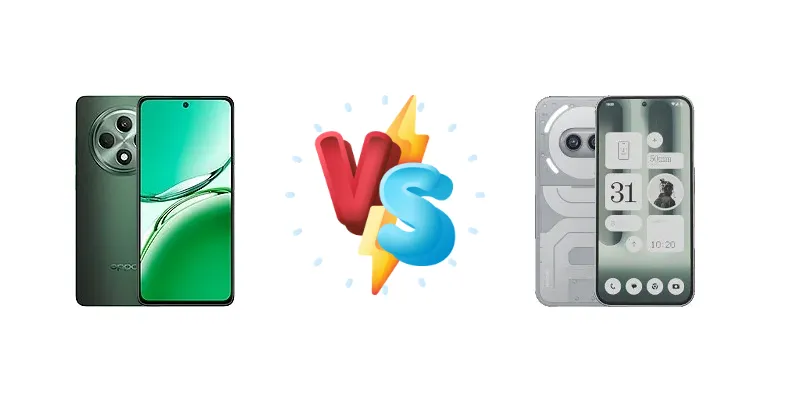
The Oppo Reno12 F 4G and the Nothing Phone (2a) Plus represent distinct approaches to the mid-range smartphone market. The Reno12 F focuses on established brand recognition and efficient power management, while the Phone (2a) Plus aims to disrupt with a more powerful chipset and a unique design aesthetic. This comparison dives deep into their specifications to determine which device delivers the best overall experience.
🏆 Quick Verdict
For the average user prioritizing performance and future-proofing, the Nothing Phone (2a) Plus is the clear winner. Its Mediatek Dimensity 7350 Pro chipset offers a significant performance leap over the Oppo Reno12 F's Snapdragon 685, and its superior display brightness enhances usability. However, the Reno12 F remains a viable option for those on a tighter budget or primarily needing basic smartphone functionality.
| Network |
|---|
| 2G bands | GSM 850 / 900 / 1800 / 1900 | GSM 850 / 900 / 1800 / 1900 |
| 3G bands | HSDPA 850 / 900 / 2100 | HSDPA 800 / 850 / 900 / 1700(AWS) / 1900 / 2100 |
| 4G bands | 1, 3, 5, 7, 8, 20, 28, 38, 40, 41 | 1, 3, 4, 5, 7, 8, 18, 19, 20, 26, 28, 38, 39, 40, 41, 42, 66 |
| 5G bands | - | 1, 3, 5, 7, 8, 20, 28, 38, 40, 41, 66, 77, 78 SA/NSA |
| Speed | HSPA, LTE, 5G | HSPA, LTE, 5G |
| Technology | GSM / HSPA / LTE | GSM / HSPA / LTE / 5G |
| Launch |
|---|
| Announced | 2024, July 18 | 2024, July 31 |
| Status | Available. Released 2024, August | Available. Released 2024, August 03 |
| Body |
|---|
| Build | - | Glass front (Gorilla Glass 5), plastic frame, plastic back |
| Dimensions | 163.1 x 75.8 x 7.7 mm (6.42 x 2.98 x 0.30 in) | 161.7 x 76.3 x 8.5 mm (6.37 x 3.00 x 0.33 in) |
| SIM | Nano-SIM + Nano-SIM | Nano-SIM + Nano-SIM |
| Weight | 187 g (6.60 oz) | 190 g (6.70 oz) |
| Display |
|---|
| Protection | Asahi Glass AGC DT-Star2 | Corning Gorilla Glass 5 |
| Resolution | 1080 x 2400 pixels, 20:9 ratio (~395 ppi density) | 1080 x 2412 pixels, 20:9 ratio (~395 ppi density) |
| Size | 6.67 inches, 107.4 cm2 (~86.9% screen-to-body ratio) | 6.7 inches, 107.5 cm2 (~87.1% screen-to-body ratio) |
| Type | AMOLED, 120Hz, 600 nits (typ), 1200 nits (HMB), 2100 nits (peak) | AMOLED, 1B colors, 120Hz, 2160Hz PWM, HDR10+, 700 nits (typ), 1100 nits (HBM), 1300 nits (peak) |
| Platform |
|---|
| CPU | Octa-core (4x2.8 GHz Cortex-A73 & 4x1.9 GHz Cortex-A53) | Octa-core (2x3.0 GHz Cortex-A715 & 6x 2.0 GHz Cortex-A510) |
| Chipset | Qualcomm SM6225 Snapdragon 685 (6 nm) | Mediatek Dimensity 7350 Pro (4 nm) |
| GPU | Adreno 610 | Mali-G610 MC4 |
| OS | Android 14, upgradable to Android 15, ColorOS 15 | Android 14, up to 3 major Android upgrades, Nothing OS 3.0 |
| Memory |
|---|
| Card slot | microSDXC | No |
| Internal | 256GB 8GB RAM, 512GB 8GB RAM | 256GB 8GB RAM, 256GB 12GB RAM |
| Main Camera |
|---|
| Dual | - | 50 MP, f/1.9, 24mm (wide), 1/1.57", 1.0µm, PDAF, OIS
50 MP, f/2.2, 114˚ (ultrawide), 1/2.76", 0.64µm |
| Features | LED flash, HDR, panorama | LED flash, panorama, HDR |
| Triple | 50 MP, f/1.8, 28mm (wide), PDAF
8 MP, f/2.2, 16mm, 112˚ (ultrawide), 1/4.0", 1.12µm
2 MP (macro) | - |
| Video | 1080p@30fps | 4K@30fps, 1080p@60/120fps, gyro-EIS |
| Selfie camera |
|---|
| Features | Panorama | HDR |
| Single | 32 MP, f/2.4, 25mm (wide), 1/2.74", 0.8µm | 50 MP, f/2.2, (wide), 1/2.76" |
| Video | 1080p@30fps | 4K@30fps |
| Sound |
|---|
| 35mm jack | No | No |
| Loudspeaker | Yes, with stereo speakers | Yes, with stereo speakers |
| Comms |
|---|
| Bluetooth | 5.0, A2DP, LE, aptX | 5.3, A2DP, LE |
| Infrared port | Yes | - |
| NFC | No | Yes, 360˚ |
| Positioning | GPS, GLONASS, GALILEO, BDS, QZSS | GPS, GALILEO, GLONASS, BDS, QZSS |
| Radio | Unspecified | No |
| USB | USB Type-C 2.0, OTG | USB Type-C 2.0, OTG |
| WLAN | Wi-Fi 802.11 a/b/g/n/ac, dual-band | Wi-Fi 802.11 a/b/g/n/ac/6, dual-band, Wi-Fi Direct |
| Features |
|---|
| Sensors | Fingerprint (side-mounted), accelerometer, proximity, compass | Fingerprint (under display, optical), accelerometer, gyro, proximity, compass |
| Battery |
|---|
| Charging | 45W wired, PD2.0, PPS
Reverse wired | 50W wired, 50% in 21 min, 100% in 56 min |
| Type | 5000 mAh | 5000 mAh |
| Misc |
|---|
| Colors | Amber Orange, Olive Green, Matte Grey | Black, Grey |
| Models | CPH2687 | A142P |
| Price | - | € 269.90 / ₹ 22,599 |
Oppo Reno12 F 4G
- Potentially lower price point
- Established brand reputation
- 45W fast charging with PD/PPS support
- Significantly less powerful processor
- Likely inferior display brightness
- Limited information on camera capabilities
Nothing Phone (2a) Plus
- Powerful Mediatek Dimensity 7350 Pro chipset
- Bright and vibrant display (1097 nits)
- Excellent battery life (16:34h active use)
- Potentially higher price
- Less established brand
- Design may not appeal to all
Display Comparison
The Nothing Phone (2a) Plus boasts a significantly brighter display, reaching a measured peak of 1097 nits, compared to an unspecified brightness for the Reno12 F. This higher brightness translates to better outdoor visibility. While both likely utilize OLED panels, the Nothing Phone (2a) Plus’s brightness advantage is a key differentiator. The Reno12 F’s display specifications are currently limited, making a detailed comparison of color accuracy and panel technology difficult, but it’s reasonable to assume it targets a more budget-conscious panel.
Camera Comparison
Without detailed camera specifications for the Reno12 F, a direct comparison is challenging. However, the focus should be on the main sensor and image processing. The Nothing Phone (2a) Plus likely benefits from the Dimensity 7350 Pro’s enhanced image signal processor (ISP), potentially leading to better image quality, especially in low-light conditions. The Reno12 F will likely rely on software optimization to compensate for a potentially less capable ISP. The presence or absence of Optical Image Stabilization (OIS) on the Reno12 F is a critical unknown, as OIS significantly improves image stability and low-light performance.
Performance
The core difference lies in the chipsets. The Nothing Phone (2a) Plus’s Mediatek Dimensity 7350 Pro, built on a 4nm process, offers a substantial performance advantage over the Oppo Reno12 F’s 6nm Qualcomm Snapdragon 685. The Dimensity 7350 Pro’s octa-core configuration (2x3.0 GHz Cortex-A715 & 6x 2.0 GHz Cortex-A510) is architecturally superior to the Snapdragon 685’s (4x2.8 GHz Cortex-A73 & 4x1.9 GHz Cortex-A53), resulting in faster processing speeds and improved efficiency. This translates to smoother multitasking, quicker app loading times, and a better gaming experience on the Nothing Phone (2a) Plus.
Battery Life
The Nothing Phone (2a) Plus demonstrates impressive battery life, achieving an active use score of 16 hours and 34 minutes. While the Reno12 F’s battery capacity is unknown, the Nothing Phone (2a) Plus’s 50W charging (50% in 21 minutes, 100% in 56 minutes) is faster than the Reno12 F’s 45W charging. The Dimensity 7350 Pro’s 4nm efficiency likely contributes to the Phone (2a) Plus’s longer battery life, offsetting any potential capacity difference. The Reno12 F supports PD2.0 and PPS charging standards, offering compatibility with a wider range of chargers.
Buying Guide
Buy the Oppo Reno12 F 4G if you need a reliable, affordable smartphone for everyday tasks like calling, texting, and social media, and prioritize a brand with a long track record. Buy the Nothing Phone (2a) Plus if you prefer a more powerful processor for gaming and demanding apps, a brighter and more vibrant display, and a distinctive, modern design, even if it means spending a bit more.
Frequently Asked Questions
❓ Does the Snapdragon 685 in the Oppo Reno12 F struggle with demanding games like Genshin Impact?
Yes, the Snapdragon 685 is a budget-oriented chipset. While it can handle less demanding games, Genshin Impact and similar titles will likely require significant graphics settings reductions and may still experience frame drops. The Nothing Phone (2a) Plus’s Dimensity 7350 Pro is far better equipped for these games.
❓ How does the 50W charging on the Nothing Phone (2a) Plus compare to other phones in this price range?
50W charging is relatively fast for this price segment. While some competitors offer 65W or 67W charging, the Nothing Phone (2a) Plus’s 50W still provides a full charge in under an hour, which is significantly faster than the Oppo Reno12 F’s 45W charging.
❓ Is the design of the Nothing Phone (2a) Plus polarizing, and will it affect resale value?
The Nothing Phone (2a) Plus’s transparent design is certainly unique and may not appeal to everyone. While it’s difficult to predict long-term resale value, the brand’s growing popularity and distinctive aesthetic could potentially hold its value better than more conventional designs.