
Oppo Reno12 (China) vs Huawei Pura 70: A Detailed Performance and Feature Comparison
| Phones Images | |||||
|---|---|---|---|---|---|
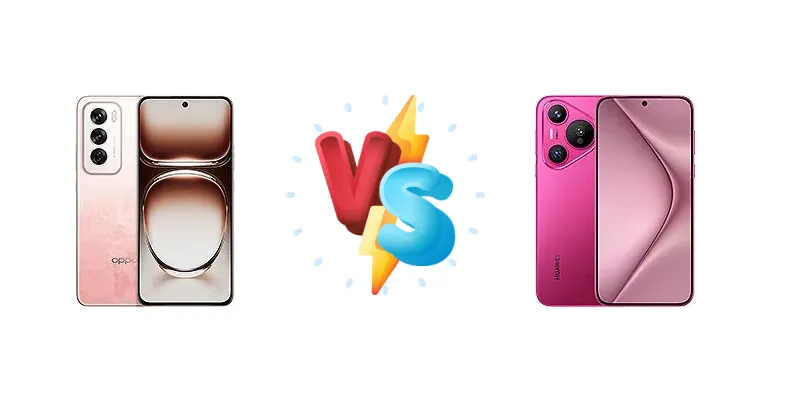
|
🏆 Quick Verdict
For the average user prioritizing fast charging and a potentially more refined software experience (despite geopolitical considerations), the Huawei Pura 70 is the stronger choice. Its 66W wired and 50W wireless charging significantly outperform the Reno12’s 80W wired-only setup. However, the Reno12 offers a compelling value proposition if software access isn't a concern.
| PHONES | ||
|---|---|---|
| Phone Names | Oppo Reno12 (China) | Huawei Pura 70 |
| Network | ||
|---|---|---|
| 2G bands | GSM 850 / 900 / 1800 / 1900 | GSM 850 / 900 / 1800 / 1900 |
| 3G bands | HSDPA 850 / 1700(AWS) / 2100 | HSDPA 800 / 850 / 900 / 1700(AWS) / 1900 / 2100 |
| 4G bands | 1, 3, 4, 5, 8, 28, 34, 38, 39, 40, 41 | 1, 2, 3, 4, 5, 6, 7, 8, 9, 12, 17, 18, 19, 20, 26, 28, 34, 38, 39, 40, 41, 42 |
| 5G bands | 1, 5, 8, 28, 41, 77, 78 SA/NSA | SA/NSA - China only |
| Speed | HSPA, LTE, 5G | HSPA, LTE, 5G |
| Technology | GSM / CDMA / HSPA / LTE / 5G | GSM / CDMA / HSPA / CDMA2000 / LTE / 5G |
| Launch | ||
|---|---|---|
| Announced | 2024, May 23 | 2024, April 18 |
| Status | Available. Released 2024, May 31 | Available. Released 2024, May 06 |
| Body | ||
|---|---|---|
| Build | - | Glass front, aluminum frame |
| Dimensions | 161.4 x 74.8 x 7.3 mm (6.35 x 2.94 x 0.29 in) | 157.6 x 74.3 x 8 mm (6.20 x 2.93 x 0.31 in) |
| SIM | Nano-SIM + Nano-SIM | Nano-SIM + Nano-SIM |
| Weight | 179 g (6.31 oz) | 207 g (7.30 oz) |
| Display | ||
|---|---|---|
| Protection | Corning Gorilla Glass (unspecified version) | Kunlun Glass 2 |
| Resolution | 1080 x 2412 pixels, 20:9 ratio (~394 ppi density) | 1256 x 2760 pixels (~460 ppi density) |
| Size | 6.7 inches, 108.0 cm2 (~89.5% screen-to-body ratio) | 6.6 inches, 105.5 cm2 (~90.1% screen-to-body ratio) |
| Type | AMOLED, 1B colors, 120Hz, HDR10+, 1200 nits (peak) | LTPO OLED, 1B colors, HDR, 120Hz, 1440Hz PWM, 2500 nits (peak) |
| Platform | ||
|---|---|---|
| CPU | Octa-core (1x3.1 GHz Cortex-A78 & 3x3.0 GHz Cortex-A78 & 4x2.0 GHz Cortex-A55) | Octa-core |
| Chipset | Mediatek Dimensity 8250 (4 nm) | Kirin 9000S1 |
| GPU | Mali-G610 MC6 | - |
| OS | Android 14, ColorOS 14.1 | EMUI 14.2 (International), HarmonyOS 4.2 (China) |
| Memory | ||
|---|---|---|
| Card slot | No | No |
| Internal | 256GB 12GB RAM, 256GB 16GB RAM, 512GB 12GB RAM, 512GB 16GB RAM | 256GB 12GB RAM, 512GB 12GB RAM, 1TB 12GB RAM |
| Main Camera | ||
|---|---|---|
| Features | LED flash, HDR, panorama | Laser AF, color spectrum sensor, LED flash, panorama, HDR |
| Triple | 50 MP, f/1.8, 26mm (wide), 1/1.95", PDAF, OIS 50 MP, f/2.0, 47mm (telephoto), PDAF, 2x optical zoom 8 MP, f/2.2, 16mm, 112˚ (ultrawide), 1/4.0", 1.12µm | 50 MP, f/1.4-4.0, 25mm (wide), 1/1.3", PDAF, OIS 12 MP, f/3.4, 125mm (periscope telephoto), PDAF, OIS, 5x optical zoom 13 MP, f/2.2, 13mm (ultrawide) |
| Video | 4K@30/60fps, 1080p@30/60/120fps, gyro-EIS, HDR | 4K, 1080p, HDR, gyro-EIS, OIS |
| Selfie camera | ||
|---|---|---|
| Features | Panorama, HDR | HDR, panorama |
| Single | 50 MP, f/2.0, (wide), AF | 13 MP, f/2.4, (ultrawide) |
| Video | 4K@30/60fps, 1080p@30/60fps, gyro-EIS | Yes, HDR |
| Sound | ||
|---|---|---|
| 35mm jack | No | No |
| Loudspeaker | Yes | Yes, with stereo speakers |
| Comms | ||
|---|---|---|
| Bluetooth | 5.4, A2DP, LE, aptX HD, LHDC | 5.2, A2DP, LE, L2HC |
| Infrared port | Yes | - |
| NFC | Yes | Yes |
| Positioning | GPS, GLONASS, GALILEO, BDS, QZSS | GPS (L1+L5), GLONASS (L1), BDS (B1I+B1c+B2a+B2b), GALILEO (E1+E5a+E5b), QZSS (L1+L5), NavIC |
| Radio | No | No |
| USB | USB Type-C 2.0, OTG | USB Type-C 3.1, OTG, DisplayPort 1.2 |
| WLAN | Wi-Fi 802.11 a/b/g/n/ac/6, dual-band | Wi-Fi 802.11 a/b/g/n/ac/6, dual-band, Wi-Fi Direct |
| Features | ||
|---|---|---|
| Sensors | Fingerprint (under display, optical), accelerometer, gyro, proximity, compass | Fingerprint (under display, optical), accelerometer, proximity, gyro, compass |
| Battery | ||
|---|---|---|
| Charging | 80W wired, PD Reverse wired | 66W wired 50W wireless 7.5W reverse wireless 5W reverse wired |
| Type | 5000 mAh | Li-Po 4900 mAh |
| Misc | ||
|---|---|---|
| Colors | Black, Silver, peach | Black, White, Blue, Pink |
| Models | PJV110 | ADY-LX9, ADY-AL00, ADY-AL10 |
| Price | About 350 EUR | € 699.95 |
Oppo Reno12 (China)
- Potentially better CPU multi-core performance due to Dimensity 8250's core configuration.
- Faster wired charging speed (80W vs 66W).
- Likely more affordable price point.
- Lacks wireless charging capabilities.
- Software ecosystem may be limited to China-specific apps and services.
- Less brand recognition outside of China.
Huawei Pura 70
- Versatile charging options: 66W wired, 50W wireless, and reverse wireless charging.
- Potentially superior camera performance due to Huawei’s image processing expertise.
- More established global brand and software support.
- Slower wired charging compared to the Reno12.
- Kirin 9000S1 chipset details are less transparent.
- Potentially higher price point.
Display Comparison
Display specifications are currently unavailable for both devices. However, given the Reno series’ history, we anticipate the Reno12 will feature a high refresh rate AMOLED panel. The Pura 70, positioned as a flagship, likely boasts a similar AMOLED display with potentially higher peak brightness and color accuracy. The absence of LTPO information suggests neither phone may offer adaptive refresh rates for maximum power efficiency, though this remains speculative.
Camera Comparison
Camera details are limited. Both phones are expected to feature multi-camera systems, but specific sensor sizes and lens apertures are unknown. Huawei historically prioritizes camera performance, and the Pura 70 likely benefits from advanced image processing algorithms. The Reno12, while capable, may lean towards a more balanced approach. Without concrete sensor information, it’s difficult to assess low-light performance or dynamic range capabilities. The inclusion of OIS (Optical Image Stabilization) on the main sensor of both devices is highly probable, crucial for stable video recording and sharper images in challenging conditions.
Performance
The core difference lies in the chipsets. The Oppo Reno12 utilizes the Mediatek Dimensity 8250, a 4nm chip with an octa-core configuration featuring a 3.1 GHz Cortex-A78 prime core. This translates to strong CPU performance, particularly in multi-threaded tasks. The Huawei Pura 70 is powered by the Kirin 9000S1, an octa-core chip with undisclosed core configurations. While the Kirin 9000S1’s architecture is less transparent, Huawei’s history suggests a focus on AI-enhanced performance and optimized power efficiency. The 4nm process node of the Dimensity 8250 should provide good thermal efficiency, but the Kirin 9000S1’s architecture could potentially offer comparable or even superior performance per watt. Gaming performance will depend heavily on GPU optimizations within each chipset.
Battery Life
The Huawei Pura 70 offers a more versatile charging solution with 66W wired charging, 50W wireless charging, and even 7.5W/5W reverse wireless charging. This provides flexibility for users who prefer wireless convenience or need to top up accessories. The Oppo Reno12, while boasting 80W wired charging, lacks wireless charging entirely. While 80W is faster than 66W, the absence of wireless charging is a significant drawback for some users. The actual 0-100% charging times will depend on battery capacity, which is currently unknown for both devices.
Buying Guide
Buy the Oppo Reno12 (China) if you need a powerful processor for demanding tasks and prioritize value for money, and are comfortable navigating the China-specific software ecosystem. Buy the Huawei Pura 70 if you prefer a more polished user experience, value fast wireless charging, and are willing to pay a premium for Huawei’s ecosystem and camera optimizations.