
Oppo Reno11 vs. Sony Xperia 5 V: A Detailed Comparison of Mid-Range and Flagship Androids
| Phones Images | |||||
|---|---|---|---|---|---|
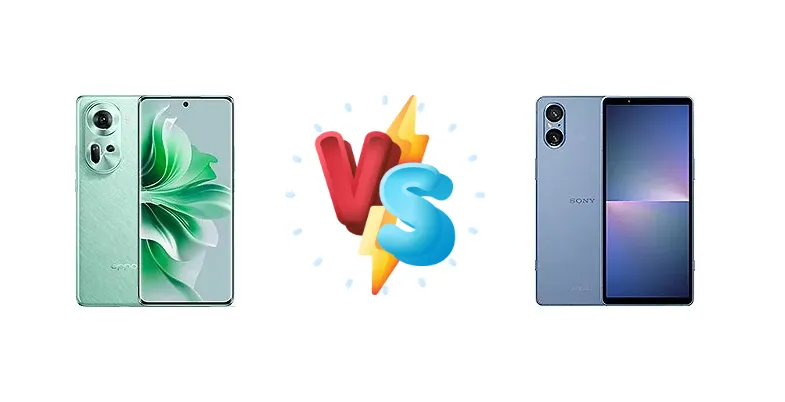
|
🏆 Quick Verdict
For the average user prioritizing value and fast charging, the Oppo Reno11 is the stronger choice. However, the Sony Xperia 5 V’s Snapdragon 8 Gen 2 chipset and superior battery endurance make it the clear winner for power users and those demanding top-tier performance.
| PHONES | ||
|---|---|---|
| Phone Names | Oppo Reno11 | Sony Xperia 5 V |
| Network | ||
|---|---|---|
| 2G bands | GSM 850 / 900 / 1800 / 1900 | GSM 850 / 900 / 1800 / 1900 |
| 3G bands | HSDPA 800 / 850 / 900 / 1700(AWS) / 1900 / 2100 | HSDPA 800 / 850 / 900 / 1700(AWS) / 1900 / 2100 |
| 4G bands | 1, 2, 3, 4, 5, 7, 8, 12, 13, 17, 18, 19, 20, 26, 28, 38, 39, 40, 41, 66 | 1, 2, 3, 4, 5, 7, 8, 12, 13, 17, 19, 20, 25, 26, 28, 29, 32, 34, 38, 39, 40, 41, 46, 66 - Europe |
| 5G bands | 1, 3, 5, 7, 8, 20, 28, 38, 40, 41, 66, 77, 78 SA/NSA | 1, 3, 5, 7, 8, 20, 28, 38, 40, 41, 77, 78 SA/NSA - Europe |
| Speed | HSPA, LTE, 5G | HSPA, LTE, 5G |
| Technology | GSM / HSPA / LTE / 5G | GSM / HSPA / LTE / 5G |
| Launch | ||
|---|---|---|
| Announced | 2024, January 12 | 2023, September 01 |
| Status | Available. Released 2024, January 25 | Available. Released 2023, September 25 |
| Body | ||
|---|---|---|
| Build | - | Glass front (Gorilla Glass Victus 2), glass back, aluminum frame |
| Dimensions | 162.4 x 74.3 x 7.9 mm or 8.0 mm | 154 x 68 x 8.6 mm (6.06 x 2.68 x 0.34 in) |
| SIM | Nano-SIM + Nano-SIM | · Nano-SIM + eSIM· Nano-SIM + Nano-SIM |
| Weight | 182 g (6.42 oz) | 182 g (6.42 oz) |
| Display | ||
|---|---|---|
| Protection | Asahi Glass AGC DT-Star2 | Corning Gorilla Glass Victus 2 |
| Resolution | 1080 x 2412 pixels, 20:9 ratio (~394 ppi density) | 1080 x 2520 pixels, 21:9 ratio (~449 ppi density) |
| Size | 6.7 inches, 108.0 cm2 (~89.5% screen-to-body ratio) | 6.1 inches, 86.9 cm2 (~83.0% screen-to-body ratio) |
| Type | AMOLED, 1B colors, 120Hz, HDR10+, 800 nits (HBM), 950 nits (peak) | OLED, 1B colors, 120Hz, HDR10, BT.2020 |
| Platform | ||
|---|---|---|
| CPU | Octa-core (2x2.6 GHz Cortex-A78 & 6x2.0 GHz Cortex-A55) | Octa-core (1x3.2 GHz Cortex-X3 & 2x2.8 GHz Cortex-A715 & 2x2.8 GHz Cortex-A710 & 3x2.0 GHz Cortex-A510) |
| Chipset | Mediatek Dimensity 7050 (6 nm) | Qualcomm SM8550-AB Snapdragon 8 Gen 2 (4 nm) |
| GPU | Mali-G68 MC4 | Adreno 740 |
| OS | Android 14, upgradable to Android 15, ColorOS 15 | Android 13, upgradable to Android 15 |
| Memory | ||
|---|---|---|
| Card slot | microSDXC | microSDXC (uses shared SIM slot) |
| Internal | 128GB 8GB RAM, 256GB 8GB RAM, 256GB 12GB RAM | 128GB 8GB RAM, 256GB 8GB RAM |
| Main Camera | ||
|---|---|---|
| Dual | - | 48 MP, f/1.9, 24mm (wide), 1/1.35", 1.12µm, dual pixel PDAF, OIS 12 MP, f/2.2, 16mm (ultrawide), 1/2.5", dual pixel PDAF |
| Features | LED flash, HDR, panorama | Zeiss optics, Zeiss T* lens coating, color spectrum sensor, LED flash, panorama, HDR, eye tracking |
| Triple | 50 MP, f/1.8, 26mm (wide), 1/1.95", PDAF, OIS 32 MP, f/2.0, 47mm (telephoto), 1/2.74", 0.8µm, PDAF, 2x optical zoom 8 MP, f/2.2, 16mm, 112˚ (ultrawide), 1/4.0", 1.12µm | - |
| Video | 4K@30fps, 1080p@30/60/120/480fps, 720p@960fps, gyro-EIS | 4K@24/25/30/60/120fps HDR, 1080p@30/60/120fps; 5-axis gyro-EIS, OIS |
| Selfie camera | ||
|---|---|---|
| Features | Panorama, HDR | HDR |
| Single | 32 MP, f/2.4, 22mm (wide), 1/2.74", 0.8µm | 12 MP, f/2.0, 24mm (wide), 1/2.9", 1.25µm |
| Video | 4K@30fps, 1080p@30fps, gyro-EIS | 4K@30fps, 1080p@30/60fps, 5-axis gyro-EIS |
| Sound | ||
|---|---|---|
| 35mm jack | No | Yes |
| Loudspeaker | Yes, with stereo speakers | Yes, with stereo speakers |
| Comms | ||
|---|---|---|
| Bluetooth | 5.3, A2DP, LE, aptX HD, LHDC | 5.3, A2DP, LE Audio, aptX HD, aptX Adaptive |
| Infrared port | Yes | - |
| NFC | Yes | Yes |
| Positioning | GPS, GLONASS, GALILEO, BDS, QZSS | GPS, GLONASS, BDS, GALILEO, QZSS |
| Radio | No | No |
| USB | USB Type-C 2.0, OTG | USB Type-C 3.2, OTG, DisplayPort |
| WLAN | Wi-Fi 802.11 a/b/g/n/ac/6, dual-band, Wi-Fi Direct | Wi-Fi 802.11 a/b/g/n/ac/6e, tri-band, Wi-Fi Direct, DLNA |
| Features | ||
|---|---|---|
| Sensors | Fingerprint (under display, optical), accelerometer, gyro, proximity, compass | Fingerprint (side-mounted), accelerometer, gyro, proximity, barometer, compass |
| Battery | ||
|---|---|---|
| Charging | 67W wired, PD, QC3, 100% in 45 min Reverse wired | 30W wired, PD3.0, PPS, 50% in 30 min Wireless Reverse wireless |
| Type | Li-Po 5000 mAh | Li-Po 5000 mAh |
| Misc | ||
|---|---|---|
| Colors | Wave Green, Rock Grey | Black, Blue, Platinum Silver |
| Models | CPH2599 | XQ-DE54 |
| Price | About 620 EUR | € 999.99 / $ 1,444.00 |
| SAR | 0.97 W/kg (head) 0.61 W/kg (body) | - |
Oppo Reno11
- Incredibly fast 67W wired charging
- Potentially more affordable price point
- Stylish design and build quality
- Less powerful chipset compared to the Snapdragon 8 Gen 2
- Likely lower battery endurance
- Missing wireless charging
Sony Xperia 5 V
- Flagship-level performance with Snapdragon 8 Gen 2
- Exceptional battery life (16:19h active use)
- Compact and pocketable form factor
- Slower 30W wired charging
- Higher price tag
- May require more frequent software updates for optimal performance
Display Comparison
The Sony Xperia 5 V boasts a measured peak brightness of 746 nits, offering excellent visibility outdoors. While the Reno11’s display specs aren’t provided, Oppo typically utilizes AMOLED panels known for vibrant colors. The Xperia 5 V’s compact 6.1-inch form factor is a key differentiator, appealing to users who prefer a more pocketable device. The lack of LTPO technology in either phone suggests both will rely on adaptive refresh rates to balance smoothness and power consumption, but the Xperia 5 V’s higher peak brightness provides a tangible advantage in direct sunlight.
Camera Comparison
The context data lacks detailed camera specifications for both devices. However, Sony’s Xperia line is renowned for its image processing and focus on photographic fidelity. The Xperia 5 V likely features a sophisticated camera system optimized for both photo and video capture. The Reno11, while capable, will likely prioritize a more consumer-friendly, vibrant image profile. Without sensor size or aperture information, it’s difficult to make a definitive judgment, but Sony’s brand reputation suggests a more advanced camera experience.
Performance
The core difference lies in the chipsets. The Sony Xperia 5 V’s Snapdragon 8 Gen 2 (4nm) is a significant leap ahead of the Oppo Reno11’s Mediatek Dimensity 7050 (6nm). The Snapdragon 8 Gen 2’s Cortex-X3 prime core, clocked at 3.2 GHz, delivers substantially higher peak performance. The 4nm process node also translates to improved thermal efficiency, minimizing throttling during sustained workloads. While the Reno11’s octa-core CPU is capable, it won’t match the Xperia 5 V in demanding tasks like gaming or video editing. The Xperia 5 V’s superior GPU will also provide a smoother gaming experience.
Battery Life
The Sony Xperia 5 V excels in battery endurance, achieving an active use score of 16:19h and an endurance rating of 130h. This suggests a highly optimized power management system. The Oppo Reno11 offers 67W wired charging, capable of reaching 100% in 45 minutes, a significant advantage over the Xperia 5 V’s 30W charging (50% in 30 minutes). The Xperia 5 V also supports wireless and reverse wireless charging, features absent in the Reno11. The trade-off is clear: the Reno11 prioritizes charging speed, while the Xperia 5 V focuses on overall battery longevity.
Buying Guide
Buy the Oppo Reno11 if you need a stylish phone with a vibrant display and incredibly fast 67W charging, and are willing to trade some raw processing power for a lower price. Buy the Sony Xperia 5 V if you prioritize a compact form factor, uncompromising performance from the Snapdragon 8 Gen 2, and exceptional battery life for demanding tasks like gaming or content creation.