
Oppo Reno11 vs. Nothing Phone (2a) Plus: A Detailed Mid-Range Showdown
| Phones Images | |||||
|---|---|---|---|---|---|
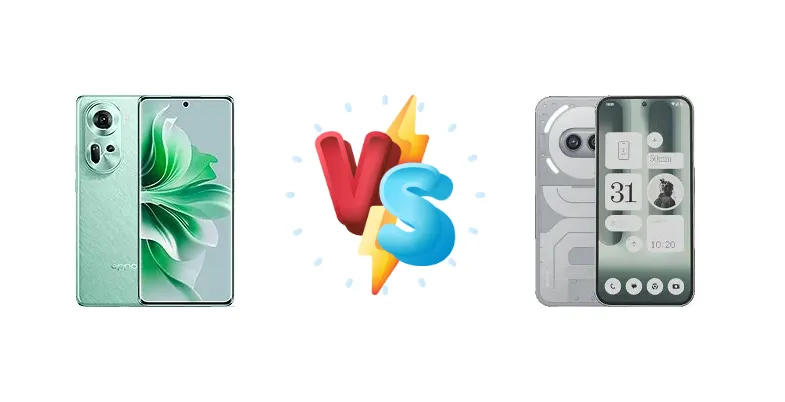
|
🏆 Quick Verdict
For the average user prioritizing sustained performance and rapid charging, the Oppo Reno11 emerges as the winner. Its Dimensity 7050, coupled with 67W charging, offers a smoother experience for demanding tasks and quicker top-ups. However, the Nothing Phone (2a) Plus excels in battery endurance.
| PHONES | ||
|---|---|---|
| Phone Names | Oppo Reno11 | Nothing Phone (2a) Plus |
| Network | ||
|---|---|---|
| 2G bands | GSM 850 / 900 / 1800 / 1900 | GSM 850 / 900 / 1800 / 1900 |
| 3G bands | HSDPA 800 / 850 / 900 / 1700(AWS) / 1900 / 2100 | HSDPA 800 / 850 / 900 / 1700(AWS) / 1900 / 2100 |
| 4G bands | 1, 2, 3, 4, 5, 7, 8, 12, 13, 17, 18, 19, 20, 26, 28, 38, 39, 40, 41, 66 | 1, 3, 4, 5, 7, 8, 18, 19, 20, 26, 28, 38, 39, 40, 41, 42, 66 |
| 5G bands | 1, 3, 5, 7, 8, 20, 28, 38, 40, 41, 66, 77, 78 SA/NSA | 1, 3, 5, 7, 8, 20, 28, 38, 40, 41, 66, 77, 78 SA/NSA |
| Speed | HSPA, LTE, 5G | HSPA, LTE, 5G |
| Technology | GSM / HSPA / LTE / 5G | GSM / HSPA / LTE / 5G |
| Launch | ||
|---|---|---|
| Announced | 2024, January 12 | 2024, July 31 |
| Status | Available. Released 2024, January 25 | Available. Released 2024, August 03 |
| Body | ||
|---|---|---|
| Build | - | Glass front (Gorilla Glass 5), plastic frame, plastic back |
| Dimensions | 162.4 x 74.3 x 7.9 mm or 8.0 mm | 161.7 x 76.3 x 8.5 mm (6.37 x 3.00 x 0.33 in) |
| SIM | Nano-SIM + Nano-SIM | Nano-SIM + Nano-SIM |
| Weight | 182 g (6.42 oz) | 190 g (6.70 oz) |
| Display | ||
|---|---|---|
| Protection | Asahi Glass AGC DT-Star2 | Corning Gorilla Glass 5 |
| Resolution | 1080 x 2412 pixels, 20:9 ratio (~394 ppi density) | 1080 x 2412 pixels, 20:9 ratio (~395 ppi density) |
| Size | 6.7 inches, 108.0 cm2 (~89.5% screen-to-body ratio) | 6.7 inches, 107.5 cm2 (~87.1% screen-to-body ratio) |
| Type | AMOLED, 1B colors, 120Hz, HDR10+, 800 nits (HBM), 950 nits (peak) | AMOLED, 1B colors, 120Hz, 2160Hz PWM, HDR10+, 700 nits (typ), 1100 nits (HBM), 1300 nits (peak) |
| Platform | ||
|---|---|---|
| CPU | Octa-core (2x2.6 GHz Cortex-A78 & 6x2.0 GHz Cortex-A55) | Octa-core (2x3.0 GHz Cortex-A715 & 6x 2.0 GHz Cortex-A510) |
| Chipset | Mediatek Dimensity 7050 (6 nm) | Mediatek Dimensity 7350 Pro (4 nm) |
| GPU | Mali-G68 MC4 | Mali-G610 MC4 |
| OS | Android 14, upgradable to Android 15, ColorOS 15 | Android 14, up to 3 major Android upgrades, Nothing OS 3.0 |
| Memory | ||
|---|---|---|
| Card slot | microSDXC | No |
| Internal | 128GB 8GB RAM, 256GB 8GB RAM, 256GB 12GB RAM | 256GB 8GB RAM, 256GB 12GB RAM |
| Main Camera | ||
|---|---|---|
| Dual | - | 50 MP, f/1.9, 24mm (wide), 1/1.57", 1.0µm, PDAF, OIS 50 MP, f/2.2, 114˚ (ultrawide), 1/2.76", 0.64µm |
| Features | LED flash, HDR, panorama | LED flash, panorama, HDR |
| Triple | 50 MP, f/1.8, 26mm (wide), 1/1.95", PDAF, OIS 32 MP, f/2.0, 47mm (telephoto), 1/2.74", 0.8µm, PDAF, 2x optical zoom 8 MP, f/2.2, 16mm, 112˚ (ultrawide), 1/4.0", 1.12µm | - |
| Video | 4K@30fps, 1080p@30/60/120/480fps, 720p@960fps, gyro-EIS | 4K@30fps, 1080p@60/120fps, gyro-EIS |
| Selfie camera | ||
|---|---|---|
| Features | Panorama, HDR | HDR |
| Single | 32 MP, f/2.4, 22mm (wide), 1/2.74", 0.8µm | 50 MP, f/2.2, (wide), 1/2.76" |
| Video | 4K@30fps, 1080p@30fps, gyro-EIS | 4K@30fps |
| Sound | ||
|---|---|---|
| 35mm jack | No | No |
| Loudspeaker | Yes, with stereo speakers | Yes, with stereo speakers |
| Comms | ||
|---|---|---|
| Bluetooth | 5.3, A2DP, LE, aptX HD, LHDC | 5.3, A2DP, LE |
| Infrared port | Yes | - |
| NFC | Yes | Yes, 360˚ |
| Positioning | GPS, GLONASS, GALILEO, BDS, QZSS | GPS, GALILEO, GLONASS, BDS, QZSS |
| Radio | No | No |
| USB | USB Type-C 2.0, OTG | USB Type-C 2.0, OTG |
| WLAN | Wi-Fi 802.11 a/b/g/n/ac/6, dual-band, Wi-Fi Direct | Wi-Fi 802.11 a/b/g/n/ac/6, dual-band, Wi-Fi Direct |
| Features | ||
|---|---|---|
| Sensors | Fingerprint (under display, optical), accelerometer, gyro, proximity, compass | Fingerprint (under display, optical), accelerometer, gyro, proximity, compass |
| Battery | ||
|---|---|---|
| Charging | 67W wired, PD, QC3, 100% in 45 min Reverse wired | 50W wired, 50% in 21 min, 100% in 56 min |
| Type | Li-Po 5000 mAh | 5000 mAh |
| Misc | ||
|---|---|---|
| Colors | Wave Green, Rock Grey | Black, Grey |
| Models | CPH2599 | A142P |
| Price | About 620 EUR | € 269.90 / ₹ 22,599 |
| SAR | 0.97 W/kg (head) 0.61 W/kg (body) | - |
Oppo Reno11
- Faster 67W charging for quick top-ups
- Potentially better image processing from Oppo's software
- Dimensity 7050 offers solid performance for everyday tasks
- Likely lower battery life compared to the Nothing Phone (2a) Plus
- Less efficient 6nm chipset compared to the 4nm Dimensity 7350 Pro
Nothing Phone (2a) Plus
- Excellent battery life (16:34h active use)
- Brighter display for better outdoor visibility
- More efficient 4nm Dimensity 7350 Pro chipset
- Slower 50W charging compared to the Oppo Reno11
- Minimalist design may not appeal to all users
Display Comparison
The Nothing Phone (2a) Plus boasts a significantly brighter display, reaching a measured peak of 1097 nits, compared to an unspecified peak brightness for the Reno11. This higher brightness translates to better visibility outdoors under direct sunlight. While panel technology isn't specified for either, the Reno11's display quality will likely be very good given Oppo's history, but the Nothing Phone (2a) Plus has a clear advantage in raw luminance. Bezels are expected to be similar, with both aiming for a modern, immersive experience. Color accuracy is unknown for both, requiring further testing.
Camera Comparison
Camera details beyond the main sensors are limited. However, the focus should be on the primary sensors and image processing. Oppo is known for its strong camera software and image processing algorithms, potentially giving the Reno11 an edge in image quality despite lacking specific sensor size information. The Nothing Phone (2a) Plus will likely prioritize a more natural, less processed look, aligning with the brand's minimalist aesthetic. The absence of details regarding OIS (Optical Image Stabilization) on either device makes it difficult to assess low-light performance definitively. Ignoring the likely low-resolution macro lenses on both, the primary sensor capabilities will be the deciding factor.
Performance
The Nothing Phone (2a) Plus leverages the Mediatek Dimensity 7350 Pro, fabricated on a more efficient 4nm process, compared to the Reno11’s Dimensity 7050 (6nm). This process node difference suggests the 7350 Pro will exhibit better thermal efficiency, potentially leading to less throttling during prolonged gaming or intensive workloads. The CPU architecture also differs; the Nothing Phone (2a) Plus uses Cortex-A715 cores clocked at 3.0 GHz, while the Reno11 employs Cortex-A78 cores at 2.6 GHz. While clock speed isn't everything, the newer A715 architecture generally offers improved IPC (Instructions Per Clock). Both phones feature 6x Cortex-A510/A55 efficiency cores, handling background tasks. The Nothing Phone (2a) Plus is expected to deliver a noticeable performance edge, particularly in sustained workloads.
Battery Life
The Nothing Phone (2a) Plus demonstrates a clear advantage in battery life, achieving an active use score of 16 hours and 34 minutes. While the Reno11’s battery capacity is unspecified, the Nothing Phone (2a) Plus’s endurance is significant. Charging speeds differ considerably: the Reno11 supports 67W wired charging, promising a full charge in 45 minutes, while the Nothing Phone (2a) Plus is limited to 50W, taking 56 minutes for a complete charge. The Reno11’s faster charging is a key benefit for users who frequently need to top up their battery quickly, but the Nothing Phone (2a) Plus offers longer runtimes between charges.
Buying Guide
Buy the Oppo Reno11 if you need consistently snappy performance for multitasking and gaming, and value the convenience of extremely fast 67W charging. You'll appreciate its responsiveness in everyday tasks. Buy the Nothing Phone (2a) Plus if you prioritize all-day battery life and a distinctive, minimalist design. This phone is ideal for users who don't push their devices to the limit and prefer a less intrusive user experience.