
Honor Magic6 Pro vs Oppo Reno11 Pro: A Deep Dive into Flagship Performance and Features
| Phones Images | |||||
|---|---|---|---|---|---|
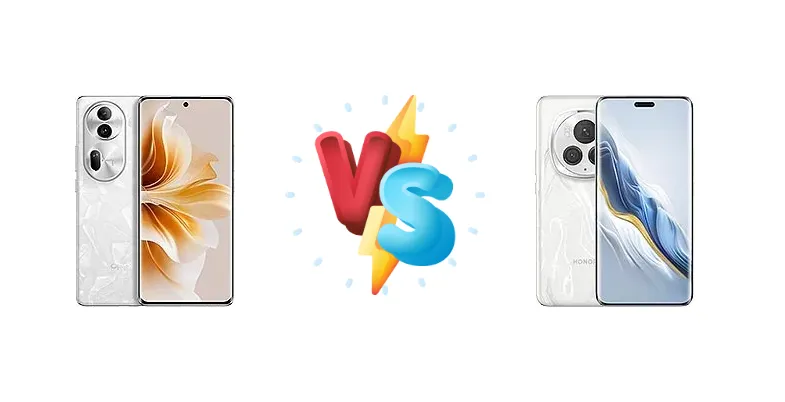
|
🏆 Quick Verdict
For users demanding the absolute best performance and a brighter display, the Honor Magic6 Pro is the clear winner. Its Snapdragon 8 Gen 3 chipset and 1578 nit peak brightness provide a noticeable advantage. However, the Oppo Reno11 Pro offers a compelling alternative for those prioritizing a more streamlined experience and potentially better thermal management.
| PHONES | ||
|---|---|---|
| Phone Names | Oppo Reno11 Pro | Honor Magic6 Pro |
| Network | ||
|---|---|---|
| 2G bands | GSM 850 / 900 / 1800 / 1900 | GSM 850 / 900 / 1800 / 1900 |
| 3G bands | HSDPA 800 / 850 / 900 / 1700(AWS) / 1900 / 2100 | HSDPA 800 / 850 / 900 / 1700(AWS) / 1900 / 2100 |
| 4G bands | 1, 2, 3, 4, 5, 7, 8, 12, 17, 18, 19, 20, 26, 28, 38, 39, 40, 41, 66 | LTE |
| 5G bands | 1, 3, 5, 7, 8, 20, 28, 38, 40, 41, 66, 77, 78 SA/NSA | SA/NSA |
| Speed | HSPA, LTE, 5G | HSPA, LTE, 5G |
| Technology | GSM / HSPA / LTE / 5G | GSM / CDMA / HSPA / CDMA2000 / LTE / 5G |
| Launch | ||
|---|---|---|
| Announced | 2024, January 12 | 2024, January 11 |
| Status | Available. Released 2024, January 18 | Available. Released 2024, January 18 |
| Body | ||
|---|---|---|
| Build | - | Glass front (NanoCrystal Shield), glass back or silicone polymer back (eco leather) |
| Dimensions | 162.4 x 74.1 x 7.6 mm or 7.7 mm | 162.5 x 75.8 x 8.9 mm (6.40 x 2.98 x 0.35 in) |
| SIM | Nano-SIM + Nano-SIM | · Nano-SIM + eSIM· Nano-SIM + Nano-SIM |
| Weight | 181 g (6.38 oz) | 225 g or 229 g (7.94 oz) |
| Display | ||
|---|---|---|
| Protection | Asahi Glass AGC | NanoCrystal Shield |
| Resolution | 1080 x 2412 pixels, 20:9 ratio (~394 ppi density) | 1280 x 2800 pixels, 19.5:9 ratio (~453 ppi density) |
| Size | 6.7 inches, 108.0 cm2 (~89.8% screen-to-body ratio) | 6.8 inches, 112.8 cm2 (~91.6% screen-to-body ratio) |
| Type | AMOLED, 1B colors, 120Hz, HDR10+, 800 nits (HBM), 950 nits (peak) | LTPO OLED, 1B colors, 120Hz, Dolby Vision, HDR, 1600 nits (HBM), 5000 nits (peak) |
| Platform | ||
|---|---|---|
| CPU | Octa-core (1x3.1 GHz Cortex-A78 & 3x3.0 GHz Cortex-A78 & 4x2.0 GHz Cortex-A55) | Octa-core (1x3.3 GHz Cortex-X4 & 3x3.2 GHz Cortex-A720 & 2x3.0 GHz Cortex-A720 & 2x2.3 GHz Cortex-A520) |
| Chipset | Mediatek Dimensity 8200 (4 nm) | Qualcomm SM8650-AB Snapdragon 8 Gen 3 (4 nm) |
| GPU | Mali-G610 MC6 | Adreno 750 |
| OS | Android 14, upgradable to Android 15, ColorOS 15 | Android 14, up to 4 major Android upgrades, MagicOS 8 |
| Memory | ||
|---|---|---|
| Card slot | No | No |
| Internal | 256GB 12GB RAM, 512GB 12GB RAM | 256GB 12GB RAM, 256GB 16GB RAM, 512GB 12GB RAM, 512GB 16GB RAM, 1TB 16GB RAM |
| Main Camera | ||
|---|---|---|
| Features | LED flash, HDR, panorama | Laser AF, color spectrum sensor, LED flash, HDR, panorama |
| Triple | 50 MP, f/1.8, 24mm (wide), 1/1.56", 1.0µm, multi-directional PDAF, OIS 32 MP, f/2.0, 47mm (telephoto), 1/2.74", 0.8µm, PDAF, 2x optical zoom 8 MP, f/2.2, 16mm, 112˚ (ultrawide), 1/4.0", 1.12µm | 50 MP, f/1.4-2.0, 23mm (wide), 1/1.3", 1.2µm, PDAF, OIS 180 MP, f/2.6, (periscope telephoto), 1/1.49", 0.56µm, PDAF, OIS, 2.5x optical zoom 50 MP, f/2.0, 13mm, 122˚ (ultrawide), 1/2.88", 0.61µm, AF |
| Video | 4K@30fps, 1080p@30/60/120/480fps, gyro-EIS, 720p@960fps, HDR | 4K@24/30/60fps, 1080p@30/60/120/240fps, gyro-EIS, OIS, HDR, 10-bit video |
| Selfie camera | ||
|---|---|---|
| Features | Panorama, HDR | - |
| Single | 32 MP, f/2.4, 22mm (wide), 1/2.74", 0.8µm, AF | 50 MP, f/2.0, 22mm (wide), 1/2.93", 0.6µm, AF TOF 3D, (depth/biometrics sensor) |
| Video | 4K@30fps, 1080p@30fps, gyro-EIS | 4K@30fps, 1080p@30/60fps, gyro-EIS |
| Sound | ||
|---|---|---|
| 35mm jack | No | No |
| Loudspeaker | Yes | Yes, with stereo speakers |
| Comms | ||
|---|---|---|
| Bluetooth | 5.3, A2DP, LE, aptX HD, LHDC | 5.3, A2DP, LE, aptX HD |
| Infrared port | Yes | Yes |
| NFC | Yes | Yes |
| Positioning | GPS, GLONASS, GALILEO, BDS, QZSS | GPS (L1+L5), GLONASS, BDS (B1I+B1c+B2a), GALILEO (E1+E5a) |
| Radio | No | No |
| USB | USB Type-C 2.0, OTG | USB Type-C 3.2, DisplayPort 1.2, OTG |
| WLAN | Wi-Fi 802.11 a/b/g/n/ac/6, dual-band, Wi-Fi Direct | Wi-Fi 802.11 a/b/g/n/ac/6/7, dual-band, Wi-Fi Direct |
| Features | ||
|---|---|---|
| Sensors | Fingerprint (under display, optical), accelerometer, gyro, proximity, compass | Fingerprint (under display, optical), Face ID, accelerometer, gyro, proximity, compass |
| Battery | ||
|---|---|---|
| Charging | 80W wired, PD, QC3, 45% in 10 min Reverse wired | 80W wired 66W wireless Reverse wireless 5W reverse wired |
| Type | Li-Po 4600 mAh | Si/C Li-Ion 5600 mAh |
| Misc | ||
|---|---|---|
| Colors | Pearl White, Rock Grey | Black, Green, Blue, Purple, White |
| Models | CPH2607 | BVL-AN16, BVL-N49 |
| Price | ₹ 29,998 | € 455.54 / $ 899.00 / £ 598.99 |
| SAR | 1.18 W/kg (head) 0.87 W/kg (body) | - |
Oppo Reno11 Pro
- Fast 80W wired charging with quick 10-minute boost
- Stylish design and comfortable ergonomics
- Balanced performance for everyday tasks
- Less powerful chipset compared to Snapdragon 8 Gen 3
- Likely lower peak display brightness
Honor Magic6 Pro
- Unmatched performance with Snapdragon 8 Gen 3
- Exceptionally bright 1578 nit display
- 66W wireless charging and reverse wireless charging
- Potentially higher price point
- May run hotter under sustained load
Display Comparison
The Honor Magic6 Pro boasts a significantly brighter display, reaching a measured 1578 nits, making it exceptionally visible in direct sunlight. While the Reno11 Pro’s display specifications aren’t provided, it’s unlikely to match this peak brightness. The Magic6 Pro’s panel likely utilizes LTPO technology for adaptive refresh rates, contributing to power efficiency. The Reno11 Pro’s display quality will be good, but the Magic6 Pro offers a superior viewing experience, particularly outdoors.
Camera Comparison
Without detailed camera specifications for both devices, a direct comparison is limited. However, the flagship positioning of the Magic6 Pro suggests a more advanced camera system. The Snapdragon 8 Gen 3’s ISP (Image Signal Processor) is also more capable than the Dimensity 8200’s, enabling better image processing, noise reduction, and dynamic range. The Reno11 Pro likely focuses on software enhancements and a pleasing aesthetic, but the Magic6 Pro is expected to deliver superior image quality, especially in challenging lighting conditions. We can assume the Magic6 Pro will have a larger main sensor and more advanced OIS.
Performance
The core difference lies in the chipsets. The Honor Magic6 Pro’s Snapdragon 8 Gen 3 (4nm) is a substantial upgrade over the Oppo Reno11 Pro’s Mediatek Dimensity 8200 (4nm). The Snapdragon 8 Gen 3 features a Cortex-X4 prime core clocked at 3.3 GHz, alongside Cortex-A720 performance cores, offering a significant leap in CPU and GPU performance. The Dimensity 8200, while capable, uses older Cortex-A78 cores and a less advanced GPU architecture. This translates to faster app loading, smoother multitasking, and superior gaming performance on the Magic6 Pro. The Magic6 Pro’s LPDDR5x RAM will also contribute to faster data transfer speeds. While both are 4nm chips, the architectural improvements in the Snapdragon 8 Gen 3 provide a clear advantage.
Battery Life
The Honor Magic6 Pro demonstrates impressive battery life with an active use score of 14:06 hours, indicating excellent power efficiency despite its powerful chipset. Both phones support 80W wired charging, offering a quick top-up – the Reno11 Pro claims 45% charge in 10 minutes. However, the Magic6 Pro adds 66W wireless charging and 5W reverse wireless charging, providing greater versatility. While the Reno11 Pro offers reverse *wired* charging, the Magic6 Pro’s wireless options are more convenient. The longer battery life of the Magic6 Pro, combined with its wireless charging capabilities, gives it an edge in this category.
Buying Guide
Buy the Oppo Reno11 Pro if you need a stylish, well-rounded phone with fast 80W charging and a focus on everyday usability. It’s ideal for social media enthusiasts and users who value a smooth, responsive experience without pushing the absolute limits of performance. Buy the Honor Magic6 Pro if you prefer a powerhouse device with cutting-edge processing capabilities, a significantly brighter display for outdoor visibility, and the convenience of 66W wireless charging. This phone is geared towards gamers, power users, and those who demand the best possible performance.