
Oppo Reno10 vs Samsung Galaxy S23 FE: Which Mid-Range Contender Reigns Supreme?
| Phones Images | |||||
|---|---|---|---|---|---|
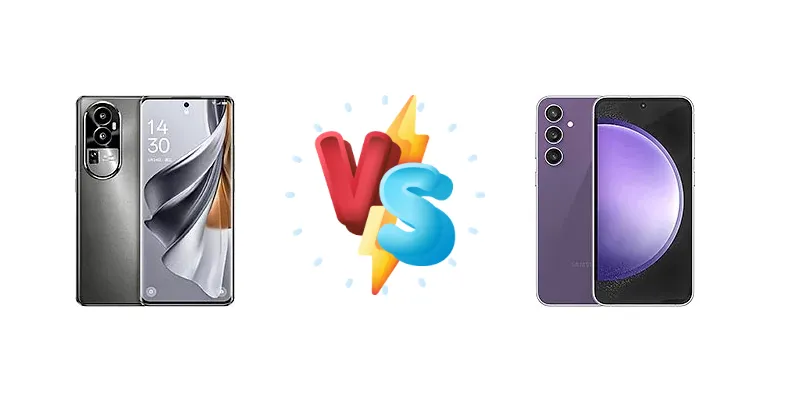
|
🏆 Quick Verdict
For the average user prioritizing consistent performance and a more refined software experience, the Samsung Galaxy S23 FE is the stronger choice. While the Oppo Reno10 boasts incredibly fast 80W charging, the S23 FE’s Exynos 2200 (or Snapdragon 8 Gen 1 in the US) provides a significant performance uplift, justifying the slightly slower charging speeds.
| PHONES | ||
|---|---|---|
| Phone Names | Oppo Reno10 (China) | Samsung Galaxy S23 FE |
| Network | ||
|---|---|---|
| 2G bands | GSM 850 / 900 / 1800 / 1900 | GSM 850 / 900 / 1800 / 1900 |
| 3G bands | HSDPA 850 / 900 / 2100 | HSDPA 850 / 900 / 1700(AWS) / 1900 / 2100 |
| 4G bands | 1, 3, 5, 7, 8, 28, 34, 38, 39, 40, 41 | 1, 2, 3, 4, 5, 7, 8, 12, 13, 17, 20, 26, 28, 38, 40, 41, 66 - International |
| 5G bands | 1, 5, 8, 28, 41, 77, 78 SA/NSA | 1, 2, 3, 5, 7, 8, 20, 28, 38, 40, 41, 66, 77, 78 SA/NSA/Sub6 - International |
| Speed | HSPA, LTE, 5G | HSPA, LTE, 5G |
| Technology | GSM / HSPA / LTE / 5G | GSM / HSPA / LTE / 5G |
| Launch | ||
|---|---|---|
| Announced | 2023, May 24 | 2023, October 04 |
| Status | Available. Released 2023, May 24 | Available. Released 2023, October 05 |
| Body | ||
|---|---|---|
| Build | Glass front, plastic frame, glass back | Glass front (Gorilla Glass 5), glass back (Gorilla Glass 5), aluminum frame |
| Dimensions | 162.4 x 74.2 x 7.6 mm (6.39 x 2.92 x 0.30 in) | 158 x 76.5 x 8.2 mm (6.22 x 3.01 x 0.32 in) |
| SIM | Nano-SIM + Nano-SIM | · Nano-SIM· Nano-SIM + Nano-SIM· Nano-SIM + Nano-SIM + eSIM (max 2 at a time) |
| Weight | 180 g (6.35 oz) | 209 g (7.37 oz) |
| Display | ||
|---|---|---|
| Protection | - | Corning Gorilla Glass 5 |
| Resolution | 1080 x 2412 pixels, 20:9 ratio (~394 ppi density) | 1080 x 2340 pixels, 19.5:9 ratio (~403 ppi density) |
| Size | 6.7 inches, 108.0 cm2 (~89.6% screen-to-body ratio) | 6.4 inches, 100.5 cm2 (~83.2% screen-to-body ratio) |
| Type | AMOLED, 1B colors, 120Hz, HDR10+, 950 nits (peak) | Dynamic AMOLED 2X, 120Hz, HDR10+, 1450 nits (peak) |
| Platform | ||
|---|---|---|
| CPU | Octa-core (1x2.4 GHz Cortex-A78 & 3x2.2 GHz Cortex-A78 & 4x1.9 GHz Cortex-A55) | Octa-core (1x2.8 GHz Cortex-X2 & 3x2.50 GHz Cortex-A710 & 4x1.8 GHz Cortex-A510) - InternationalOcta-core (1x3.00 GHz Cortex-X2 & 3x2.50 GHz Cortex-A710 & 4x1.80 GHz Cortex-A510) - USA |
| Chipset | Qualcomm SM7325 Snapdragon 778G 5G (6 nm) | Exynos 2200 (4 nm) - InternationalQualcomm SM8450 Snapdragon 8 Gen 1 (4 nm) - USA |
| GPU | Adreno 642L | Xclipse 920 - InternationalAdreno 730 - USA |
| OS | Android 13, upgradable to Android 14, ColorOS 14 | Android 13, up to 4 major Android upgrades, One UI 8 |
| Memory | ||
|---|---|---|
| Card slot | No | No |
| Internal | 256GB 8GB RAM, 256GB 12GB RAM, 512GB 12GB RAM | 128GB 8GB RAM, 256GB 8GB RAM |
| Main Camera | ||
|---|---|---|
| Features | Color spectrum sensor, LED flash, HDR, panorama | LED flash, HDR, panorama |
| Triple | 64 MP, f/1.7, (wide), 1/2", 0.7µm, PDAF 32 MP, f/2.0, (telephoto), 1/2.74", 0.8µm, PDAF, 2x optical zoom 8 MP, f/2.2, (ultrawide) | 50 MP, f/1.8, 23mm (wide), 1/1.57", 1.0µm, dual pixel PDAF, OIS 8 MP, f/2.4, 76mm (telephoto), 1/4.5", 1.0µm, PDAF, OIS, 3x optical zoom 12 MP, f/2.2, 13mm, 123˚ (ultrawide), 1/3.0", 1.12µm |
| Video | 4K@30fps, 1080p@30/60fps, gyro-EIS | 8K@24fps, 4K@30/60fps, 1080p@30/60/120/240fps |
| Selfie camera | ||
|---|---|---|
| Features | Panorama, HDR | - |
| Single | 32 MP, f/2.4, 22mm (wide), 1/2.74", 0.8µm, AF | 10 MP, f/2.4, 25mm (wide), 1/3.0", 1.22µm |
| Video | 1080p@30fps, gyro-EIS | 4K@30/60fps, 1080p@30/60fps; gyro-EIS |
| Sound | ||
|---|---|---|
| 35mm jack | No | No |
| Loudspeaker | Yes | Yes, with stereo speakers |
| Comms | ||
|---|---|---|
| Bluetooth | 5.2, A2DP, LE, aptX HD | 5.3, A2DP, LE |
| Infrared port | Yes | - |
| NFC | Yes | Yes |
| Positioning | GPS, GLONASS, GALILEO, BDS, QZSS | GPS, GLONASS, GALILEO, BDS |
| Radio | No | Unspecified |
| USB | USB Type-C 2.0, OTG | USB Type-C, OTG |
| WLAN | Wi-Fi 802.11 a/b/g/n/ac/6, dual-band, Wi-Fi Direct | Wi-Fi 802.11 a/b/g/n/ac/6e, dual-band, Wi-Fi Direct |
| Features | ||
|---|---|---|
| Sensors | Fingerprint (under display, optical), accelerometer, gyro, proximity, compass | Fingerprint (under display, optical), accelerometer, gyro, compass |
| Battery | ||
|---|---|---|
| Charging | 80W wired, PD, QC3, 50% in 11 min Reverse wired | 25W wired, PD3.0, 50% in 30 min 15W wireless Reverse wireless |
| Type | Li-Po 4600 mAh | Li-Ion 4500 mAh |
| Misc | ||
|---|---|---|
| Colors | Black, Gold, Blue | Mint, Cream, Graphite, Purple, Indigo, Tangerine |
| Models | PHW110 | SM-S711B, SM-S711B/DS, SM-S711U1, SM-S711U, SM-S711W, SM-S7110, SM-S711N |
| Price | About 330 EUR | $ 219.95 / C$ 327.90 / £ 248.99 / € 272.00 / ₹ 34,999 |
| SAR | - | 0.80 W/kg (head) 0.72 W/kg (body) |
| SAR EU | - | 0.76 W/kg (head) 1.04 W/kg (body) |
Oppo Reno10 (China)
- Incredibly fast 80W wired charging
- Potentially lighter and more compact design
- Competitive price point (China market)
- Less powerful Snapdragon 778G chipset
- Limited information on display quality
- No wireless charging
Samsung Galaxy S23 FE
- Significantly more powerful Exynos 2200/Snapdragon 8 Gen 1
- Brighter and more durable display
- Wireless and reverse wireless charging
- Slower 25W wired charging
- Potential for Exynos 2200 throttling
- Higher price compared to Reno10 (China)
Display Comparison
The Samsung Galaxy S23 FE boasts a significantly brighter display, reaching a measured 985 nits, compared to an unstated value for the Reno10. This brightness advantage translates to better outdoor visibility. While the Reno10’s panel specifics are unknown, the S23 FE’s likely utilizes a high refresh rate panel, enhancing smoothness. The S23 FE’s display is also protected by Gorilla Glass 5, offering better scratch resistance. The Reno10’s display quality is likely good for its price point, but it doesn’t compete with the S23 FE’s brightness and durability.
Camera Comparison
Detailed camera specs for the Reno10 are unavailable, but Oppo typically focuses on strong selfie cameras. The S23 FE’s camera system is more comprehensively equipped, though details beyond 'Photo/Video' are lacking. The S23 FE likely features a larger main sensor and optical image stabilization (OIS), crucial for low-light performance and stable video recording. While the Reno10 may offer competitive image processing, the S23 FE’s hardware advantage suggests superior image quality, especially in challenging conditions. The presence of a 2MP macro camera on either device is largely inconsequential; image quality from such sensors is typically poor.
Performance
The core difference lies in the chipsets. The Oppo Reno10 utilizes the Qualcomm SM7325 Snapdragon 778G 5G (6nm), a capable mid-range processor. However, the Samsung Galaxy S23 FE is equipped with either the Exynos 2200 (4nm - International) or the Snapdragon 8 Gen 1 (4nm - USA). Both of Samsung’s options represent a substantial performance leap over the Snapdragon 778G, particularly in GPU-intensive tasks. The 4nm process node used in both S23 FE chipsets also offers improved thermal efficiency, potentially mitigating throttling during sustained workloads. The S23 FE’s CPU, featuring a Cortex-X2 prime core, further enhances its multi-core performance. The Reno10’s Cortex-A78 cores, while competent, are architecturally older and less efficient.
Battery Life
The Samsung Galaxy S23 FE achieves an active use score of 8:28h, demonstrating solid battery life. The Oppo Reno10’s battery capacity is unknown, but its 80W wired charging is a standout feature, achieving 50% charge in just 11 minutes. The S23 FE’s 25W charging takes 30 minutes to reach 50%, a significant difference. However, the S23 FE also offers 15W wireless and reverse wireless charging, features absent on the Reno10. The Reno10’s faster charging is ideal for quick top-ups, while the S23 FE’s combination of decent battery life and wireless charging provides greater versatility.
Buying Guide
Buy the Oppo Reno10 (China) if you prioritize incredibly fast charging and a lighter, more streamlined user experience. It’s ideal for users who frequently top up their phones and don’t demand the absolute highest performance. Buy the Samsung Galaxy S23 FE if you prefer a more powerful processor for demanding tasks like gaming and video editing, a brighter display, and a more established software ecosystem with longer update support.