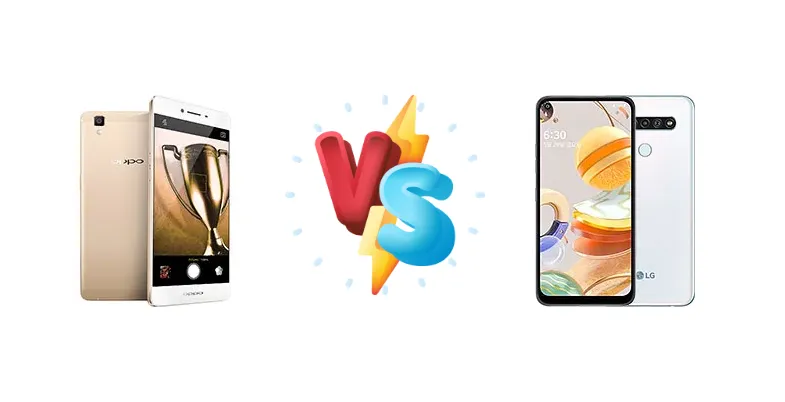
The smartphone market is brimming with options, especially in the budget segment. Today, we're pitting two contenders against each other: the Oppo R7s, a slightly older but well-regarded device, and the LG Q61, a more modern offering. Let's dive into a detailed comparison to see which phone comes out on top.
🏆 Quick Verdict
The LG Q61 generally edges out the Oppo R7s thanks to its newer chipset and more efficient manufacturing process. While the R7s boasts impressive battery endurance, the Q61 offers a smoother overall experience and potentially better long-term software support. It's a close call, but the Q61 is the slightly better choice.
| Network |
|---|
| 2G bands | GSM 850 / 900 / 1800 / 1900 - SIM 1 & SIM 2 | GSM 850 / 900 / 1800 / 1900 |
| 3G bands | HSDPA 850 / 900 / 1900 / 2100 - Global, Taiwan, USA | HSDPA 850 / 900 / 1900 / 2100 |
| 4G bands | 1, 3, 5, 7, 8, 20, 40 - Global | LTE |
| Speed | HSPA, LTE Cat4 150/50 Mbps | HSPA 42.2/5.76 Mbps, LTE (2CA) Cat6 300/50 Mbps |
| Technology | GSM / HSPA / LTE | GSM / HSPA / LTE |
| | 1, 2, 4, 7, 17 - USA | - |
| Launch |
|---|
| Announced | 2015, October. Released 2015, December | 2020, May 21. Released 2020, May 29 |
| Status | Discontinued | Discontinued |
| Body |
|---|
| Dimensions | 151.8 x 75.4 x 7 mm (5.98 x 2.97 x 0.28 in) | 164.5 x 77.5 x 8.3 mm (6.48 x 3.05 x 0.33 in) |
| SIM | Nano-SIM + Micro-SIM | Nano-SIM |
| Weight | 155 g (5.47 oz) | - |
| | - | MIL-STD-810G compliant*
*does not guarantee ruggedness or use in extreme conditions |
| Display |
|---|
| Protection | Corning Gorilla Glass 3 | Scratch-resistant glass |
| Resolution | 1080 x 1920 pixels, 16:9 ratio (~401 ppi density) | 1080 x 2340 pixels, 19.5:9 ratio (~395 ppi density) |
| Size | 5.5 inches, 83.4 cm2 (~72.9% screen-to-body ratio) | 6.53 inches, 104.7 cm2 (~82.1% screen-to-body ratio) |
| Type | AMOLED | IPS LCD |
| Platform |
|---|
| CPU | Octa-core (4x1.5 GHz Cortex-A53 & 4x1.0 GHz Cortex-A53) | Octa-core (4x2.3 GHz Cortex-A53 & 4x1.8 GHz Cortex-A53) |
| Chipset | Qualcomm MSM8939 Snapdragon 615 (28 nm) | Mediatek MT6765 Helio P35 (12 nm) |
| GPU | Adreno 405 | PowerVR GE8320 |
| OS | Android 5.1 (Lollipop), ColorOS 2.1 | Android 9.0 (Pie) |
| Memory |
|---|
| Card slot | microSDXC (uses shared SIM slot) | microSDXC (dedicated slot) |
| Internal | 32GB 4GB RAM | 64GB 4GB RAM |
| | eMMC 4.5 | eMMC 5.1 |
| Main Camera |
|---|
| Features | LED flash, panorama, HDR | LED flash, panorama, HDR |
| Quad | - | 48 MP, f/1.8, 26mm (wide), 1/2.0", 0.8µm, PDAF
8 MP, f/2.2, 118˚, (ultrawide)
2 MP (macro)
Auxiliary lens |
| Single | 13 MP, f/2.2, PDAF | 8 MP, AF |
| Video | 1080p@30fps | 1080p@30fps |
| Selfie camera |
|---|
| Single | 8 MP, f/2.4 | 16 MP |
| Video | - | 1080p@30fps |
| Sound |
|---|
| 3.5mm jack | Yes | Yes |
| 35mm jack | Yes | Yes |
| Loudspeaker | Yes | Yes |
| Comms |
|---|
| Bluetooth | 4.0, A2DP | 5.0, A2DP, LE |
| NFC | No | Yes |
| Positioning | GPS | GPS |
| Radio | No | No |
| USB | microUSB 2.0, OTG | USB Type-C 2.0 |
| WLAN | Wi-Fi 802.11 a/b/g/n/ac, Wi-Fi Direct, hotspot | Wi-Fi 802.11 a/b/g/n/ac, dual-band, Wi-Fi Direct |
| Features |
|---|
| Browser | - | HTML, Adobe Flash |
| Sensors | Accelerometer, proximity, compass | Fingerprint (rear-mounted), accelerometer, gyro, proximity, compass |
| Battery |
|---|
| Charging | 20W wired, 75% in 30 min | - |
| Stand-by | - | Up to 200 h |
| Talk time | - | Up to 8 h 20 min |
| Type | Li-Po 3070 mAh, non-removable | Li-Po 4000 mAh |
| Misc |
|---|
| Colors | Golden | White |
| Models | R7sf | LM-Q630N |
| Price | About 260 EUR | About 270 EUR |
| Tests |
|---|
| Audio quality |
Noise -94.5dB / Crosstalk -94.9dB | - |
| Battery life |
Endurance rating 73h
| - |
| Camera |
Photo / Video | - |
| Display |
Contrast ratio: Infinite (nominal), 3.964 (sunlight) | - |
| Loudspeaker |
Voice 73dB / Noise 66dB / Ring 71dB
| - |
| Performance |
Basemark OS II 2.0: 930Basemark X: 5302 | - |
Oppo R7s
- Exceptional battery life (73h endurance)
- Bright display with good sunlight visibility
- Fast charging (20W)
- Older chipset (Snapdragon 615)
- Potentially outdated software support
- Performance may lag in demanding tasks
LG Q61
- More modern chipset (Helio P35)
- Smoother performance
- Likely better software support
- Decent display quality
- Shorter battery life compared to R7s
- Limited display specifications available
- Camera performance details are scarce
Display Comparison
The Oppo R7s features a reported 'infinite' contrast ratio (likely a marketing term, with a measured 3.964 in sunlight), suggesting good visibility. The LG Q61 likely has a standard IPS LCD display, offering accurate colors and decent viewing angles. While specific display specs for the Q61 are limited, it's likely to be a respectable display for everyday use. The R7s's sunlight performance is a notable advantage.
Camera Comparison
Camera details are sparse for both devices. The Oppo R7s was known for decent image quality in its time, but the LG Q61 likely benefits from newer image processing algorithms and potentially a higher resolution main sensor. Both phones likely offer standard camera features like HDR and panorama mode. A direct comparison would require detailed testing, but the Q61 is expected to perform slightly better.
Performance
Here, the LG Q61 has a clear advantage. Its Mediatek Helio P35 chipset (12nm) is more modern and efficient than the Oppo R7s's Snapdragon 615 (28nm). The Q61's CPU clocks are also higher, resulting in noticeably snappier performance for multitasking and demanding apps. The R7s, while capable, will show its age in more intensive tasks.
Battery Life
The Oppo R7s shines in this category. Its endurance rating of 73h is exceptional, suggesting outstanding battery life. The LG Q61, while having a decent battery capacity, is less efficient due to the older chipset in the R7s. This is a significant advantage for the R7s if battery longevity is your top priority.
Buying Guide
The Oppo R7s is a good choice for users prioritizing exceptional battery life and a bright display on a tight budget. The LG Q61 is ideal for those seeking a more modern chipset, smoother performance, and a slightly more contemporary design, even if it means sacrificing some battery longevity.
Frequently Asked Questions
❓ Is the Oppo R7s still worth buying?
If battery life is your absolute top priority and you can find it at a very low price, the R7s is still a contender. However, be aware of its age and potential software limitations.
❓ Which phone has better future-proofing?
The LG Q61 is likely to have better future-proofing due to its more modern chipset and potential for longer software support from LG (though LG's smartphone support has been inconsistent).