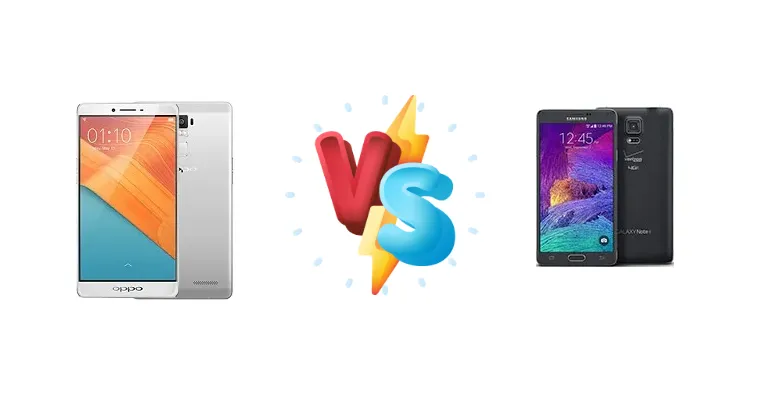
The Oppo R7 Plus and Samsung Galaxy Note 4 were both contenders in their time, offering compelling features and designs. But which phone holds up better today? We're diving deep into a head-to-head comparison to help you decide which device might be right for you, especially if considering a used purchase.
🏆 Quick Verdict
The Samsung Galaxy Note 4 edges out the Oppo R7 Plus thanks to its superior processor and more versatile camera. While the R7 Plus boasts incredible battery life, the Note 4's overall performance and features make it the slightly better choice, assuming you can find one in good condition.
| Network |
|---|
| 2G bands | GSM 850 / 900 / 1800 / 1900 - SIM 1 & SIM 2 | CDMA 800 / 1900 |
| 3G bands | HSDPA 850 / 900 / 1900 / 2100 - Global, Taiwan | CDMA2000 1xEV-DO |
| 4G bands | 1, 3, 5, 7, 8, 40 - Global | 2, 4, 5, 12, 17 |
| Speed | HSPA, LTE Cat4 150/50 Mbps | HSPA, LTE Cat4 150/50 Mbps, EV-DO Rev.A 3.1 Mbps |
| Technology | GSM / HSPA / LTE | GSM / CDMA / HSPA / EVDO / LTE |
| | 1, 2, 4, 7, 17 - USA | HSDPA 850 / 900 / 1900 / 2100 |
| Launch |
|---|
| Announced | 2015, May. Released 2015, May | 2014, Q4. Released 2014, Q4 |
| Status | Discontinued | Discontinued |
| Body |
|---|
| Dimensions | 158 x 82 x 7.8 mm (6.22 x 3.23 x 0.31 in) | 153.5 x 78.6 x 8.5 mm (6.04 x 3.09 x 0.33 in) |
| SIM | Nano-SIM + Micro-SIM | Micro-SIM |
| Weight | 192 g (6.77 oz) | 176 g (6.21 oz) |
| | - | Stylus |
| Display |
|---|
| Protection | Corning Gorilla Glass 3 | Corning Gorilla Glass 4 |
| Resolution | 1080 x 1920 pixels, 16:9 ratio (~367 ppi density) | 1440 x 2560 pixels, 16:9 ratio (~518 ppi density) |
| Size | 6.0 inches, 99.2 cm2 (~76.6% screen-to-body ratio) | 5.7 inches, 88.5 cm2 (~73.4% screen-to-body ratio) |
| Type | AMOLED | Super AMOLED |
| Platform |
|---|
| CPU | Octa-core (4x1.5 GHz Cortex-A53 & 4x1.0 GHz Cortex-A53) | Quad-core 2.7 GHz Krait 450 |
| Chipset | Qualcomm MSM8939 Snapdragon 615 (28 nm) | Qualcomm APQ8084 Snapdragon 805 (28 nm) |
| GPU | Adreno 405 | Adreno 420 |
| OS | Android 5.1.1 (Lollipop), ColorOS 2.1 | Android 4.4.4 (KitKat), upgradable to 6.0.1 (Marshmallow) |
| Memory |
|---|
| Card slot | microSDXC (uses shared SIM slot) | microSDXC (dedicated slot) |
| Internal | 32GB 3GB RAM, 64GB 4GB RAM | 32GB 3GB RAM |
| | eMMC 4.5 | eMMC 5.0 |
| Main Camera |
|---|
| Features | Laser AF, Schneider-Kreuznach optics, dual-LED flash, panorama, HDR | LED flash, panorama, HDR |
| Single | 13 MP, f/2.2, 1/3.1", 1.12µm | 16 MP, f/2.2, 31mm (standard), 1/2.6", 1.12µm, AF, OIS |
| Video | 1080p@60fps, 720p@120fps | 4K@30fps, 1080p@30/60fps, stereo sound rec. |
| Selfie camera |
|---|
| Features | - | HDR |
| Single | 8 MP, f/2.4 | 3.7 MP, f/1.9, 22mm (wide) |
| Video | - | 1440p@30fps |
| Sound |
|---|
| 3.5mm jack | Yes | Yes |
| 35mm jack | Yes | Yes |
| Loudspeaker | Yes | Yes |
| | - | 24-bit/192kHz audio
|
| Comms |
|---|
| Bluetooth | 4.0, LE | 4.1, A2DP, EDR, LE |
| Infrared port | - | Yes |
| NFC | No | Yes |
| Positioning | GPS, GLONASS | GPS, GLONASS |
| Radio | No | No |
| USB | microUSB 2.0, OTG | microUSB 2.0 (MHL 3 TV-out), OTG |
| WLAN | Wi-Fi 802.11 a/b/g/n/ac, dual-band, Wi-Fi Direct, hotspot | Wi-Fi 802.11 a/b/g/n/ac, dual-band, Wi-Fi Direct, hotspot |
| Features |
|---|
| Sensors | Fingerprint (rear-mounted), accelerometer, proximity, compass | Fingerprint (front-mounted), accelerometer, gyro, proximity, compass, barometer, gesture, UV, heart rate, SpO2 |
| | - | ANT+
S-Voice natural language commands and dictation
Air gestures |
| Battery |
|---|
| Charging | 20W wired, 75% in 30 min | 15W wired, QC2 |
| Music play | - | Up to 80 h |
| Stand-by | - | Up to 212 h (3G) |
| Talk time | - | Up to 31 h 20 min (3G) |
| Type | Li-Po 4100 mAh, non-removable | Li-Ion 3220 mAh, removable |
| Misc |
|---|
| Colors | Golden, Silver | Frosted white, Charcoal black, Bronze Gold, Blossom Pink |
| Models | R7plusf | SM-N910A, SM-N910T, SM-N910V, SM-N910M, SM-N910P, SM-N910R4, SM-N910W8, SM-N910T3 |
| Price | About 430 EUR | About 250 EUR |
| SAR | - | 0.88 W/kg (head) 1.40 W/kg (body) |
| Tests |
|---|
| Audio quality |
Noise -94.3dB / Crosstalk -94.9dB | - |
| Battery life |
Endurance rating 94h
| - |
| Camera |
Photo / Video | - |
| Display |
Contrast ratio: Infinite (nominal), 3.499 (sunlight) | - |
| Loudspeaker |
Voice 73dB / Noise 72dB / Ring 79dB
| - |
| Performance |
Basemark OS II 2.0: 968Basemark X: 5349 | - |
Oppo R7 Plus
- Exceptional battery life
- Bright and vibrant display
- Fast charging (20W)
- Sleek design
- Weaker processor
- Less versatile camera
- Older software support
Samsung Galaxy Note 4 (USA)
- Powerful processor (Snapdragon 805)
- High-resolution display
- Versatile camera with OIS
- Larger screen
- Shorter battery life
- Older device (limited software updates)
- Slower charging (15W)
Display Comparison
The Oppo R7 Plus features a 5.5-inch AMOLED display with a reported 'infinite' contrast ratio (likely a marketing term, with a measured 3.499 in sunlight). The Note 4 has a 5.7-inch Quad HD Super AMOLED display. While the R7 Plus's display is vibrant, the Note 4's higher resolution and slightly larger size offer a more immersive viewing experience. Both offer excellent color reproduction.
Camera Comparison
The Note 4 boasts a 16MP main camera with optical image stabilization (OIS) and a 3.7MP front camera. The R7 Plus has a 13MP main camera and a 5MP front camera. While both capture decent photos, the Note 4's OIS provides sharper images in low light, and its camera software offers more features. Video recording capabilities are also slightly better on the Note 4.
Performance
Here's where the Note 4 shines. Its Snapdragon 805 chipset and 2.7 GHz Krait 450 quad-core processor significantly outperform the R7 Plus's Snapdragon 615 octa-core. The Note 4 handles demanding apps and games with ease, while the R7 Plus can show some lag under heavy load. The Note 4's RAM (3GB vs 2GB) also contributes to smoother multitasking.
Battery Life
The Oppo R7 Plus is the clear winner in this category. Its endurance rating of 94 hours is exceptional. The Note 4's battery life is respectable, but falls far short of the R7 Plus's longevity. The R7 Plus's 20W charging is also faster than the Note 4's 15W QC2 charging.
Buying Guide
Who should buy the Oppo R7 Plus? Users prioritizing exceptional battery life and a bright display on a budget. Who should buy the Samsung Galaxy Note 4 (USA)? Those seeking a more powerful processor, a more versatile camera, and a larger screen, even if it means dealing with an older device.
Frequently Asked Questions
❓ Is the Oppo R7 Plus still worth buying?
If battery life is your absolute top priority and you can find it at a very low price, the R7 Plus can be a decent option. However, be aware of its limitations in performance and software support.
❓ Can I still get software updates for the Samsung Galaxy Note 4?
Official software updates have ceased for the Note 4. However, custom ROMs may be available for those comfortable with flashing their device.