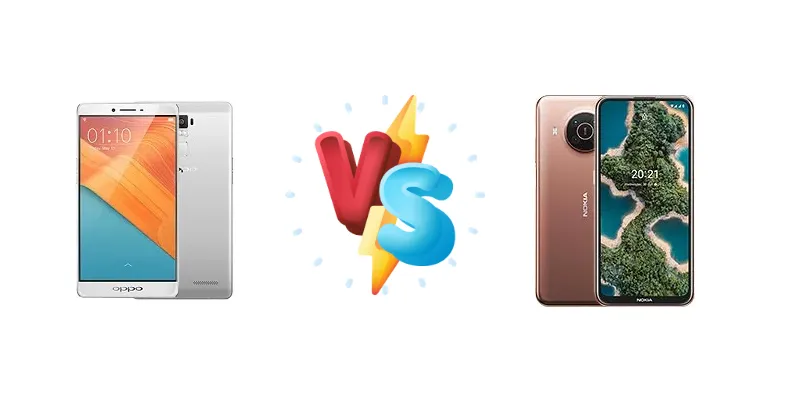
The Oppo R7 Plus, a phone from a bygone era, boasted impressive battery life and a unique display. Now, it faces off against the Nokia X20, a more modern device with 5G capabilities. Let's dive into a comprehensive comparison to see which phone emerges as the victor.
🏆 Quick Verdict
The Nokia X20 wins overall due to its modern chipset, 5G connectivity, and more recent software. While the Oppo R7 Plus had exceptional battery life, its aging hardware and lack of modern features make it less appealing in today's market. The X20 offers a better long-term investment.
| Network |
|---|
| 2G bands | GSM 850 / 900 / 1800 / 1900 - SIM 1 & SIM 2 | GSM 850 / 900 / 1800 / 1900 |
| 3G bands | HSDPA 850 / 900 / 1900 / 2100 - Global, Taiwan | HSDPA 850 / 900 / 1700(AWS) / 1900 / 2100 |
| 4G bands | 1, 3, 5, 7, 8, 40 - Global | 1, 2, 3, 4, 5, 7, 8, 12, 20, 28, 66, 38, 39, 40, 41 |
| 5G bands | - | 1, 2, 3, 5, 7, 28, 38, 41, 66, 78 SA/NSA/Sub6 |
| Speed | HSPA, LTE Cat4 150/50 Mbps | HSPA, LTE, 5G |
| Technology | GSM / HSPA / LTE | GSM / HSPA / LTE / 5G |
| | 1, 2, 4, 7, 17 - USA | - |
| Launch |
|---|
| Announced | 2015, May. Released 2015, May | 2021, April 08 |
| Status | Discontinued | Available. Released 2021, May 12 |
| Body |
|---|
| Dimensions | 158 x 82 x 7.8 mm (6.22 x 3.23 x 0.31 in) | 168.9 x 79.7 x 9.1 mm (6.65 x 3.14 x 0.36 in) |
| SIM | Nano-SIM + Micro-SIM | · Nano-SIM· Nano-SIM + Nano-SIM |
| Weight | 192 g (6.77 oz) | 220 g (7.76 oz) |
| Display |
|---|
| Protection | Corning Gorilla Glass 3 | Corning Gorilla Glass 5 |
| Resolution | 1080 x 1920 pixels, 16:9 ratio (~367 ppi density) | 1080 x 2400 pixels, 20:9 ratio (~395 ppi density) |
| Size | 6.0 inches, 99.2 cm2 (~76.6% screen-to-body ratio) | 6.67 inches, 107.4 cm2 (~79.8% screen-to-body ratio) |
| Type | AMOLED | IPS LCD, 450 nits (typ) |
| Platform |
|---|
| CPU | Octa-core (4x1.5 GHz Cortex-A53 & 4x1.0 GHz Cortex-A53) | Octa-core (2x2.0 GHz Kryo 460 & 6x1.8 GHz Kryo 460) |
| Chipset | Qualcomm MSM8939 Snapdragon 615 (28 nm) | Qualcomm SM4350 Snapdragon 480 5G (8 nm) |
| GPU | Adreno 405 | Adreno 619 |
| OS | Android 5.1.1 (Lollipop), ColorOS 2.1 | Android 11, upgradable to Android 14 |
| Memory |
|---|
| Card slot | microSDXC (uses shared SIM slot) | microSDXC (uses shared SIM slot) |
| Internal | 32GB 3GB RAM, 64GB 4GB RAM | 128GB 6GB RAM, 128GB 8GB RAM |
| | eMMC 4.5 | - |
| Main Camera |
|---|
| Features | Laser AF, Schneider-Kreuznach optics, dual-LED flash, panorama, HDR | Zeiss optics, LED flash, HDR, panorama |
| Quad | - | 64 MP, (wide), PDAF
5 MP, (ultrawide)
2 MP (macro)
Auxiliary lens |
| Single | 13 MP, f/2.2, 1/3.1", 1.12µm | 32 MP, (wide) |
| Video | 1080p@60fps, 720p@120fps | 1080p@30/60fps |
| Selfie camera |
|---|
| Single | 8 MP, f/2.4 | 32 MP, (wide) |
| Video | - | 1080p@30fps |
| Sound |
|---|
| 3.5mm jack | Yes | Yes |
| 35mm jack | Yes | Yes |
| Loudspeaker | Yes | Yes |
| Comms |
|---|
| Bluetooth | 4.0, LE | 5.0, A2DP, LE, aptX HD |
| NFC | No | Yes |
| Positioning | GPS, GLONASS | GPS, GLONASS, GALILEO |
| Radio | No | FM radio |
| USB | microUSB 2.0, OTG | USB Type-C 2.0, OTG |
| WLAN | Wi-Fi 802.11 a/b/g/n/ac, dual-band, Wi-Fi Direct, hotspot | Wi-Fi 802.11 a/b/g/n/ac, dual-band, Wi-Fi Direct |
| Features |
|---|
| Sensors | Fingerprint (rear-mounted), accelerometer, proximity, compass | Fingerprint (side-mounted), accelerometer, gyro, proximity |
| Battery |
|---|
| Charging | 20W wired, 75% in 30 min | 18W wired |
| Type | Li-Po 4100 mAh, non-removable | Li-Po 4470 mAh |
| Misc |
|---|
| Colors | Golden, Silver | Midnight Sun, Nordic Blue |
| Models | R7plusf | TA-1341, TA-1344 |
| Price | About 430 EUR | About 130 EUR |
| SAR | - | 1.04 W/kg (head) 0.62 W/kg (body) |
| SAR EU | - | 0.51 W/kg (head) 1.29 W/kg (body) |
| Tests |
|---|
| Audio quality |
Noise -94.3dB / Crosstalk -94.9dB | - |
| Battery life |
Endurance rating 94h
| - |
| Camera |
Photo / Video | - |
| Display |
Contrast ratio: Infinite (nominal), 3.499 (sunlight) | - |
| Loudspeaker |
Voice 73dB / Noise 72dB / Ring 79dB
| - |
| Performance |
Basemark OS II 2.0: 968Basemark X: 5349 | - |
Oppo R7 Plus
- Exceptional battery life
- Good sunlight readability (claimed)
- Fast charging (20W)
- Outdated chipset
- Lack of 5G
- Older software
- Lower camera quality compared to modern phones
Nokia X20
- 5G connectivity
- Modern chipset (Snapdragon 480 5G)
- Clean Android experience
- Versatile camera system
- Battery life not as exceptional as R7 Plus
- 18W charging is slower than R7 Plus
Display Comparison
The Oppo R7 Plus touted an 'infinite' contrast ratio (likely a marketing term, with a sunlight readability of 3.499), suggesting good outdoor visibility. The Nokia X20 features a 6.67-inch FHD+ display, offering a more standard but likely more accurate color reproduction and better overall viewing experience. The X20's resolution provides sharper visuals.
Camera Comparison
The Nokia X20 boasts a quad-camera setup (64MP main, 5MP ultrawide, 2MP depth, 2MP macro) offering more versatility. The Oppo R7 Plus's camera is likely adequate for basic photography, but lacks the advanced features and image processing capabilities of the X20. The X20's larger sensor should also capture more light.
Performance
Here, the Nokia X20 takes a significant lead. Its Snapdragon 480 5G chipset, built on an 8nm process, is considerably more efficient and powerful than the Oppo R7 Plus's Snapdragon 615 (28nm). The X20's Kryo 460 cores offer better performance for multitasking and demanding applications. The R7 Plus's CPU, while Octa-core, is based on older Cortex-A53 architecture.
Battery Life
The Oppo R7 Plus's 94-hour endurance rating is truly remarkable, a testament to its efficient hardware and larger battery capacity. However, the Nokia X20's 4470 mAh battery, while not reaching the R7 Plus's longevity, still provides solid all-day battery life and benefits from more efficient power management due to its newer chipset.
Buying Guide
The Oppo R7 Plus is best for users prioritizing extreme battery life above all else and who don't need modern features. The Nokia X20 is ideal for those seeking a reliable, 5G-enabled smartphone with a decent camera and a clean Android experience.
Frequently Asked Questions
❓ Is the Oppo R7 Plus still worth buying?
Only if battery life is your absolute top priority and you don't need 5G or modern features. Otherwise, it's best to consider newer devices.
❓ Does the Nokia X20 have 5G?
Yes, the Nokia X20 supports 5G connectivity, making it a more future-proof option.