
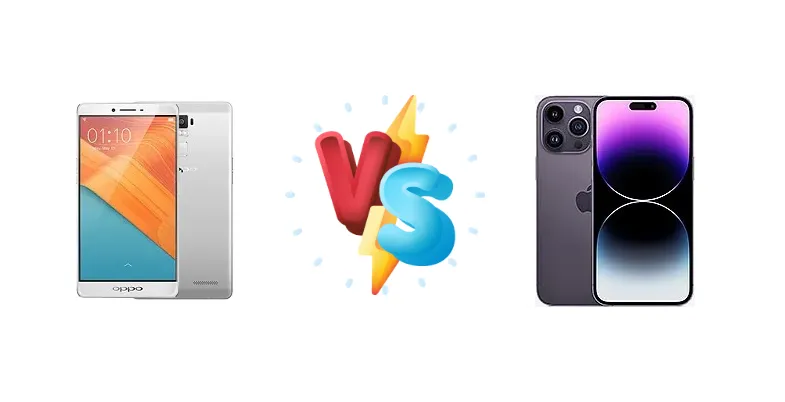
Oppo R7 Plus vs. iPhone 14 Pro Max: A Generational Leap?
| Phones Images | |||||
|---|---|---|---|---|---|
|
🏆 Quick Verdict
The iPhone 14 Pro Max utterly dominates this comparison. While the Oppo R7 Plus boasts impressive battery endurance for its time, the iPhone's superior performance, camera, display, and modern features make it the clear winner. It's a David vs. Goliath scenario.
| PHONES | ||
|---|---|---|
| Phone Names | Oppo R7 Plus | Apple iPhone 14 Pro Max |
| Network | ||
|---|---|---|
| 2G bands | GSM 850 / 900 / 1800 / 1900 - SIM 1 & SIM 2 | GSM 850 / 900 / 1800 / 1900 |
| 3G bands | HSDPA 850 / 900 / 1900 / 2100 - Global, Taiwan | HSDPA 850 / 900 / 1700(AWS) / 1900 / 2100 |
| 4G bands | 1, 3, 5, 7, 8, 40 - Global | 1, 2, 3, 4, 5, 7, 8, 12, 13, 17, 18, 19, 20, 25, 26, 28, 30, 32, 34, 38, 39, 40, 41, 42, 46, 48, 66 - A2894, A2896 |
| 5G bands | - | 1, 2, 3, 5, 7, 8, 12, 20, 25, 26, 28, 30, 38, 40, 41, 48, 66, 70, 77, 78, 79 SA/NSA/Sub6 - A2894, A2896 |
| Speed | HSPA, LTE Cat4 150/50 Mbps | HSPA, LTE, 5G, EV-DO Rev.A 3.1 Mbps |
| Technology | GSM / HSPA / LTE | GSM / CDMA / HSPA / EVDO / LTE / 5G |
| 1, 2, 4, 7, 17 - USA | 1, 2, 3, 5, 7, 8, 12, 20, 25, 26, 28, 30, 38, 40, 41, 48, 66, 70, 77, 78, 79 SA/NSA/Sub6 - A2895 | |
| Launch | ||
|---|---|---|
| Announced | 2015, May. Released 2015, May | 2022, September 07 |
| Status | Discontinued | Available. Released 2022, September 16 |
| Body | ||
|---|---|---|
| Build | - | Glass front, glass back, stainless steel frame |
| Dimensions | 158 x 82 x 7.8 mm (6.22 x 3.23 x 0.31 in) | 160.7 x 77.6 x 7.9 mm (6.33 x 3.06 x 0.31 in) |
| SIM | Nano-SIM + Micro-SIM | · Nano-SIM + eSIM + eSIM (max 2 at a time; International)· eSIM + eSIM (8 or more, max 2 at a time; USA)· Nano-SIM + Nano-SIM (China) |
| Weight | 192 g (6.77 oz) | 240 g (8.47 oz) |
| - | IP68 dust/water resistant (up to 6m for 30 min) Apple Pay (Visa, MasterCard, AMEX certified) | |
| Display | ||
|---|---|---|
| Protection | Corning Gorilla Glass 3 | Ceramic Shield glass |
| Resolution | 1080 x 1920 pixels, 16:9 ratio (~367 ppi density) | 1290 x 2796 pixels, 19.5:9 ratio (~460 ppi density) |
| Size | 6.0 inches, 99.2 cm2 (~76.6% screen-to-body ratio) | 6.7 inches, 110.2 cm2 (~88.3% screen-to-body ratio) |
| Type | AMOLED | LTPO Super Retina XDR OLED, 120Hz, HDR10, Dolby Vision, 1000 nits (typ), 2000 nits (HBM) |
| - | Always-On display | |
| Platform | ||
|---|---|---|
| CPU | Octa-core (4x1.5 GHz Cortex-A53 & 4x1.0 GHz Cortex-A53) | Hexa-core (2x3.46 GHz Everest + 4x2.02 GHz Sawtooth) |
| Chipset | Qualcomm MSM8939 Snapdragon 615 (28 nm) | Apple A16 Bionic (4 nm) |
| GPU | Adreno 405 | Apple GPU (5-core graphics) |
| OS | Android 5.1.1 (Lollipop), ColorOS 2.1 | iOS 16, upgradable to iOS 26.1 |
| Memory | ||
|---|---|---|
| Card slot | microSDXC (uses shared SIM slot) | No |
| Internal | 32GB 3GB RAM, 64GB 4GB RAM | 128GB 6GB RAM, 256GB 6GB RAM, 512GB 6GB RAM, 1TB 6GB RAM |
| eMMC 4.5 | NVMe | |
| Main Camera | ||
|---|---|---|
| Features | Laser AF, Schneider-Kreuznach optics, dual-LED flash, panorama, HDR | Dual-LED dual-tone flash, HDR (photo/panorama) |
| Single | 13 MP, f/2.2, 1/3.1", 1.12µm | 12 MP, f/1.9, 23mm (wide), 1/3.6", PDAF, OIS (unconfirmed) SL 3D, (depth/biometrics sensor) |
| Triple | - | 48 MP, f/1.8, 24mm (wide), 1/1.28", 1.22µm, dual pixel PDAF, sensor-shift OIS 12 MP, f/2.8, 77mm (telephoto), 1/3.5", 1.0µm, PDAF, OIS, 3x optical zoom 12 MP, f/2.2, 13mm, 120˚ (ultrawide), 1/2.55", 1.4µm, dual pixel PDAF TOF 3D LiDAR scanner (depth) |
| Video | 1080p@60fps, 720p@120fps | 4K@24/25/30/60fps, 1080p@25/30/60/120/240fps, 10-bit HDR, Dolby Vision HDR (up to 60fps), ProRes, stereo sound rec. |
| Selfie camera | ||
|---|---|---|
| Features | - | HDR |
| Single | 8 MP, f/2.4 | 12 MP, f/1.9, 23mm (wide), 1/3.6", 1.0µm, PDAF, OIS SL 3D, (depth/biometrics sensor) |
| Video | - | 4K@24/25/30/60fps, 1080p@25/30/60/120fps, gyro-EIS |
| Sound | ||
|---|---|---|
| 3.5mm jack | Yes | No |
| 35mm jack | Yes | No |
| Loudspeaker | Yes | Yes, with stereo speakers |
| Comms | ||
|---|---|---|
| Bluetooth | 4.0, LE | 5.3, A2DP, LE |
| NFC | No | Yes |
| Positioning | GPS, GLONASS | GPS (L1+L5), GLONASS, GALILEO, BDS, QZSS |
| Radio | No | No |
| USB | microUSB 2.0, OTG | Lightning, USB 2.0 |
| WLAN | Wi-Fi 802.11 a/b/g/n/ac, dual-band, Wi-Fi Direct, hotspot | Wi-Fi 802.11 a/b/g/n/ac/6, dual-band, hotspot |
| Features | ||
|---|---|---|
| Sensors | Fingerprint (rear-mounted), accelerometer, proximity, compass | Face ID, accelerometer, gyro, proximity, compass, barometer |
| - | Ultra Wideband (UWB) support Emergency SOS via satellite (SMS sending/receiving) | |
| Battery | ||
|---|---|---|
| Charging | 20W wired, 75% in 30 min | Wired, PD2.0, 50% in 30 min 15W wireless (MagSafe) 15W wireless (Qi2) - requires iOS 17.2 update |
| Type | Li-Po 4100 mAh, non-removable | Li-Ion 4323 mAh (16.68 Wh) |
| Misc | ||
|---|---|---|
| Colors | Golden, Silver | Space Black, Silver, Gold, Deep Purple |
| Models | R7plusf | A2894, A2651, A2893, A2895, A2896, iphone15,3 |
| Price | About 430 EUR | € 530.79 / $ 489.81 / £ 446.75 |
| SAR | - | 1.15 W/kg (head) 1.07 W/kg (body) |
| SAR EU | - | 0.99 W/kg (head) 0.98 W/kg (body) |
| Tests | ||
|---|---|---|
| Audio quality | Noise -94.3dB / Crosstalk -94.9dB | - |
| Battery life | Endurance rating 94h | Endurance rating 121h |
| Camera | Photo / Video | Photo / Video |
| Display | Contrast ratio: Infinite (nominal), 3.499 (sunlight) | Contrast ratio: Infinite (nominal) |
| Loudspeaker | Voice 73dB / Noise 72dB / Ring 79dB | -24.3 LUFS (Very good) |
| Performance | Basemark OS II 2.0: 968Basemark X: 5349 | AnTuTu: 955884 (v9) GeekBench: 5423 (v5.1) GFXBench: 54fps (ES 3.1 onscreen) |
Oppo R7 Plus
- Excellent battery life (for its time)
- Fast charging (for its time)
- Compact size
- Outdated processor
- Low-resolution display
- Basic camera
- No modern features
Apple iPhone 14 Pro Max
- Exceptional performance
- Stunning display
- Advanced camera system
- Long battery life
- Wireless charging
- Modern iOS features
- Expensive
- Large size
- Lightning port (transitioning to USB-C)
Display Comparison
The iPhone 14 Pro Max's display is in a different league. Its 1760 nits peak brightness blows the R7 Plus's contrast ratio (while impressive for its era) out of the water. Color accuracy, resolution, and overall visual experience are vastly superior on the iPhone. The R7 Plus's display was good for its time, but it simply can't compete with modern OLED technology.
Camera Comparison
The iPhone 14 Pro Max's camera system is a major upgrade. Expect significantly better image quality, dynamic range, low-light performance, and video recording capabilities. The Oppo R7 Plus's camera was decent for its time, but it lacks the advanced features and image processing of the iPhone.
Performance
The A16 Bionic chip in the iPhone 14 Pro Max is a beast, easily outperforming the Snapdragon 615 in the Oppo R7 Plus. Expect significantly faster app loading, smoother multitasking, and better gaming performance on the iPhone. The R7 Plus's octa-core processor was adequate for its time, but it struggles with modern demands.
Battery Life
While the Oppo R7 Plus has an impressive endurance rating of 94h, the iPhone 14 Pro Max matches it at 121h. However, the iPhone's faster charging (PD 2.0) and wireless charging capabilities give it an edge in real-world usage.
Buying Guide
The Oppo R7 Plus is a nostalgic choice for those seeking a budget-friendly, simple phone. The iPhone 14 Pro Max is for users who demand top-tier performance, a stunning camera, and the latest iOS features, regardless of price.