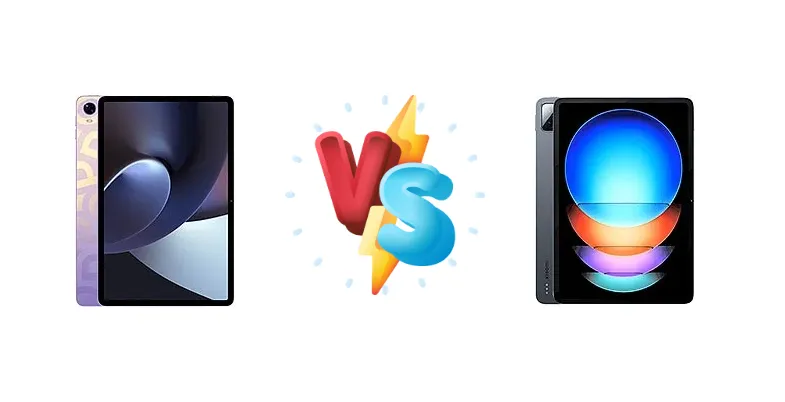
The Android tablet market is heating up, with Oppo and Xiaomi delivering compelling options. The Oppo Pad, leveraging the proven Snapdragon 870, offers a balance of performance and value. However, the Xiaomi Pad 6S Pro 12.4 arrives with the significantly newer and more powerful Snapdragon 8 Gen 2, alongside a larger display and faster charging. This comparison dissects these two tablets to determine which one best suits your needs.
🏆 Quick Verdict
For the average user prioritizing raw performance and future-proofing, the Xiaomi Pad 6S Pro 12.4 is the clear winner. Its Snapdragon 8 Gen 2 chipset delivers a substantial leap in processing power and efficiency, complemented by a brighter display and blazing-fast 120W charging. However, the Oppo Pad remains a strong contender for budget-conscious users.
| Network |
|---|
| 2G bands | N/A | N/A |
| 3G bands | N/A | N/A |
| 4G bands | N/A | - |
| EDGE | No | N/A |
| GPRS | No | N/A |
| Technology | No cellular connectivity | No cellular connectivity |
| Launch |
|---|
| Announced | 2022, February 24 | 2024, February 22 |
| Status | Available. Released 2022, March 03 | Available. Released 2024, February 22 |
| Body |
|---|
| Build | - | Glass front (Gorilla Glass 5), aluminum frame, aluminum back |
| Dimensions | 252.2 x 163.8 x 7.1 mm (9.93 x 6.45 x 0.28 in) | 278.7 x 191.6 x 6.3 mm (10.97 x 7.54 x 0.25 in) |
| SIM | No | No |
| Weight | 507 g / 510 g (1.12 lb) | 590 g (1.30 lb) |
| Display |
|---|
| Protection | - | Corning Gorilla Glass 5 |
| Resolution | 1600 x 2560 pixels, 16:10 ratio (~274 ppi density) | 2032 x 3048 pixels, 3:2 ratio (~295 ppi density) |
| Size | 11.0 inches, 350.9 cm2 (~84.9% screen-to-body ratio) | 12.4 inches, 457.8 cm2 (~85.7% screen-to-body ratio) |
| Type | IPS LCD, 120Hz, 480 nits | IPS LCD, 68B colors, 144Hz, HDR10, Dolby Vision, 900 nits (peak) |
| Platform |
|---|
| CPU | Octa-core (1x3.2 GHz Kryo 585 & 3x2.42 GHz Kryo 585 & 4x1.80 GHz Kryo 585) | Octa-core (1x3.2 GHz Cortex-X3 & 2x2.8 GHz Cortex-A715 & 2x2.8 GHz Cortex-A710 & 3x2.0 GHz Cortex-A510) |
| Chipset | Qualcomm SM8250-AC Snapdragon 870 5G (7 nm) | Qualcomm SM8550-AB Snapdragon 8 Gen 2 (4 nm) |
| GPU | Adreno 650 | Adreno 740 |
| OS | Android 11, ColorOS 12 | Android 14, up to 3 major Android upgrades, HyperOS |
| Memory |
|---|
| Card slot | No | No |
| Internal | 128GB 6GB RAM, 256GB 6GB RAM, 256GB 8GB RAM | 256GB 8GB RAM, 256GB 12GB RAM, 512GB 12GB RAM, 1TB 16GB RAM |
| | UFS 3.1 | - |
| Main Camera |
|---|
| Dual | - | 50 MP, f/1.8, (wide), 1/2.76", 0.64µm, PDAF
Auxiliary lens |
| Features | LED flash, panorama | LED flash, HDR, panorama |
| Single | 13 MP, f/2.2, 26mm (wide), AF | - |
| Video | 1080p@30fps | 4K@30/60fps, 1080p@30/60fps |
| Selfie camera |
|---|
| Single | 8 MP, f/2.0, 27mm (wide) | 32 MP, f/2.2, (wide), 1/3.6", 0.61µm |
| Video | 1080p@30fps | 1080p@30fps |
| Sound |
|---|
| 3.5mm jack | No | - |
| 35mm jack | No | No |
| Loudspeaker | Yes, with stereo speakers | Yes, with stereo speakers (6 speakers) |
| Comms |
|---|
| Bluetooth | 5.1, A2DP, LE, aptX HD | 5.3, A2DP, LE, LHDC |
| NFC | No | Yes (file transfer only) |
| Positioning | No | No |
| Radio | No | No |
| USB | USB Type-C 2.0, OTG | USB Type-C 3.2, accessory connector |
| WLAN | Wi-Fi 802.11 a/b/g/n/ac/6, dual-band, Wi-Fi Direct | Wi-Fi 802.11 a/b/g/n/a/6/7, dual-band, Wi-Fi Direct |
| Features |
|---|
| Sensors | Accelerometer, gyro, proximity | Fingerprint (side-mounted), accelerometer, gyro, proximity (accessories only), compass |
| Battery |
|---|
| Charging | 33W wired, PD
5W reverse wired | 120W wired, PD3.0, QC4, 45% in 10 min, 100% in 35 min |
| Type | Li-Po 8360 mAh | 10000 mAh |
| Misc |
|---|
| Colors | Black, Silver, Purple | Black, Blue, Green |
| Models | OPD2101 | 24018RPACG |
| Price | About 310 EUR | About 700 EUR |
| SAR EU | - | 0.99 W/kg (body) |
Oppo Pad
- More affordable price point
- Proven Snapdragon 870 performance
- PD charging compatibility
- Slower charging speed (33W)
- Likely lower peak performance compared to Snapdragon 8 Gen 2
Xiaomi Pad 6S Pro 12.4
- Significantly faster Snapdragon 8 Gen 2 processor
- Brighter and higher contrast display
- Ultra-fast 120W charging
- Higher price tag
- Potentially more expensive repairs
Display Comparison
The Xiaomi Pad 6S Pro 12.4 boasts a significant advantage with its measured peak brightness of 848 nits, ensuring excellent visibility even in bright environments. While the Oppo Pad’s display specs are not provided, the larger screen real estate of the Xiaomi model (12.4 inches vs. Oppo Pad’s unspecified size) offers a more immersive viewing experience. The Xiaomi’s 1378:1 contrast ratio further enhances image quality, delivering deeper blacks and more vibrant colors. Without knowing the Oppo Pad’s panel technology, it’s difficult to assess features like refresh rate or HDR support, but the Xiaomi Pad 6S Pro 12.4 clearly sets a high bar for display quality.
Camera Comparison
Neither tablet is positioned as a photography powerhouse, but the Xiaomi Pad 6S Pro 12.4 likely holds an edge. While specific camera specs are not provided for either device, Xiaomi generally prioritizes camera performance even in its tablets. The Snapdragon 8 Gen 2’s ISP (Image Signal Processor) is significantly more advanced than the 870’s, enabling better image processing and noise reduction. Without detailed camera specifications, it’s difficult to make a definitive judgment, but the Xiaomi’s chipset advantage suggests superior image quality.
Performance
The core difference lies in the chipsets. The Xiaomi Pad 6S Pro 12.4’s Snapdragon 8 Gen 2 (4nm) represents a generational leap over the Oppo Pad’s Snapdragon 870 (7nm). The 8 Gen 2 features a new CPU architecture – Cortex-X3, A715, and A710 cores – compared to the 870’s Kryo 585 cores. This translates to a substantial performance increase in both CPU and GPU tasks. The 4nm process node also contributes to improved thermal efficiency, meaning the Xiaomi Pad 6S Pro 12.4 is likely to sustain peak performance for longer periods without throttling. While the Oppo Pad’s 870 is still a capable chip, it will struggle to match the 8 Gen 2 in demanding scenarios like high-end gaming or video editing. The Xiaomi’s LPDDR5x RAM (spec not provided for Oppo) further enhances memory bandwidth, contributing to smoother multitasking.
Battery Life
The Xiaomi Pad 6S Pro 12.4’s 120W wired charging is a game-changer, achieving 45% charge in just 10 minutes and a full charge in 35 minutes. This drastically reduces downtime compared to the Oppo Pad’s 33W charging. The Xiaomi Pad 6S Pro 12.4 also demonstrates impressive battery life, achieving an active use score of 11:14h. While the Oppo Pad’s battery capacity isn’t specified, the Xiaomi’s combination of efficient chipset and fast charging provides a clear advantage for users who need to stay productive on the go.
Buying Guide
Buy the Oppo Pad if you need a capable tablet for everyday tasks like browsing, streaming, and light gaming, and value a more affordable price point. Buy the Xiaomi Pad 6S Pro 12.4 if you demand top-tier performance for demanding applications, gaming, or creative work, and appreciate a premium display and incredibly fast charging capabilities.
Frequently Asked Questions
❓ Will the Snapdragon 8 Gen 2 in the Xiaomi Pad 6S Pro 12.4 handle demanding games like Genshin Impact at max settings?
Yes, the Snapdragon 8 Gen 2 is more than capable of running Genshin Impact and other graphically intensive games at maximum settings with consistently high frame rates. Its advanced GPU and thermal management system prevent significant throttling, ensuring a smooth gaming experience.
❓ How much faster is the 120W charging on the Xiaomi Pad 6S Pro 12.4 compared to the Oppo Pad's 33W charging in real-world use?
The 120W charging on the Xiaomi Pad 6S Pro 12.4 is dramatically faster. It can reach 45% charge in just 10 minutes and 100% in 35 minutes, whereas the Oppo Pad’s 33W charging will take considerably longer – likely over 1.5 hours for a full charge. This makes a significant difference for users who need to quickly top up their tablet before a meeting or travel.
❓ Does the Xiaomi Pad 6S Pro 12.4 support stylus input and keyboard accessories?
Yes, the Xiaomi Pad 6S Pro 12.4 is designed to work with Xiaomi's Smart Pen (sold separately) and a variety of keyboard accessories, transforming it into a versatile productivity tool. The tablet's large display and powerful processor make it ideal for note-taking, document editing, and creative tasks.