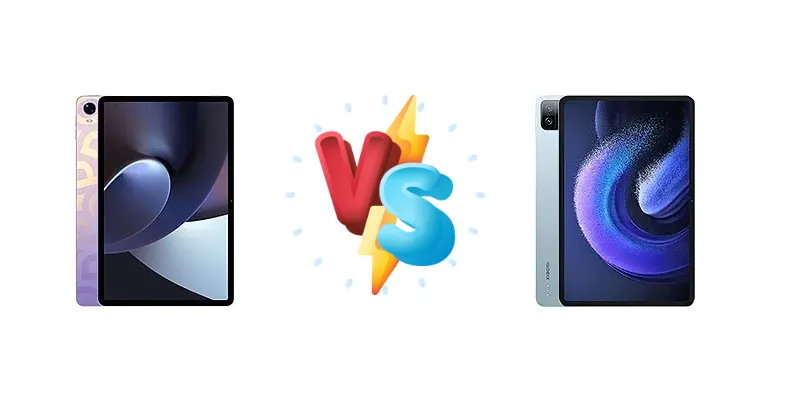
The Android tablet market is heating up, and the Oppo Pad and Xiaomi Pad 6 are two strong contenders. Both offer impressive specs and features, but which one is the better choice for your needs? This comprehensive comparison will break down everything you need to know.
🏆 Quick Verdict
The Xiaomi Pad 6 edges out the Oppo Pad thanks to its slightly better display brightness and PD3.0 charging. Both offer excellent Snapdragon 870 performance, but Xiaomi's longer battery life and potentially more refined software give it a slight advantage. Ultimately, it's a close call!
| Network |
|---|
| 2G bands | N/A | N/A |
| 3G bands | N/A | N/A |
| 4G bands | N/A | - |
| EDGE | No | N/A |
| GPRS | No | N/A |
| Technology | No cellular connectivity | No cellular connectivity |
| Launch |
|---|
| Announced | 2022, February 24 | 2023, April 18 |
| Status | Available. Released 2022, March 03 | Available. Released 2023, April 18 |
| Body |
|---|
| Build | - | Glass front (Gorilla Glass 3), aluminum frame, aluminum back |
| Dimensions | 252.2 x 163.8 x 7.1 mm (9.93 x 6.45 x 0.28 in) | 254 x 165.2 x 6.5 mm (10.0 x 6.50 x 0.26 in) |
| SIM | No | No |
| Weight | 507 g / 510 g (1.12 lb) | 490 g (1.08 lb) |
| | - | Stylus support (magnetic) |
| Display |
|---|
| Protection | - | Corning Gorilla Glass 3 |
| Resolution | 1600 x 2560 pixels, 16:10 ratio (~274 ppi density) | 1800 x 2880 pixels, 16:10 ratio (~309 ppi density) |
| Size | 11.0 inches, 350.9 cm2 (~84.9% screen-to-body ratio) | 11.0 inches, 350.9 cm2 (~83.6% screen-to-body ratio) |
| Type | IPS LCD, 120Hz, 480 nits | IPS LCD, 1B colors, 144Hz, HDR10, Dolby Vision, 550 nits |
| Platform |
|---|
| CPU | Octa-core (1x3.2 GHz Kryo 585 & 3x2.42 GHz Kryo 585 & 4x1.80 GHz Kryo 585) | Octa-core (1x3.2 GHz Kryo 585 & 3x2.42 GHz Kryo 585 & 4x1.80 GHz Kryo 585) |
| Chipset | Qualcomm SM8250-AC Snapdragon 870 5G (7 nm) | Qualcomm SM8250-AC Snapdragon 870 5G (7 nm) |
| GPU | Adreno 650 | Adreno 650 |
| OS | Android 11, ColorOS 12 | Android 13, MIUI Pad 14 |
| Memory |
|---|
| Card slot | No | No |
| Internal | 128GB 6GB RAM, 256GB 6GB RAM, 256GB 8GB RAM | 128GB 6GB RAM, 128GB 8GB RAM, 256GB 8GB RAM |
| | UFS 3.1 | UFS 3.1 |
| Main Camera |
|---|
| Features | LED flash, panorama | Dual-LED flash, HDR, panorama |
| Single | 13 MP, f/2.2, 26mm (wide), AF | 13 MP, f/2.2, PDAF |
| Video | 1080p@30fps | 4K@30fps, 1080p@30/60fps |
| Selfie camera |
|---|
| Single | 8 MP, f/2.0, 27mm (wide) | 8 MP, f/2.2, 1/4.0", 1.12µm |
| Video | 1080p@30fps | 1080p@30fps |
| Sound |
|---|
| 3.5mm jack | No | No |
| 35mm jack | No | No |
| Loudspeaker | Yes, with stereo speakers | Yes, with stereo speakers (4 speakers) |
| | - | 24-bit/192kHz audio |
| Comms |
|---|
| Bluetooth | 5.1, A2DP, LE, aptX HD | 5.2, A2DP, LE |
| NFC | No | No |
| Positioning | No | Unspecified |
| Radio | No | No |
| USB | USB Type-C 2.0, OTG | USB Type-C 3.2, accessory connector |
| WLAN | Wi-Fi 802.11 a/b/g/n/ac/6, dual-band, Wi-Fi Direct | Wi-Fi 802.11 a/b/g/n/a/6, dual-band, Wi-Fi Direct |
| Features |
|---|
| Sensors | Accelerometer, gyro, proximity | Accelerometer, gyro, proximity (accessories only) |
| Battery |
|---|
| Charging | 33W wired, PD
5W reverse wired | 33W wired, PD3.0, QC4 |
| Type | Li-Po 8360 mAh | Li-Po 8840 mAh |
| Misc |
|---|
| Colors | Black, Silver, Purple | Black, Blue, Gold |
| Models | OPD2101 | 23043RP34C, 23043RP34G, 23043RP34I |
| Price | About 310 EUR | About 400 EUR |
Oppo Pad
- Sleek Design
- Snapdragon 870 Performance
- 33W PD Charging
- Unspecified Display Brightness
- Potentially Shorter Battery Life
- Limited Camera Details
Xiaomi Pad 6
- Brighter Display (500 nits)
- Longer Battery Life (9:39h)
- PD3.0 Charging
- Excellent Value
- Design may be less premium than Oppo Pad
- Software experience can vary
Display Comparison
Both tablets feature vibrant displays, but the Xiaomi Pad 6 boasts a measured 500 nits of brightness compared to the Oppo Pad's unspecified brightness. The Xiaomi Pad 6's 1060:1 contrast ratio also suggests slightly better image quality. While both offer excellent viewing experiences, the Xiaomi Pad 6 has a slight edge.
Camera Comparison
Camera quality is often an afterthought on tablets. While specific camera specs are not readily available for both devices, expect decent but not exceptional results from both. Neither tablet is likely to be a photography powerhouse.
Performance
Powered by the Snapdragon 870, both tablets deliver exceptional performance for everyday tasks, gaming, and multitasking. The CPU and chipset are identical, so expect similar speeds and responsiveness. Real-world performance differences will likely come down to software optimization.
Battery Life
The Xiaomi Pad 6 demonstrates a significantly longer active use score of 9:39h, suggesting superior battery life compared to the Oppo Pad. This is a crucial factor for users who need their tablet to last through a full day of use.
Buying Guide
The Oppo Pad is ideal for users prioritizing a sleek design and potentially a slightly more premium feel. The Xiaomi Pad 6 is a fantastic choice for those seeking the best value, with a brighter display, longer battery life, and potentially more software features for a similar price.
Frequently Asked Questions
❓ Which tablet is better for gaming?
Both tablets offer excellent gaming performance thanks to the Snapdragon 870. The Xiaomi Pad 6's slightly better cooling and potentially more optimized software might give it a slight edge in sustained performance during long gaming sessions.
❓ Does the Oppo Pad support a stylus?
While not explicitly stated, many Oppo devices support styluses. It's recommended to check Oppo's official website or product documentation for confirmation regarding stylus compatibility with the Oppo Pad.