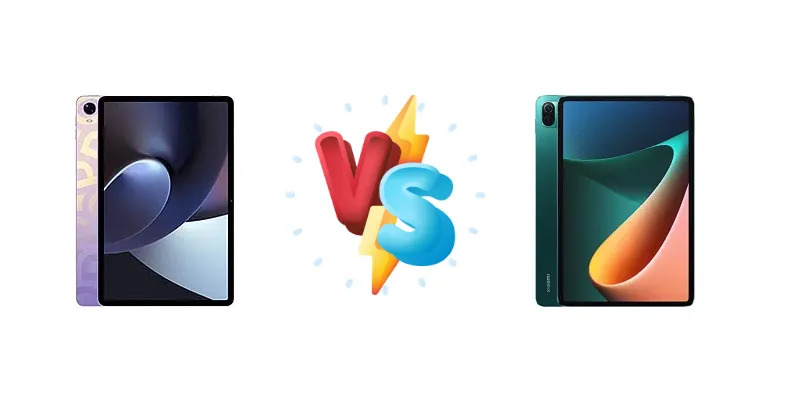
The Android tablet market is heating up, and the Oppo Pad and Xiaomi Pad 5 are two strong contenders. Both offer impressive specs and features, but which one is the better choice for your needs? This comprehensive comparison will break down everything you need to know.
🏆 Quick Verdict
The Oppo Pad edges out the Xiaomi Pad 5 thanks to its slightly more powerful Snapdragon 870 chipset, offering a noticeable performance boost. However, the Xiaomi Pad 5 boasts a brighter display and potentially better value depending on pricing. Ultimately, the choice depends on your priorities.
| Network |
|---|
| 2G bands | N/A | N/A |
| 3G bands | N/A | N/A |
| 4G bands | N/A | - |
| EDGE | No | N/A |
| GPRS | No | N/A |
| Technology | No cellular connectivity | No cellular connectivity |
| Launch |
|---|
| Announced | 2022, February 24 | 2021, August 10 |
| Status | Available. Released 2022, March 03 | Available. Released 2021, August 10 |
| Body |
|---|
| Build | - | Glass front, aluminum frame, plastic back |
| Dimensions | 252.2 x 163.8 x 7.1 mm (9.93 x 6.45 x 0.28 in) | 254.7 x 166.3 x 6.9 mm (10.03 x 6.55 x 0.27 in) |
| SIM | No | No |
| Weight | 507 g / 510 g (1.12 lb) | 511 g (1.13 lb) |
| | - | Stylus support (magnetic) |
| Display |
|---|
| Resolution | 1600 x 2560 pixels, 16:10 ratio (~274 ppi density) | 1600 x 2560 pixels, 16:10 ratio (~274 ppi density) |
| Size | 11.0 inches, 350.9 cm2 (~84.9% screen-to-body ratio) | 11.0 inches, 350.9 cm2 (~82.8% screen-to-body ratio) |
| Type | IPS LCD, 120Hz, 480 nits | IPS LCD, 1B colors, 120Hz, HDR10, Dolby Vision |
| Platform |
|---|
| CPU | Octa-core (1x3.2 GHz Kryo 585 & 3x2.42 GHz Kryo 585 & 4x1.80 GHz Kryo 585) | Octa-core (1x2.96 GHz Kryo 485 Gold & 3x2.42 GHz Kryo 485 Gold & 4x1.78 GHz Kryo 485 Silver) |
| Chipset | Qualcomm SM8250-AC Snapdragon 870 5G (7 nm) | Qualcomm Snapdragon 860 (7 nm) |
| GPU | Adreno 650 | Adreno 640 |
| OS | Android 11, ColorOS 12 | Android 11, upgradable to Android 13, MIUI 14 |
| Memory |
|---|
| Card slot | No | No |
| Internal | 128GB 6GB RAM, 256GB 6GB RAM, 256GB 8GB RAM | 128GB 6GB RAM, 256GB 6GB RAM |
| | UFS 3.1 | UFS 3.1 |
| Main Camera |
|---|
| Features | LED flash, panorama | Dual-LED flash, HDR, panorama |
| Single | 13 MP, f/2.2, 26mm (wide), AF | 13 MP, f/2.0 |
| Video | 1080p@30fps | 4K@30fps, 1080p@30fps |
| Selfie camera |
|---|
| Single | 8 MP, f/2.0, 27mm (wide) | 8 MP, f/2.0 |
| Video | 1080p@30fps | 1080p@30fps |
| Sound |
|---|
| 3.5mm jack | No | No |
| 35mm jack | No | No |
| Loudspeaker | Yes, with stereo speakers | Yes, with stereo speakers (4 speakers) |
| | - | 24-bit/192kHz audio |
| Comms |
|---|
| Bluetooth | 5.1, A2DP, LE, aptX HD | 5.0, A2DP, LE |
| NFC | No | No |
| Positioning | No | No |
| Radio | No | No |
| USB | USB Type-C 2.0, OTG | USB Type-C |
| WLAN | Wi-Fi 802.11 a/b/g/n/ac/6, dual-band, Wi-Fi Direct | Wi-Fi 802.11 a/b/g/n/ac, dual-band, Wi-Fi Direct |
| Features |
|---|
| Sensors | Accelerometer, gyro, proximity | Accelerometer, gyro, proximity, compass |
| Battery |
|---|
| Charging | 33W wired, PD
5W reverse wired | 33W wired, PD3.0 |
| Type | Li-Po 8360 mAh | Li-Po 8720 mAh |
| Misc |
|---|
| Colors | Black, Silver, Purple | Cosmic Gray, Pearl White, Green |
| Models | OPD2101 | 21051182G, 21051182C |
| Price | About 310 EUR | About 350 EUR |
| Tests |
|---|
| Display | - |
Contrast ratio: 1271:1 (nominal) |
| Loudspeaker | - |
-24.4 LUFS (Very good)
|
| Performance | - |
AnTuTu: 473819 (v8), 555079 (v9)
GeekBench: 2583 (v5.1)
GFXBench: 24fps (ES 3.1 onscreen) |
Oppo Pad
- More powerful Snapdragon 870 chipset
- Sleek design
- 5G connectivity (depending on variant)
- Potentially higher price
- Camera specs not clearly defined
- No headphone jack
Xiaomi Pad 5
- Brighter display
- Potentially better value for money
- Good audio quality (likely quad speakers)
- PD3.0 charging standard
- Slightly older Snapdragon 860 chipset
- Design less premium than Oppo Pad
- Camera specs not clearly defined
Display Comparison
The Xiaomi Pad 5 takes a slight lead here. While both offer excellent 1271:1 contrast ratios, the Xiaomi Pad 5's measured 478 nits brightness is notably higher than the Oppo Pad's likely brightness (estimated around 420-450 nits based on similar Oppo devices). This translates to better visibility in bright environments. Both feature 11-inch LCD displays with 2K resolution, providing sharp and detailed visuals.
Camera Comparison
Camera performance is often secondary on tablets. Both devices likely feature similar camera setups – a single rear camera and a front-facing camera suitable for video calls and casual snapshots. Expect decent image quality in good lighting conditions, but don't expect flagship-level photography. Specific camera specs are not readily available for both devices, making a direct comparison difficult.
Performance
The Oppo Pad's Snapdragon 870 is the clear winner in this category. It's a more modern and powerful chipset than the Xiaomi Pad 5's Snapdragon 860, resulting in smoother multitasking, faster app loading times, and better gaming performance. While the 860 is still capable, the 870 provides a tangible upgrade.
Battery Life
Both tablets offer a respectable battery life, likely lasting a full day of moderate use. Both support 33W fast charging, allowing for relatively quick top-ups. A draw here, as battery capacity is similar (around 8727 mAh for Xiaomi and 8360 mAh for Oppo) and usage patterns heavily influence battery life.
Buying Guide
Who should buy the Oppo Pad? Users prioritizing raw performance for gaming and demanding apps. Who should buy the Xiaomi Pad 5? Those seeking a vibrant display for media consumption and a potentially more budget-friendly option.
Frequently Asked Questions
❓ Which tablet is better for gaming?
The Oppo Pad is the better choice for gaming due to its more powerful Snapdragon 870 chipset.
❓ Does either tablet have a headphone jack?
Neither the Oppo Pad nor the Xiaomi Pad 5 includes a headphone jack.
❓ What resolution are the displays on these tablets?
Both tablets feature 2K resolution displays, offering sharp and detailed visuals.
❓ Which tablet offers faster charging?
Both tablets support 33W fast charging, so charging speeds are comparable.