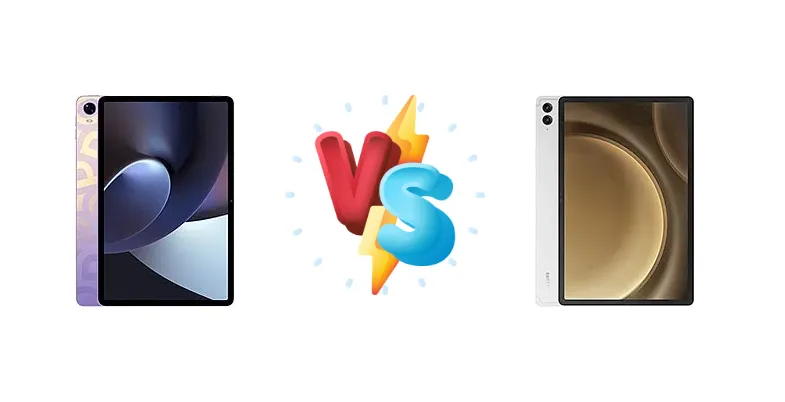
The mid-range Android tablet space is heating up. The Oppo Pad, leveraging the proven Snapdragon 870, faces off against Samsung’s newer Galaxy Tab S9 FE+, powered by the Exynos 1380. This comparison dissects the core differences, helping you determine which tablet best suits your needs – raw power or optimized charging and ecosystem integration.
🏆 Quick Verdict
For the average user prioritizing fast charging and Samsung’s feature-rich One UI, the Galaxy Tab S9 FE+ is the better choice. However, the Oppo Pad’s Snapdragon 870 delivers a performance edge, making it ideal for demanding tasks and gaming, especially if you value sustained performance over rapid top-ups.
| Network |
|---|
| 2G bands | N/A | GSM 850 / 900 / 1800 / 1900 |
| 3G bands | N/A | HSDPA 850 / 900 / 1700(AWS) / 1900 / 2100 |
| 4G bands | N/A | 1, 2, 3, 4, 5, 7, 8, 12, 13, 17, 20, 26, 28, 32, 38, 40, 41, 66 |
| 5G bands | - | 1, 3, 5, 7, 8, 20, 28, 38, 40, 41, 66, 77, 78 SA/NSA/Sub6 |
| EDGE | No | - |
| GPRS | No | - |
| Speed | - | HSPA, LTE, 5G - cellular model only |
| Technology | No cellular connectivity | GSM / HSPA / LTE / 5G |
| Launch |
|---|
| Announced | 2022, February 24 | 2023, October 04 |
| Status | Available. Released 2022, March 03 | Available. Released 2023, October 16 |
| Body |
|---|
| Build | - | Glass front, aluminum back, aluminum frame |
| Dimensions | 252.2 x 163.8 x 7.1 mm (9.93 x 6.45 x 0.28 in) | 285.4 x 185.4 x 6.5 mm (11.24 x 7.30 x 0.26 in) |
| SIM | No | Nano-SIM + eSIM (cellular model only) |
| Weight | 507 g / 510 g (1.12 lb) | 627 g or 628 g (1.38 lb) |
| Display |
|---|
| Resolution | 1600 x 2560 pixels, 16:10 ratio (~274 ppi density) | 1600 x 2560 pixels, 16:10 ratio (~243 ppi density) |
| Size | 11.0 inches, 350.9 cm2 (~84.9% screen-to-body ratio) | 12.4 inches, 445.8 cm2 (~84.3% screen-to-body ratio) |
| Type | IPS LCD, 120Hz, 480 nits | IPS LCD, 90Hz |
| Platform |
|---|
| CPU | Octa-core (1x3.2 GHz Kryo 585 & 3x2.42 GHz Kryo 585 & 4x1.80 GHz Kryo 585) | Octa-core (4x2.4 GHz Cortex-A78 & 4x2.0 GHz Cortex-A55) |
| Chipset | Qualcomm SM8250-AC Snapdragon 870 5G (7 nm) | Exynos 1380 (5 nm) |
| GPU | Adreno 650 | Mali-G68 MP5 |
| OS | Android 11, ColorOS 12 | Android 13, up to 4 major Android upgrades, One UI 6 |
| Memory |
|---|
| Card slot | No | microSDXC (dedicated slot) |
| Internal | 128GB 6GB RAM, 256GB 6GB RAM, 256GB 8GB RAM | 128GB 6GB RAM, 128GB 8GB RAM, 256GB 8GB RAM, 256GB 12GB RAM |
| | UFS 3.1 | - |
| Main Camera |
|---|
| Dual | - | 8 MP, (wide)
8 MP, (ultrawide) |
| Features | LED flash, panorama | - |
| Single | 13 MP, f/2.2, 26mm (wide), AF | - |
| Video | 1080p@30fps | 4K@30fps, 1080p@30fps |
| Selfie camera |
|---|
| Single | 8 MP, f/2.0, 27mm (wide) | 12 MP, (ultrawide) |
| Video | 1080p@30fps | Yes |
| Sound |
|---|
| 3.5mm jack | No | - |
| 35mm jack | No | No |
| Loudspeaker | Yes, with stereo speakers | Yes, with stereo speakers |
| Comms |
|---|
| Bluetooth | 5.1, A2DP, LE, aptX HD | 5.3, A2DP, LE |
| NFC | No | No |
| Positioning | No | GPS, GALILEO, GLONASS, BDS, QZSS - cellular model only |
| Radio | No | No |
| USB | USB Type-C 2.0, OTG | USB Type-C 2.0, magnetic connector |
| WLAN | Wi-Fi 802.11 a/b/g/n/ac/6, dual-band, Wi-Fi Direct | Wi-Fi 802.11 a/b/g/n/ac/6, dual-band, Wi-Fi Direct |
| Features |
|---|
| Sensors | Accelerometer, gyro, proximity | Fingerprint (side-mounted), accelerometer, gyro, compass, proximity (accessories only) |
| Battery |
|---|
| Charging | 33W wired, PD
5W reverse wired | 45W wired, QC2.0 |
| Type | Li-Po 8360 mAh | Li-Po 10090 mAh |
| Misc |
|---|
| Colors | Black, Silver, Purple | Mint, Silver, Gray, Lavender |
| Models | OPD2101 | SM-X610, SM-X616B |
| Price | About 310 EUR | About 770 EUR |
| SAR | - | 0.77 W/kg (body) |
| SAR EU | - | 0.50 W/kg (body) |
Oppo Pad
- Stronger CPU and GPU performance with Snapdragon 870
- Established processor with proven reliability
- 5W Reverse Wired Charging for accessory top-ups
- Slower 33W charging compared to the S9 FE+
- Potentially less optimized software experience
Samsung Galaxy Tab S9 FE+
- Faster 45W charging with QC2.0
- Seamless integration with Samsung ecosystem
- Modern software experience with One UI and guaranteed updates
- Less powerful processor compared to Snapdragon 870
- Potential for thermal throttling under sustained load
Display Comparison
Neither device’s display specifications are provided, so we must infer. Given the price points, both likely utilize IPS LCD panels. However, Samsung typically employs higher-quality panels with better color accuracy and viewing angles. The S9 FE+’s larger size (12.4” vs the Oppo Pad’s 11”) offers a more immersive experience. While neither is expected to have LTPO, Samsung’s display technology generally offers superior brightness and outdoor visibility. Bezels are likely comparable, focusing on cost optimization in this segment.
Camera Comparison
Camera performance is unlikely to be a deciding factor for most tablet buyers. Both devices likely feature modest camera setups. Without specific sensor details, it’s difficult to make a definitive comparison. However, Samsung generally prioritizes camera quality even in its mid-range devices, potentially offering slightly better image processing and detail. The Oppo Pad’s camera is likely adequate for basic video calls and document scanning, but not a primary reason to purchase.
Performance
The core difference lies in the chipsets. The Oppo Pad’s Snapdragon 870 5G (7nm) is a mature, well-regarded processor known for its balance of power and efficiency. Its octa-core configuration (1x3.2 GHz Kryo 585, 3x2.42 GHz Kryo 585, 4x1.80 GHz Kryo 585) provides strong multi-core performance. The Samsung Galaxy Tab S9 FE+ utilizes the Exynos 1380 (5nm). While the 5nm process *should* offer better efficiency, the Exynos 1380’s CPU configuration (4x2.4 GHz Cortex-A78 & 4x2.0 GHz Cortex-A55) is architecturally less advanced than the Snapdragon 870’s Kryo cores. This translates to a potential performance deficit in CPU-intensive tasks. The Snapdragon 870’s Adreno 660 GPU is also likely to outperform the Exynos 1380’s GPU, offering a smoother gaming experience. The Oppo Pad’s LPDDR5 RAM (speculation based on market segment) will further enhance performance.
Battery Life
Battery capacity is not specified for either device. However, the charging speeds are a key differentiator. The Samsung Galaxy Tab S9 FE+ supports 45W wired charging with QC2.0, significantly faster than the Oppo Pad’s 33W wired charging with PD. This means the S9 FE+ will reach a full charge much quicker. The Oppo Pad does offer 5W reverse wired charging, a useful feature for topping up accessories, but the S9 FE+ lacks this functionality. The Exynos 1380’s 5nm process *could* lead to slightly better battery life under light workloads, but the Snapdragon 870’s efficiency optimizations might close the gap during demanding tasks.
Buying Guide
Buy the Oppo Pad if you need a tablet capable of handling demanding applications, extended gaming sessions, and benefit from the Snapdragon 870’s established performance profile. Buy the Samsung Galaxy Tab S9 FE+ if you prioritize faster charging speeds, seamless integration with the Samsung ecosystem, and a more modern software experience with guaranteed updates.
Frequently Asked Questions
❓ Does the Exynos 1380 in the Galaxy Tab S9 FE+ overheat during prolonged gaming sessions?
While the Exynos 1380 is a capable chip, it's known to exhibit some thermal throttling under sustained heavy loads. The Tab S9 FE+'s larger chassis helps dissipate heat, but demanding games may experience frame drops after extended play. The Oppo Pad’s Snapdragon 870, with its more efficient architecture, is likely to maintain higher sustained performance.
❓ Is the 5W reverse wired charging on the Oppo Pad useful in real-world scenarios?
Yes, the 5W reverse wired charging is a convenient feature for topping up accessories like wireless earbuds or a smartwatch when you're away from a power outlet. While slow, it can provide a crucial boost in emergencies. The Samsung Galaxy Tab S9 FE+ lacks this functionality.
❓ How does the software experience differ between Oppo’s ColorOS and Samsung’s One UI on these tablets?
Samsung’s One UI is generally considered more polished and feature-rich, with a stronger emphasis on multitasking and productivity features optimized for larger screens. Oppo’s ColorOS, while improving, can sometimes feel less refined and may include more pre-installed bloatware. Samsung also offers longer software support commitments.