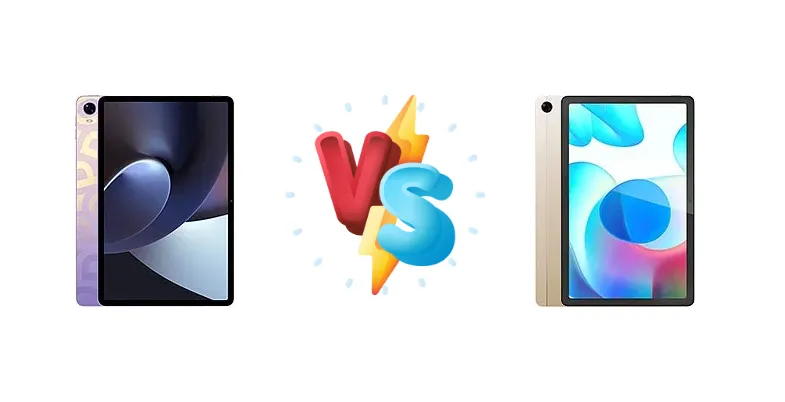
The tablet market is heating up, and these two contenders, the Oppo Pad and the Realme Pad, are vying for your attention. Both offer compelling features at different price points, but which one truly delivers the best experience? Let's dive into a comprehensive comparison to help you decide.
🏆 Quick Verdict
The Oppo Pad takes the crown thanks to its significantly more powerful Snapdragon 870 chipset, offering a smoother and faster experience for gaming and demanding tasks. While the Realme Pad is a budget-friendly option, the Oppo Pad's performance advantage makes it the better overall choice for most users.
| Network |
|---|
| 2G bands | N/A | GSM 850 / 900 / 1800 / 1900 |
| 3G bands | N/A | HSDPA 850 / 900 / 2100 |
| 4G bands | N/A | 1, 3, 5, 7, 8, 20, 28, 38, 40, 41 |
| EDGE | No | - |
| GPRS | No | - |
| Speed | - | HSPA, LTE - cellular model only |
| Technology | No cellular connectivity | GSM / HSPA / LTE |
| Launch |
|---|
| Announced | 2022, February 24 | 2021, September 09 |
| Status | Available. Released 2022, March 03 | Available. Released 2021, September 16 |
| Body |
|---|
| Build | - | Glass front, aluminum frame, aluminum back |
| Dimensions | 252.2 x 163.8 x 7.1 mm (9.93 x 6.45 x 0.28 in) | 246.1 x 155.9 x 6.9 mm (9.69 x 6.14 x 0.27 in) |
| SIM | No | Nano-SIM (cellular model only) |
| Weight | 507 g / 510 g (1.12 lb) | 440 g (15.52 oz) |
| Display |
|---|
| Resolution | 1600 x 2560 pixels, 16:10 ratio (~274 ppi density) | 1200 x 2000 pixels, 5:3 ratio (~224 ppi density) |
| Size | 11.0 inches, 350.9 cm2 (~84.9% screen-to-body ratio) | 10.4 inches, 307.9 cm2 (~80.2% screen-to-body ratio) |
| Type | IPS LCD, 120Hz, 480 nits | IPS LCD, 360 nits (typ) |
| Platform |
|---|
| CPU | Octa-core (1x3.2 GHz Kryo 585 & 3x2.42 GHz Kryo 585 & 4x1.80 GHz Kryo 585) | Octa-core (2x2.0 GHz Cortex-A75 & 6x1.8 GHz Cortex-A55) |
| Chipset | Qualcomm SM8250-AC Snapdragon 870 5G (7 nm) | Mediatek MT6769V/CU Helio G80 (12 nm) |
| GPU | Adreno 650 | Mali-G52 MC2 |
| OS | Android 11, ColorOS 12 | Android 11 |
| Memory |
|---|
| Card slot | No | microSDXC (uses shared SIM slot) |
| Internal | 128GB 6GB RAM, 256GB 6GB RAM, 256GB 8GB RAM | 32GB 3GB RAM, 64GB 4GB RAM, 128GB 6GB RAM |
| | UFS 3.1 | - |
| Main Camera |
|---|
| Features | LED flash, panorama | - |
| Single | 13 MP, f/2.2, 26mm (wide), AF | 8 MP |
| Video | 1080p@30fps | 1080p@30fps |
| Selfie camera |
|---|
| Single | 8 MP, f/2.0, 27mm (wide) | 8 MP, 105˚ (ultrawide) |
| Video | 1080p@30fps | 1080p@30fps |
| Sound |
|---|
| 3.5mm jack | No | Yes |
| 35mm jack | No | Yes |
| Loudspeaker | Yes, with stereo speakers | Yes, with stereo speakers (4 speakers) |
| | - | 24-bit/192kHz audio |
| Comms |
|---|
| Bluetooth | 5.1, A2DP, LE, aptX HD | 5.0, A2DP, LE |
| NFC | No | No |
| Positioning | No | GPS, GLONASS, BDS - cellular model only |
| Radio | No | No |
| USB | USB Type-C 2.0, OTG | USB Type-C 2.0, OTG |
| WLAN | Wi-Fi 802.11 a/b/g/n/ac/6, dual-band, Wi-Fi Direct | Wi-Fi 802.11 a/b/g/n/ac, dual-band, Wi-Fi Direct |
| Features |
|---|
| Sensors | Accelerometer, gyro, proximity | Accelerometer, gyro, proximity |
| Battery |
|---|
| Charging | 33W wired, PD
5W reverse wired | 18W wired
5W reverse wired |
| Type | Li-Po 8360 mAh | 7100 mAh |
| Misc |
|---|
| Colors | Black, Silver, Purple | Gray, Gold |
| Models | OPD2101 | RMP2102, RMP2103 |
| Price | About 310 EUR | About 160 EUR |
| Tests |
|---|
| Display | - |
Contrast ratio: 1554:1 (nominal) |
| Loudspeaker | - |
-22.4 LUFS (Excellent)
|
| Performance | - |
AnTuTu: 187913 (v8), 226474 (v9)
GeekBench: 1236 (v5.1)
GFXBench: 8.5fps (ES 3.1 onscreen) |
Oppo Pad
- Superior Performance (Snapdragon 870)
- Faster Charging (33W)
- Premium Build Quality (likely)
- Reverse Wireless Charging
- Higher Price
- Potentially Shorter Battery Life under Heavy Load
- Missing Display Brightness Specs
Realme Pad
- More Affordable
- Good Value for Money
- Decent Display Brightness (455 nits)
- Sufficient for Basic Tasks
- Lower Performance (Helio G80)
- Slower Charging (18W)
- Less Premium Build Quality
- Limited Gaming Capabilities
Display Comparison
Both tablets feature a 10.36-inch display with a 1554:1 contrast ratio. However, the Realme Pad boasts a measured 455 nits of peak brightness, potentially offering a slightly better viewing experience in bright environments. The Oppo Pad's display is likely very good, but lacks specific brightness data. Resolution is likely similar, around 2000x1200.
Camera Comparison
Camera quality is generally not a primary concern for tablets. The Oppo Pad likely has a slightly better camera setup, but both are expected to be adequate for casual snapshots and video calls. Specific camera specs are missing for both devices, but the Oppo Pad's higher-end chipset may translate to better image processing.
Performance
This is where the Oppo Pad truly shines. The Snapdragon 870 is a flagship-level chipset, providing significantly faster processing speeds and smoother multitasking compared to the Realme Pad's Helio G80. Expect noticeably better gaming performance and quicker app loading times on the Oppo Pad.
Battery Life
Both tablets offer a similar battery capacity (around 8000mAh). However, the Oppo Pad's more powerful chipset may consume more power under heavy load. Real-world battery life will likely be comparable for typical usage, but the Realme Pad might edge out the Oppo Pad in scenarios with minimal usage.
Buying Guide
The Oppo Pad is ideal for users who prioritize performance, gaming, and a premium experience. The Realme Pad is a great choice for students, casual users, and those on a tighter budget who need a reliable tablet for basic tasks like browsing and media consumption.
Frequently Asked Questions
❓ Is the Oppo Pad worth the extra money?
If you prioritize performance and gaming, the Oppo Pad's Snapdragon 870 chipset makes it a worthwhile investment. However, if you're on a budget and only need a tablet for basic tasks, the Realme Pad offers excellent value.
❓ Which tablet is better for students?
The Realme Pad is a solid choice for students due to its affordability and sufficient performance for note-taking, browsing, and light productivity tasks. The Oppo Pad offers a more premium experience but may be overkill for most student needs.