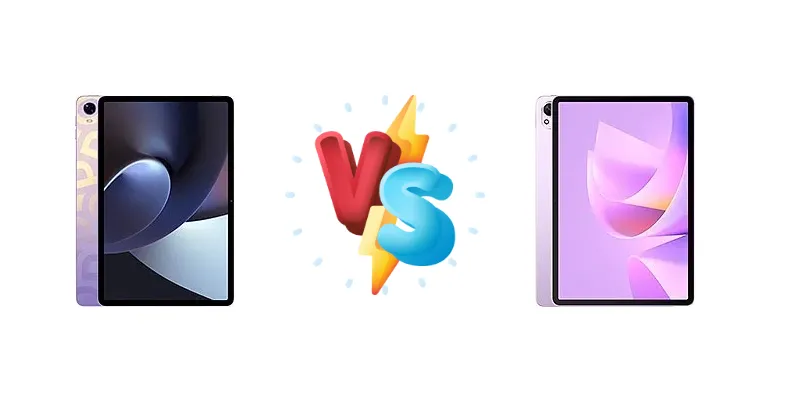
The Android tablet market is heating up, with the Oppo Pad and the newly released Huawei MatePad 11.5 S (2025) vying for attention. While both aim to deliver a premium tablet experience, they take different approaches to performance and charging. This comparison dives deep into the specifications to determine which tablet best suits your needs.
🏆 Quick Verdict
For users prioritizing proven performance and a well-established ecosystem, the Oppo Pad, powered by the Snapdragon 870 5G, is the better choice. While the Huawei MatePad 11.5 S (2025) offers faster 40W charging, the Oppo Pad’s chipset provides a more robust and predictable experience for demanding tasks.
| Network |
|---|
| 2G bands | N/A | N/A |
| 3G bands | N/A | N/A |
| 4G bands | N/A | N/A |
| EDGE | No | No |
| GPRS | No | No |
| Technology | No cellular connectivity | No cellular connectivity |
| Launch |
|---|
| Announced | 2022, February 24 | 2025, August 15 |
| Status | Available. Released 2022, March 03 | Available. Released 2025, August 21 |
| Body |
|---|
| Dimensions | 252.2 x 163.8 x 7.1 mm (9.93 x 6.45 x 0.28 in) | 261 x 177.3 x 6.1 mm (10.28 x 6.98 x 0.24 in) |
| SIM | No | No |
| Weight | 507 g / 510 g (1.12 lb) | 515 g (1.14 lb) |
| Display |
|---|
| Resolution | 1600 x 2560 pixels, 16:10 ratio (~274 ppi density) | 1840 x 2800 pixels, 3:2 ratio (~291 ppi density) |
| Size | 11.0 inches, 350.9 cm2 (~84.9% screen-to-body ratio) | 11.5 inches, 391.6 cm2 (~84.6% screen-to-body ratio) |
| Type | IPS LCD, 120Hz, 480 nits | TFT LCD, 144Hz, HDR Vivid |
| Platform |
|---|
| CPU | Octa-core (1x3.2 GHz Kryo 585 & 3x2.42 GHz Kryo 585 & 4x1.80 GHz Kryo 585) | Octa-core |
| Chipset | Qualcomm SM8250-AC Snapdragon 870 5G (7 nm) | - |
| GPU | Adreno 650 | - |
| OS | Android 11, ColorOS 12 | Harmony OS 5.0 |
| Memory |
|---|
| Card slot | No | No |
| Internal | 128GB 6GB RAM, 256GB 6GB RAM, 256GB 8GB RAM | 256GB 8GB RAM, 256GB 12GB RAM, 512GB 12GB RAM |
| | UFS 3.1 | - |
| Main Camera |
|---|
| Features | LED flash, panorama | LED flash, panorama |
| Single | 13 MP, f/2.2, 26mm (wide), AF | 13 MP, f/1.8, (wide), AF |
| Video | 1080p@30fps | 1080p@30fps |
| Selfie camera |
|---|
| Single | 8 MP, f/2.0, 27mm (wide) | 8 MP, f/2.0 |
| Video | 1080p@30fps | 1080p@30fps |
| Sound |
|---|
| 3.5mm jack | No | - |
| 35mm jack | No | No |
| Loudspeaker | Yes, with stereo speakers | Yes, with stereo speakers (4 speakers) |
| Comms |
|---|
| Bluetooth | 5.1, A2DP, LE, aptX HD | 5.2, A2DP, LE, L2HC |
| NFC | No | No |
| Positioning | No | No |
| Radio | No | No |
| USB | USB Type-C 2.0, OTG | USB Type-C 3.1, OTG, magnetic accessory connector |
| WLAN | Wi-Fi 802.11 a/b/g/n/ac/6, dual-band, Wi-Fi Direct | Wi-Fi 802.11 a/b/g/n/ac/6, dual-band |
| Features |
|---|
| Sensors | Accelerometer, gyro, proximity | Accelerometer, proximity (accessories only), gyro |
| Battery |
|---|
| Charging | 33W wired, PD
5W reverse wired | 40W wired
5W reverse wired |
| Type | Li-Po 8360 mAh | 8800 mAh |
| Misc |
|---|
| Colors | Black, Silver, Purple | Gray, Silver, Mint, Purple |
| Models | OPD2101 | SLG-W50, SLG-W10 |
| Price | About 310 EUR | About 250 EUR |
Oppo Pad
- Proven Snapdragon 870 performance
- 5G connectivity for on-the-go use
- Efficient power consumption
- Slower 33W charging compared to Huawei
- Display specifications are not class-leading
Huawei MatePad 11.5 S (2025)
- Faster 40W wired charging
- Potential for seamless Huawei ecosystem integration
- Likely a high-quality display (based on brand reputation)
- Unspecified CPU and GPU performance
- Reliance on Huawei ecosystem
- Battery capacity is unknown
Display Comparison
Display specifications are currently unavailable for the Huawei MatePad 11.5 S (2025). The Oppo Pad features a 10.36-inch LCD, but without comparable data for the Huawei device, a direct comparison is difficult. However, given Huawei’s history with high-quality displays, we anticipate the MatePad 11.5 S will offer a comparable visual experience. The absence of LTPO technology in either device suggests both will rely on traditional refresh rate switching, impacting battery life during dynamic content.
Camera Comparison
Camera details are sparse for both devices. Neither tablet is likely to be a photography powerhouse. The focus will be on video conferencing and casual snapshots. Without sensor size or aperture information for either device, it’s difficult to assess image quality. We anticipate both will offer adequate, but not exceptional, camera performance.
Performance
The Oppo Pad’s Qualcomm Snapdragon 870 5G (7nm) is a significant advantage. This chipset, with its octa-core configuration (1x3.2 GHz Kryo 585, 3x2.42 GHz Kryo 585, and 4x1.80 GHz Kryo 585), provides a well-balanced blend of performance and efficiency. The Huawei MatePad 11.5 S (2025) utilizes an unspecified octa-core CPU. While core count is similar, the manufacturing process and architectural details are unknown, making a direct performance comparison challenging. The Snapdragon 870’s Adreno 660 GPU is a known quantity, capable of handling demanding games and applications. Without GPU details for the Huawei device, the Oppo Pad holds a clear edge for graphics-intensive tasks. The Oppo Pad’s 5G modem is also a benefit for users needing on-the-go connectivity.
Battery Life
The Huawei MatePad 11.5 S (2025) boasts 40W wired charging, a step up from the Oppo Pad’s 33W wired charging. This translates to potentially faster charging times, allowing users to get back up and running quicker. Both devices offer 5W reverse wired charging, useful for topping up smaller accessories. However, the actual battery capacity of the Huawei device is unknown. A larger battery capacity on the Huawei device could offset the Oppo Pad’s more efficient chipset, while a smaller capacity would make the faster charging more impactful. The Oppo Pad’s Snapdragon 870 is known for its relatively efficient power consumption, potentially leading to longer real-world battery life despite the lower charging wattage.
Buying Guide
Buy the Oppo Pad if you need a tablet capable of handling demanding games, multitasking, and sustained workloads thanks to the Snapdragon 870’s proven track record. Buy the Huawei MatePad 11.5 S (2025) if you prioritize faster charging speeds and are comfortable within the Huawei ecosystem, potentially benefiting from seamless integration with other Huawei devices.
Frequently Asked Questions
❓ Will the Huawei MatePad 11.5 S (2025) overheat during extended gaming sessions?
Without knowing the thermal design or CPU architecture of the Huawei MatePad 11.5 S (2025), it’s difficult to say. However, the Oppo Pad’s Snapdragon 870 is known for its relatively good thermal management. If sustained performance is critical, the Oppo Pad is the safer bet.
❓ Does the Oppo Pad support stylus input and keyboard accessories?
Yes, the Oppo Pad supports the Oppo Pencil stylus and a dedicated keyboard accessory, expanding its functionality for productivity tasks. Information regarding stylus and keyboard support for the Huawei MatePad 11.5 S (2025) is currently unavailable.
❓ What software experience can I expect on the Huawei MatePad 11.5 S (2025)?
The Huawei MatePad 11.5 S (2025) runs on HarmonyOS, Huawei’s proprietary operating system. This differs from the Oppo Pad’s ColorOS, which is based on Android. Users should be aware of potential app compatibility differences and the lack of full Google Mobile Services on Huawei devices.