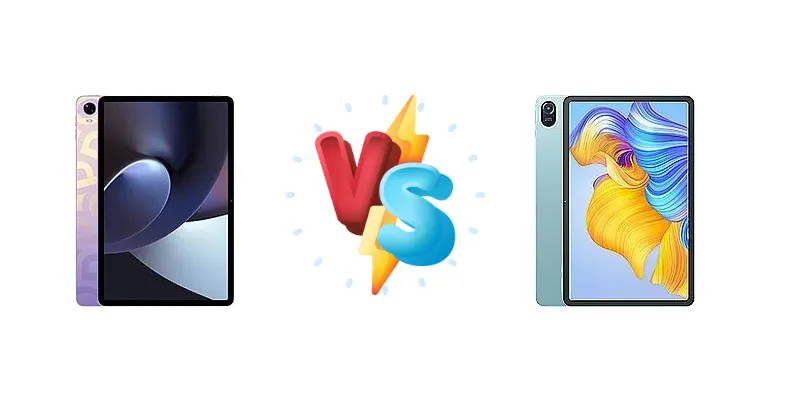
The Android tablet market is heating up, with the Oppo Pad and Honor Pad 8 offering compelling options at different price points. While both aim to deliver a versatile tablet experience, they diverge significantly in their core hardware. This comparison dissects the key differences, focusing on performance, display, and charging to determine which tablet best suits your needs.
🏆 Quick Verdict
For users prioritizing performance and future-proofing, the Oppo Pad is the clear winner. Its Snapdragon 870 5G chipset provides a substantial performance advantage over the Honor Pad 8’s Snapdragon 680. However, the Honor Pad 8 offers a respectable experience for everyday tasks at a potentially lower price.
| Network |
|---|
| 2G bands | N/A | N/A |
| 3G bands | N/A | N/A |
| 4G bands | N/A | N/A |
| EDGE | No | No |
| GPRS | No | No |
| Technology | No cellular connectivity | No cellular connectivity |
| Launch |
|---|
| Announced | 2022, February 24 | 2022, July 22 |
| Status | Available. Released 2022, March 03 | Available. Released 2022, July 29 |
| Body |
|---|
| Build | - | Glass front, aluminum frame, aluminum back |
| Dimensions | 252.2 x 163.8 x 7.1 mm (9.93 x 6.45 x 0.28 in) | 278.5 x 174.1 x 6.9 mm (10.96 x 6.85 x 0.27 in) |
| SIM | No | No |
| Weight | 507 g / 510 g (1.12 lb) | 520 g (1.15 lb) |
| | - | Stylus support |
| Display |
|---|
| Resolution | 1600 x 2560 pixels, 16:10 ratio (~274 ppi density) | 1200 x 2000 pixels, 5:3 ratio (~194 ppi density) |
| Size | 11.0 inches, 350.9 cm2 (~84.9% screen-to-body ratio) | 12.0 inches, 409.9 cm2 (~84.5% screen-to-body ratio) |
| Type | IPS LCD, 120Hz, 480 nits | IPS LCD, 1B colors, 350 nits (typ) |
| Platform |
|---|
| CPU | Octa-core (1x3.2 GHz Kryo 585 & 3x2.42 GHz Kryo 585 & 4x1.80 GHz Kryo 585) | Octa-core (4x2.4 GHz Kryo 265 Gold & 4x1.9 GHz Kryo 265 Silver) |
| Chipset | Qualcomm SM8250-AC Snapdragon 870 5G (7 nm) | Qualcomm SM6225 Snapdragon 680 4G (6 nm) |
| GPU | Adreno 650 | Adreno 610 |
| OS | Android 11, ColorOS 12 | Android 12, Magic UI 6.1 |
| Memory |
|---|
| Card slot | No | No |
| Internal | 128GB 6GB RAM, 256GB 6GB RAM, 256GB 8GB RAM | 128GB 4GB RAM, 128GB 6GB RAM, 256GB 8GB RAM |
| | UFS 3.1 | - |
| Main Camera |
|---|
| Features | LED flash, panorama | LED flash |
| Single | 13 MP, f/2.2, 26mm (wide), AF | 5 MP, f/2.2, 27mm (wide), 1/5.0", 1.12µm, AF |
| Video | 1080p@30fps | 1080p@30fps |
| Selfie camera |
|---|
| Single | 8 MP, f/2.0, 27mm (wide) | 5 MP, f/2.2, 27mm (wide), 1/5.0", 1.12µm |
| Video | 1080p@30fps | 1080p@30fps |
| Sound |
|---|
| 3.5mm jack | No | No |
| 35mm jack | No | No |
| Loudspeaker | Yes, with stereo speakers | Yes, with stereo speakers (8 speakers) |
| Comms |
|---|
| Bluetooth | 5.1, A2DP, LE, aptX HD | 5.1, A2DP, LE |
| NFC | No | No |
| Positioning | No | No |
| Radio | No | No |
| USB | USB Type-C 2.0, OTG | USB Type-C, OTG |
| WLAN | Wi-Fi 802.11 a/b/g/n/ac/6, dual-band, Wi-Fi Direct | Wi-Fi 802.11 a/b/g/n/ac, dual-band |
| Features |
|---|
| Sensors | Accelerometer, gyro, proximity | Accelerometer |
| Battery |
|---|
| Charging | 33W wired, PD
5W reverse wired | 22.5W wired |
| Type | Li-Po 8360 mAh | Li-Po 7250 mAh |
| Misc |
|---|
| Colors | Black, Silver, Purple | Dark Blue, Gold, Mint |
| Models | OPD2101 | HEY-W09 |
| Price | About 310 EUR | About 330 EUR |
| Tests |
|---|
| Display | - |
Contrast ratio: 1468:1 (nominal) |
| Loudspeaker | - |
-22.7 LUFS (Excellent)
|
| Performance | - |
AnTuTu: 279242 (v9)
GeekBench: 1545 (v5.1)
GFXBench: 7.3fps (ES 3.1 onscreen) |
Oppo Pad
- Significantly faster processor (Snapdragon 870)
- 5G connectivity for faster data speeds
- Faster 33W charging with PD support
- Potential for better image processing
- Display specifications currently unknown
- Potentially higher price
Honor Pad 8
- Decent display brightness (392 nits)
- Potentially lower price point
- More power-efficient chipset (Snapdragon 680)
- Acceptable contrast ratio (1468:1)
- Significantly slower processor (Snapdragon 680)
- Slower 22.5W charging
- Lacks 5G connectivity
- Limited performance for demanding tasks
Display Comparison
The Honor Pad 8 boasts a measured peak brightness of 392 nits and a 1468:1 contrast ratio, providing a visually acceptable experience for everyday use. However, the Oppo Pad’s display specifications are currently unavailable, leaving a gap in direct comparison. Given Oppo’s typical display quality, it’s reasonable to expect a comparable or superior panel. The Honor Pad 8’s contrast ratio, while decent, doesn’t indicate advanced display technology like OLED or mini-LED. The lack of refresh rate information for both tablets suggests standard 60Hz panels, impacting smoothness during scrolling and gaming.
Camera Comparison
Neither tablet is positioned as a photography powerhouse, and detailed camera specifications are lacking. Without sensor size or aperture information, a meaningful comparison is difficult. It’s safe to assume both tablets feature basic camera setups suitable for video calls and casual snapshots. Focusing on the chipsets, the Oppo Pad’s ISP (Image Signal Processor) within the Snapdragon 870 will likely offer superior image processing capabilities compared to the Snapdragon 680 in the Honor Pad 8, potentially resulting in better image quality in challenging lighting conditions.
Performance
The performance disparity is the most significant difference between these tablets. The Oppo Pad’s Qualcomm Snapdragon 870 5G (7nm) is a flagship-level chipset featuring an octa-core CPU with a prime core clocked at 3.2 GHz. This contrasts sharply with the Honor Pad 8’s Snapdragon 680 4G (6nm). The Snapdragon 680, while more efficient due to its 6nm process, utilizes Kryo 265 cores clocked at 2.4 GHz, resulting in considerably lower CPU and GPU performance. The 7nm Snapdragon 870 offers a substantial uplift in graphics processing, making the Oppo Pad far more capable for gaming and graphically intensive applications. The Oppo Pad’s 5G connectivity is another advantage, offering faster data speeds where available.
Battery Life
The Oppo Pad supports 33W wired charging with PD (Power Delivery) and 5W reverse wired charging, offering relatively fast charging speeds and the convenience of charging other devices. The Honor Pad 8 is limited to 22.5W wired charging. While battery capacity isn’t specified for either device, the faster charging of the Oppo Pad mitigates the impact of a potentially smaller battery. The Oppo Pad’s PD support also ensures compatibility with a wider range of chargers.
Buying Guide
Buy the Oppo Pad if you need a tablet capable of handling demanding tasks like gaming, video editing, or multitasking. Its superior processing power and 5G connectivity make it ideal for power users. Buy the Honor Pad 8 if you prioritize portability, a decent display for media consumption, and a lower price point for basic tasks like browsing, streaming, and light productivity.
Frequently Asked Questions
❓ Will the Snapdragon 680 in the Honor Pad 8 struggle with graphically intensive games like Genshin Impact?
Yes, the Snapdragon 680 is a mid-range chipset and will likely struggle to deliver a smooth gaming experience in demanding titles like Genshin Impact. Expect lower frame rates and the need to reduce graphics settings significantly. The Oppo Pad’s Snapdragon 870 is far better suited for gaming.
❓ Does the Oppo Pad support external displays or desktop mode functionality?
While not explicitly stated, the Snapdragon 870 chipset often supports external display output and potentially desktop mode functionality. However, this depends on Oppo’s software implementation. Check Oppo’s official documentation for confirmation.
❓ Is the 22.5W charging on the Honor Pad 8 slow compared to other tablets?
22.5W is relatively slow compared to the 33W charging on the Oppo Pad and some other tablets in this price range. Expect a longer charging time from 0-100%, potentially taking over 2 hours. It's sufficient for overnight charging but less convenient for quick top-ups.
❓ What type of storage does the Honor Pad 8 use, and is it expandable?
Storage type and expandability are not specified. However, many tablets in this segment utilize UFS 2.2 storage. Expandability via microSD card is common but not guaranteed; check the official specifications for confirmation.