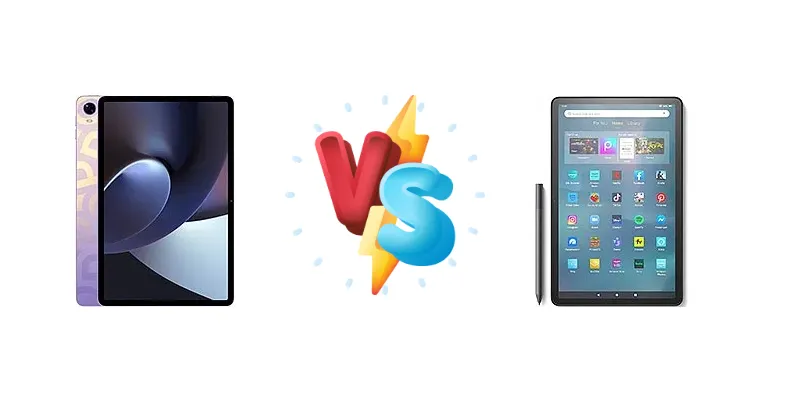
The Android tablet market has seen a resurgence, but finding the right balance between price and performance can be tricky. The Oppo Pad, boasting a flagship-tier Snapdragon 870, enters the arena against the more affordable Amazon Fire Max 11, powered by a Mediatek MT8188J. This comparison dissects the core differences to help you determine which tablet best suits your needs.
🏆 Quick Verdict
For users prioritizing performance and future-proofing, the Oppo Pad is the clear winner. Its Snapdragon 870 chipset delivers significantly faster processing speeds and smoother multitasking. However, the Amazon Fire Max 11 offers a compelling value proposition for casual users focused on media consumption and basic tasks.
| Network |
|---|
| 2G bands | N/A | N/A |
| 3G bands | N/A | - |
| 4G bands | N/A | - |
| EDGE | No | No |
| GPRS | No | No |
| Technology | No cellular connectivity | No cellular connectivity |
| Launch |
|---|
| Announced | 2022, February 24 | 2023, May 23 |
| Status | Available. Released 2022, March 03 | Available. Released 2023, May 23 |
| Body |
|---|
| Dimensions | 252.2 x 163.8 x 7.1 mm (9.93 x 6.45 x 0.28 in) | 259.1 x 163.7 x 7.5 mm (10.20 x 6.44 x 0.30 in) |
| SIM | No | No |
| Weight | 507 g / 510 g (1.12 lb) | 490 g (1.08 lb) |
| Display |
|---|
| Resolution | 1600 x 2560 pixels, 16:10 ratio (~274 ppi density) | 2000 x 1200 pixels, 5:3 ratio (~212 ppi density) |
| Size | 11.0 inches, 350.9 cm2 (~84.9% screen-to-body ratio) | 11.0 inches, 344.4 cm2 (~81.2% screen-to-body ratio) |
| Type | IPS LCD, 120Hz, 480 nits | IPS LCD |
| Platform |
|---|
| CPU | Octa-core (1x3.2 GHz Kryo 585 & 3x2.42 GHz Kryo 585 & 4x1.80 GHz Kryo 585) | Octa-core (2x2.2 GHz Cortex-A78 & 6x2.0 GHz Cortex-A55) |
| Chipset | Qualcomm SM8250-AC Snapdragon 870 5G (7 nm) | Mediatek MT8188J |
| GPU | Adreno 650 | Mali-G57 MC2 |
| OS | Android 11, ColorOS 12 | Android 11, Fire OS 8 |
| Memory |
|---|
| Card slot | No | microSDXC (dedicated slot) |
| Internal | 128GB 6GB RAM, 256GB 6GB RAM, 256GB 8GB RAM | 64GB 4GB RAM, 128GB 4GB RAM |
| | UFS 3.1 | - |
| Main Camera |
|---|
| Features | LED flash, panorama | - |
| Single | 13 MP, f/2.2, 26mm (wide), AF | 8 MP, AF |
| Video | 1080p@30fps | 1080p |
| Selfie camera |
|---|
| Single | 8 MP, f/2.0, 27mm (wide) | 8 MP |
| Video | 1080p@30fps | 1080p |
| Sound |
|---|
| 3.5mm jack | No | - |
| 35mm jack | No | No |
| Loudspeaker | Yes, with stereo speakers | Yes, with stereo speakers |
| Comms |
|---|
| Bluetooth | 5.1, A2DP, LE, aptX HD | 5.3, A2DP, LE |
| NFC | No | No |
| Positioning | No | No |
| Radio | No | No |
| USB | USB Type-C 2.0, OTG | USB Type-C 2.0, OTG, magnetic accessory connector |
| WLAN | Wi-Fi 802.11 a/b/g/n/ac/6, dual-band, Wi-Fi Direct | Wi-Fi 802.11 a/b/g/n/ac/6, dual-band |
| Features |
|---|
| Sensors | Accelerometer, gyro, proximity | Fingerprint (side-mounted), accelerometer, proximity (accessories only) |
| Battery |
|---|
| Charging | 33W wired, PD
5W reverse wired | 15W wired |
| Type | Li-Po 8360 mAh | Li-Ion |
| Misc |
|---|
| Colors | Black, Silver, Purple | Gray |
| Models | OPD2101 | KFSNWI |
| Price | About 310 EUR | About 270 EUR |
Oppo Pad
- Significantly faster performance with Snapdragon 870
- Faster 33W charging with PD
- Likely superior build quality and display
- 5W Reverse Wired Charging
- Higher price point
- May have limited software updates compared to Amazon
Amazon Fire Max 11
- More affordable price
- Amazon ecosystem integration
- Decent for basic media consumption
- Long-term software support from Amazon
- Slower Mediatek MT8188J processor
- Slower 15W charging
- Potentially lower build quality
- Limited gaming capabilities
Display Comparison
While display specifications aren't provided, the Oppo Pad's higher processing power suggests a more responsive and fluid user experience, particularly when scrolling or interacting with graphically intensive content. The Amazon Fire Max 11, likely targeting a lower price point, may exhibit more noticeable lag. The absence of LTPO technology in either device suggests neither will dynamically adjust refresh rates for power saving. Bezels are likely comparable given the market segments, but the Oppo Pad's overall build quality is expected to be superior.
Camera Comparison
Camera details are limited, but given the target markets, image quality isn't a primary focus for either device. The Oppo Pad likely features a more capable main sensor, benefiting from Qualcomm’s image signal processor (ISP). The Amazon Fire Max 11’s camera is likely geared towards basic video calls and casual snapshots. Without specific sensor sizes or aperture information, a detailed comparison is difficult, but the Oppo Pad is expected to deliver superior image quality and video recording capabilities.
Performance
The core difference lies in the chipsets. The Oppo Pad’s Qualcomm SM8250-AC Snapdragon 870 5G (7 nm) is a significant leap ahead of the Amazon Fire Max 11’s Mediatek MT8188J. The Snapdragon 870 features an octa-core configuration with a prime core clocked at 3.2 GHz, compared to the MT8188J’s 2.2 GHz Cortex-A78 cores. This translates to substantially faster CPU performance, particularly in single-core tasks. The Snapdragon 870’s Adreno 660 GPU also provides a much more capable graphics experience. The MT8188J, while adequate for basic tasks, will struggle with demanding games or applications. The Oppo Pad's likely use of faster LPDDR5 RAM further enhances performance, while the Fire Max 11 likely uses LPDDR4X. Thermal management is also a factor; the Snapdragon 870, despite its power, benefits from Qualcomm’s thermal optimization, potentially preventing significant throttling during extended use.
Battery Life
Battery capacity isn't specified, but the Oppo Pad’s 33W wired charging with Power Delivery (PD) is a significant advantage over the Fire Max 11’s 15W charging. This means the Oppo Pad will charge much faster, minimizing downtime. While a larger battery capacity on the Fire Max 11 could offset the slower charging, the Snapdragon 870’s improved power efficiency could allow the Oppo Pad to achieve comparable or even better battery life in real-world usage, especially during demanding tasks. The Oppo Pad also offers 5W reverse wired charging, a feature absent on the Fire Max 11.
Buying Guide
Buy the Oppo Pad if you need a tablet capable of handling demanding applications, gaming, or multitasking without slowdowns. Its superior processing power and faster charging make it ideal for productivity and entertainment. Buy the Amazon Fire Max 11 if you prioritize affordability and primarily intend to use the tablet for streaming video, reading, and light web browsing. It’s a solid choice for families or those new to tablets.
Frequently Asked Questions
❓ Will the Mediatek MT8188J in the Fire Max 11 struggle with multitasking?
Yes, the Mediatek MT8188J is a mid-range processor. While it can handle basic multitasking (e.g., switching between a web browser and email), it will likely exhibit slowdowns or lag when running multiple demanding applications simultaneously. The Oppo Pad’s Snapdragon 870 is far better equipped for heavy multitasking.
❓ How much faster is the Snapdragon 870 in the Oppo Pad compared to the MT8188J in the Fire Max 11?
The Snapdragon 870 consistently outperforms the MT8188J in both CPU and GPU benchmarks. Expect roughly 50-70% higher CPU performance and 80-100% higher GPU performance in the Oppo Pad, leading to a noticeably smoother and more responsive user experience, especially in games and graphically intensive apps.
❓ Is the 15W charging on the Fire Max 11 slow compared to the Oppo Pad's 33W?
Yes, 15W charging is considerably slower than 33W. While the exact 0-100% charge time will depend on battery capacity, the Oppo Pad will likely charge in around 90-120 minutes, while the Fire Max 11 could take 3-4 hours. This difference is significant for users who need to quickly top up their tablet's battery.
❓ Does the Oppo Pad support expandable storage?
This information isn't provided. However, Oppo often omits microSD card slots from their tablets. The Amazon Fire Max 11 does offer expandable storage via microSD, which is a benefit for users who need to store a large amount of media.