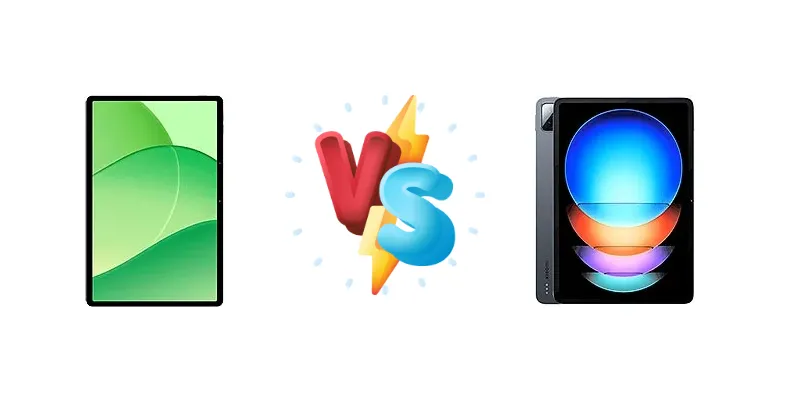
The Android tablet market is heating up, with options ranging from budget-friendly to premium. We're pitting the Oppo Pad SE, a value-focused device, against the Xiaomi Pad 6S Pro 12.4, a new contender boasting flagship-level performance. This comparison will dissect their key differences to help you determine which tablet best suits your workflow and entertainment needs.
🏆 Quick Verdict
For most users, the Xiaomi Pad 6S Pro 12.4 is the superior choice. Its Snapdragon 8 Gen 2 chipset delivers significantly faster performance, and the 120W charging is a game-changer. However, the Oppo Pad SE remains a compelling option for those prioritizing affordability and basic tablet functionality.
| Network |
|---|
| 2G bands | GSM 850 / 900 / 1800 / 1900 - cellular model only | N/A |
| 3G bands | HSDPA 2100 - cellular model only | N/A |
| 4G bands | LTE - cellular model only | - |
| EDGE | - | N/A |
| GPRS | - | N/A |
| Speed | LTE - cellular model only | - |
| Technology | GSM / HSPA / LTE | No cellular connectivity |
| Launch |
|---|
| Announced | 2025, May 15 | 2024, February 22 |
| Status | Available. Released 2025, May 23 | Available. Released 2024, February 22 |
| Body |
|---|
| Build | Glass front, aluminum frame, aluminum back | Glass front (Gorilla Glass 5), aluminum frame, aluminum back |
| Dimensions | 254.9 x 166.5 x 7.4 mm (10.04 x 6.56 x 0.29 in) | 278.7 x 191.6 x 6.3 mm (10.97 x 7.54 x 0.25 in) |
| SIM | Nano-SIM - cellular model only | No |
| Weight | 527 g or 530 g (1.16 lb) | 590 g (1.30 lb) |
| Display |
|---|
| Protection | - | Corning Gorilla Glass 5 |
| Resolution | 1200 x 1920 pixels, 16:10 ratio (~206 ppi density) | 2032 x 3048 pixels, 3:2 ratio (~295 ppi density) |
| Size | 11.0 inches, 350.9 cm2 (~82.7% screen-to-body ratio) | 12.4 inches, 457.8 cm2 (~85.7% screen-to-body ratio) |
| Type | IPS LCD, 1B colors, 90Hz, 500 nits (peak) | IPS LCD, 68B colors, 144Hz, HDR10, Dolby Vision, 900 nits (peak) |
| Platform |
|---|
| CPU | Octa-core (2x2.2 GHz Cortex-A76 & 6x2.0 GHz Cortex-A55) | Octa-core (1x3.2 GHz Cortex-X3 & 2x2.8 GHz Cortex-A715 & 2x2.8 GHz Cortex-A710 & 3x2.0 GHz Cortex-A510) |
| Chipset | Mediatek Helio G100 (6 nm) | Qualcomm SM8550-AB Snapdragon 8 Gen 2 (4 nm) |
| GPU | Mali-G57 MC2 | Adreno 740 |
| OS | Android 15, ColorOS 15 | Android 14, up to 3 major Android upgrades, HyperOS |
| Memory |
|---|
| Card slot | No | No |
| Internal | 128GB 4GB RAM, 128GB 6GB RAM, 128GB 8GB RAM, 256GB 8GB RAM | 256GB 8GB RAM, 256GB 12GB RAM, 512GB 12GB RAM, 1TB 16GB RAM |
| Main Camera |
|---|
| Dual | - | 50 MP, f/1.8, (wide), 1/2.76", 0.64µm, PDAF
Auxiliary lens |
| Features | Panorama | LED flash, HDR, panorama |
| Single | 5 MP, f/2.2, (wide), AF | - |
| Video | 1080p@30fps | 4K@30/60fps, 1080p@30/60fps |
| Selfie camera |
|---|
| Features | Panorama | - |
| Single | 5 MP, f/2.2, (wide) | 32 MP, f/2.2, (wide), 1/3.6", 0.61µm |
| Video | 1080p@30fps | 1080p@30fps |
| Sound |
|---|
| 35mm jack | No | No |
| Loudspeaker | Yes, with stereo speakers | Yes, with stereo speakers (6 speakers) |
| Comms |
|---|
| Bluetooth | 5.4, A2DP, LE | 5.3, A2DP, LE, LHDC |
| NFC | No | Yes (file transfer only) |
| Positioning | GPS, GLONASS (cellular model only) | No |
| Radio | No | No |
| USB | USB Type-C 2.0 | USB Type-C 3.2, accessory connector |
| WLAN | Wi-Fi 802.11 a/b/g/n/ac, dual-band | Wi-Fi 802.11 a/b/g/n/a/6/7, dual-band, Wi-Fi Direct |
| Features |
|---|
| Sensors | Accelerometer, proximity (accessories only), compass (LTE model only) | Fingerprint (side-mounted), accelerometer, gyro, proximity (accessories only), compass |
| Battery |
|---|
| Charging | 33W wired, 33W UFCS, PD | 120W wired, PD3.0, QC4, 45% in 10 min, 100% in 35 min |
| Type | 9340 mAh | 10000 mAh |
| Misc |
|---|
| Colors | Twilight Blue, Starlight Silver | Black, Blue, Green |
| Models | OPD2417 | 24018RPACG |
| Price | About 110 EUR | About 700 EUR |
| SAR EU | - | 0.99 W/kg (body) |
Oppo Pad SE
- More affordable price point
- Decent performance for basic tasks
- Supports 33W fast charging
- Significantly weaker processor than the Xiaomi
- Likely lower display quality
- Slower charging speeds
Xiaomi Pad 6S Pro 12.4
- Flagship Snapdragon 8 Gen 2 performance
- Ultra-fast 120W charging
- Bright and high-contrast display
- Higher price tag
- May be overkill for basic users
- Larger size may not be ideal for all
Display Comparison
The Xiaomi Pad 6S Pro 12.4 boasts a significantly more impressive display. While both are large format, the Xiaomi’s measured 848 nits of peak brightness dwarfs what we’d expect from the Oppo Pad SE, making it far more usable outdoors. The 1378:1 contrast ratio on the Xiaomi further enhances visual fidelity. While the Oppo Pad SE’s display specs are not provided, it’s likely to be an IPS LCD, whereas the Xiaomi is likely an IPS LCD with better calibration. The larger screen real estate of the Xiaomi also benefits productivity tasks.
Camera Comparison
Camera performance isn’t a primary focus for tablets, but the Xiaomi Pad 6S Pro 12.4 likely has a more capable camera system. While specific details are missing, Xiaomi generally equips its tablets with decent sensors. The Oppo Pad SE’s camera specs are not available, suggesting a basic configuration. Given the target market, it’s safe to assume the Xiaomi will deliver better image quality and more versatile shooting options.
Performance
The performance gap between these two tablets is substantial. The Xiaomi Pad 6S Pro 12.4’s Snapdragon 8 Gen 2 (4nm) is a flagship chipset featuring a Cortex-X3 prime core clocked at 3.2GHz, alongside Cortex-A715 and A710 performance cores. This architecture provides a massive leap in CPU and GPU performance compared to the Oppo Pad SE’s MediaTek Helio G100 (6nm) which utilizes older Cortex-A76 and A55 cores. The 4nm process node of the Snapdragon 8 Gen 2 also translates to better thermal efficiency, minimizing throttling during sustained workloads. The Xiaomi will handle demanding games and multitasking with ease, while the Oppo Pad SE will struggle with more intensive tasks.
Battery Life
The Xiaomi Pad 6S Pro 12.4’s 120W wired charging is a standout feature, capable of charging the device to 45% in just 10 minutes and fully charging it in 35 minutes. This is a significant advantage over the Oppo Pad SE’s 33W wired charging, which, while supporting UFCS, PD, is considerably slower. The Xiaomi Pad 6S Pro 12.4 also achieves an impressive 11:14h active use score, indicating excellent battery life despite the powerful processor. While the Oppo Pad SE’s battery capacity isn’t specified, the slower charging suggests it may require more time to replenish.
Buying Guide
Buy the Oppo Pad SE if you need a basic tablet for casual browsing, video streaming, and light productivity tasks, and are on a tight budget. It's ideal for students or families needing a secondary device. Buy the Xiaomi Pad 6S Pro 12.4 if you demand high performance for gaming, demanding apps, or professional workflows, and value fast charging and a premium display experience. This is the tablet for power users and content creators.
Frequently Asked Questions
❓ How much faster is the Snapdragon 8 Gen 2 in the Xiaomi Pad 6S Pro 12.4 compared to the Helio G100 in the Oppo Pad SE for gaming?
The Snapdragon 8 Gen 2 offers a substantial performance uplift – easily 2-3x the gaming performance of the Helio G100. This translates to higher frame rates, smoother gameplay, and the ability to run more demanding titles at higher settings. The Xiaomi will also handle sustained gaming sessions with less thermal throttling.
❓ Does the 120W charging on the Xiaomi Pad 6S Pro 12.4 degrade the battery health over time?
While faster charging can theoretically contribute to battery degradation, Xiaomi employs intelligent charging algorithms and battery management systems to mitigate this effect. The 120W charging is dynamically adjusted based on battery level and temperature, minimizing stress on the battery cells. The convenience of rapid charging often outweighs the minimal potential for long-term degradation.
❓ Is the lack of detailed camera specs on the Oppo Pad SE a significant drawback?
For most tablet users, camera quality isn't a primary concern. However, the absence of detailed specs suggests a basic camera setup, likely suitable only for casual snapshots. If you frequently use your tablet for photography or video calls, the Xiaomi Pad 6S Pro 12.4 is the better choice.