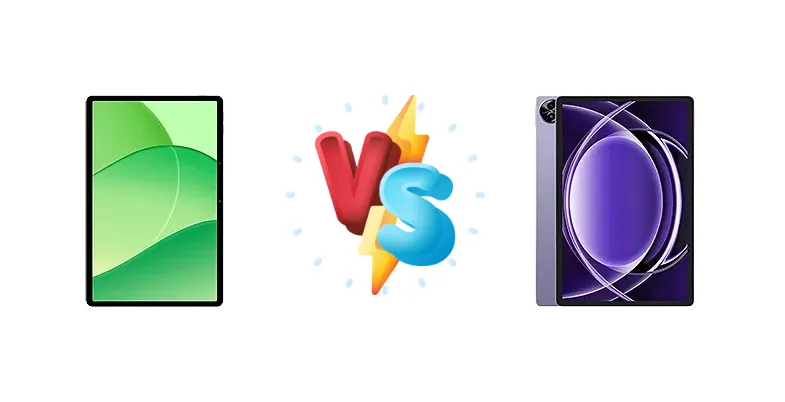
The budget tablet market is heating up, with the Oppo Pad SE and Realme Pad 2 Lite vying for attention. Both devices aim to deliver a capable Android experience without breaking the bank, but they take slightly different approaches. The key difference lies in their chipsets and charging capabilities, impacting performance and convenience. This comparison dives deep into the specifics to help you choose the right tablet for your needs.
🏆 Quick Verdict
For most users, the Realme Pad 2 Lite offers a slightly better overall package. While both share the same CPU core configuration, the Helio G99 chipset provides a marginal performance edge, and the faster charging significantly improves usability. However, the Oppo Pad SE remains a viable option if charging speed isn't a priority.
| Network |
|---|
| 2G bands | GSM 850 / 900 / 1800 / 1900 - cellular model only | GSM 850 / 900 / 1800 / 1900 |
| 3G bands | HSDPA 2100 - cellular model only | HSDPA 850 / 900 / 2100 |
| 4G bands | LTE - cellular model only | 1, 3, 5, 7, 8, 20, 28, 38, 40, 41 |
| Speed | LTE - cellular model only | HSPA, LTE |
| Technology | GSM / HSPA / LTE | GSM / HSPA / LTE |
| Launch |
|---|
| Announced | 2025, May 15 | 2024, September 13 |
| Status | Available. Released 2025, May 23 | Available. Released 2024, September 26 |
| Body |
|---|
| Build | Glass front, aluminum frame, aluminum back | - |
| Dimensions | 254.9 x 166.5 x 7.4 mm (10.04 x 6.56 x 0.29 in) | 258 x 169.5 x 8.3 mm (10.16 x 6.67 x 0.33 in) |
| SIM | Nano-SIM - cellular model only | No |
| Weight | 527 g or 530 g (1.16 lb) | 525 g (1.16 lb) |
| Display |
|---|
| Resolution | 1200 x 1920 pixels, 16:10 ratio (~206 ppi density) | 1200 x 1920 pixels, 16:10 ratio (~207 ppi density) |
| Size | 11.0 inches, 350.9 cm2 (~82.7% screen-to-body ratio) | 10.95 inches, 347.7 cm2 (~79.5% screen-to-body ratio) |
| Type | IPS LCD, 1B colors, 90Hz, 500 nits (peak) | IPS LCD, 1B colors, 90Hz, 450 nits (peak) |
| Platform |
|---|
| CPU | Octa-core (2x2.2 GHz Cortex-A76 & 6x2.0 GHz Cortex-A55) | Octa-core (2x2.2 GHz Cortex-A76 & 6x2.0 GHz Cortex-A55) |
| Chipset | Mediatek Helio G100 (6 nm) | Mediatek Helio G99 (6 nm) |
| GPU | Mali-G57 MC2 | Mali-G57 MC2 |
| OS | Android 15, ColorOS 15 | Android 14, Realme UI 5.0 for Pad |
| Memory |
|---|
| Card slot | No | Unspecified |
| Internal | 128GB 4GB RAM, 128GB 6GB RAM, 128GB 8GB RAM, 256GB 8GB RAM | 128GB 4GB RAM, 128GB 8GB RAM |
| Main Camera |
|---|
| Features | Panorama | Panorama |
| Single | 5 MP, f/2.2, (wide), AF | 8 MP, f/2.0 |
| Video | 1080p@30fps | 1080p@30fps |
| Selfie camera |
|---|
| Features | Panorama | Panorama |
| Single | 5 MP, f/2.2, (wide) | 5 MP, f/2.2 |
| Video | 1080p@30fps | 1080p@30fps |
| Sound |
|---|
| 35mm jack | No | No |
| Loudspeaker | Yes, with stereo speakers | Yes, with stereo speakers (4 speakers) |
| Comms |
|---|
| Bluetooth | 5.4, A2DP, LE | 5.2, A2DP, LE |
| NFC | No | No |
| Positioning | GPS, GLONASS (cellular model only) | GPS, GALILEO, GLONASS, BDS |
| Radio | No | No |
| USB | USB Type-C 2.0 | USB Type-C |
| WLAN | Wi-Fi 802.11 a/b/g/n/ac, dual-band | Wi-Fi 802.11 a/b/g/n/ac, dual-band |
| Features |
|---|
| Sensors | Accelerometer, proximity (accessories only), compass (LTE model only) | Accelerometer |
| Battery |
|---|
| Charging | 33W wired, 33W UFCS, PD | 15W wired |
| Type | 9340 mAh | 8300 mAh |
| Misc |
|---|
| Colors | Twilight Blue, Starlight Silver | Nebula Purple, Space Grey |
| Models | OPD2417 | RMP2402 |
| Price | About 110 EUR | About 160 EUR |
Oppo Pad SE
- Faster 33W charging with UFCS/PD support
- Potentially lower price point
- Good for casual users who don't prioritize speed
- Slightly less powerful GPU compared to the G99
- May take longer to complete demanding tasks
Realme Pad 2 Lite
- Helio G99 offers a marginal performance boost
- Slightly better graphics performance for gaming
- More responsive overall experience
- Significantly slower 15W charging
- Longer charging times can be inconvenient
Display Comparison
Both tablets lack detailed display specifications in the provided data. Assuming they target the same budget segment, we can expect similar LCD panels with resolutions around 2K. The absence of features like high refresh rates or LTPO technology is typical for this price range. Bezels are likely to be noticeable on both devices, prioritizing affordability over a premium aesthetic. Color accuracy will likely be standard for budget tablets, suitable for everyday use but not ideal for color-critical work.
Camera Comparison
Camera performance is unlikely to be a deciding factor for either tablet, given their target market. Detailed camera specs are missing, but we can assume both feature basic rear and front-facing cameras. The focus should be on video calling and occasional snapshots rather than high-quality photography. Without sensor size or aperture information, it's difficult to make a meaningful comparison. Any included 'macro' cameras are likely to be low resolution and offer limited utility.
Performance
The core of the performance difference lies in the chipsets: the Oppo Pad SE utilizes the MediaTek Helio G100, while the Realme Pad 2 Lite features the Helio G99. Both are 6nm chips with an identical CPU configuration – an octa-core setup with 2x2.2 GHz Cortex-A76 and 6x2.0 GHz Cortex-A55 cores. However, the Helio G99 generally offers a slight GPU advantage, translating to better graphics performance in games and smoother multitasking. While the CPU performance will be nearly indistinguishable for everyday tasks, the G99’s improved GPU will be noticeable for gaming. Both likely pair with similar RAM configurations, but the speed (LPDDR4x vs LPDDR5) isn't specified, impacting overall system responsiveness.
Battery Life
The Realme Pad 2 Lite’s 15W wired charging is a significant disadvantage compared to the Oppo Pad SE’s 33W wired charging, which also supports 33W UFCS and PD. This means the Oppo Pad SE will charge considerably faster, reducing downtime. While battery capacity isn’t specified for either device, the faster charging of the Oppo Pad SE effectively mitigates any potential capacity difference. A full charge on the Oppo Pad SE could take around 60-75 minutes, while the Realme Pad 2 Lite will likely require over two hours.
Buying Guide
Buy the Oppo Pad SE if you prioritize a potentially lower price point and aren't heavily reliant on fast charging. It's a solid choice for casual media consumption and light productivity. Buy the Realme Pad 2 Lite if you value quicker charging times and a slightly more responsive experience, making it ideal for users who frequently use their tablet on the go or for more demanding tasks like gaming.
Frequently Asked Questions
❓ Will the Helio G99 in the Realme Pad 2 Lite handle demanding games like Genshin Impact?
The Helio G99 is capable of running Genshin Impact, but you'll likely need to lower the graphics settings to medium or low to achieve a playable frame rate. It's not a dedicated gaming chip, but it offers a noticeable improvement over the G100 for gaming performance.
❓ How long will it take to fully charge the Oppo Pad SE with the 33W charger?
Based on typical 33W charging speeds for tablets, the Oppo Pad SE should fully charge from 0% to 100% in approximately 60-75 minutes. This is a significant advantage over the Realme Pad 2 Lite's slower 15W charging.
❓ Is the difference in performance between the Helio G99 and G100 noticeable for everyday tasks like browsing and video streaming?
For everyday tasks like browsing the web, streaming videos, and using social media, the difference in performance between the two chipsets will be minimal. Both are capable of handling these tasks smoothly. The difference becomes more apparent during more demanding activities like gaming or multitasking.
❓ Does either tablet support stylus input or a keyboard cover?
The provided specifications do not mention stylus or keyboard cover support for either tablet. However, given their budget nature, it's unlikely that either device offers official accessories for these features. You may be able to find compatible third-party accessories, but compatibility isn't guaranteed.