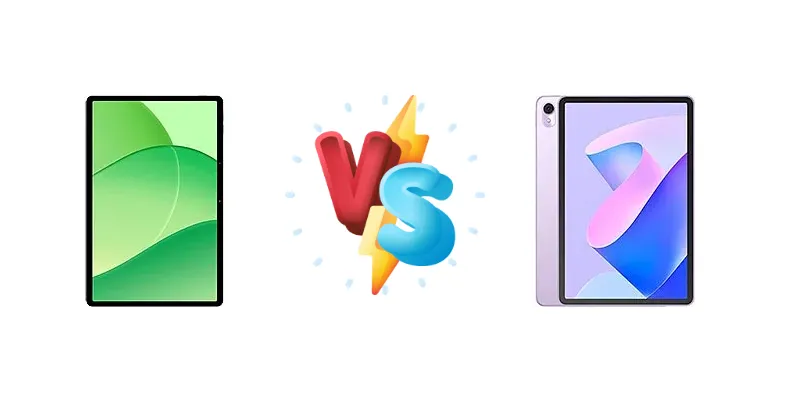
The tablet market offers a diverse range of options, but finding the right balance between performance and price can be challenging. We pit the Oppo Pad SE, a budget-focused offering, against the Huawei MatePad 11 (2023), which aims for a more premium experience, to determine which tablet best suits your needs.
🏆 Quick Verdict
For the average user prioritizing performance and future-proofing, the Huawei MatePad 11 (2023) is the clear winner. Its Snapdragon 870 chipset provides a significant performance advantage over the Oppo Pad SE’s Helio G100, making it better suited for demanding tasks and gaming. However, the Oppo Pad SE offers a compelling value proposition for basic use cases.
| Network |
|---|
| 2G bands | GSM 850 / 900 / 1800 / 1900 - cellular model only | N/A |
| 3G bands | HSDPA 2100 - cellular model only | N/A |
| 4G bands | LTE - cellular model only | N/A |
| EDGE | - | No |
| GPRS | - | No |
| Speed | LTE - cellular model only | - |
| Technology | GSM / HSPA / LTE | No cellular connectivity |
| Launch |
|---|
| Announced | 2025, May 15 | 2023, March 23 |
| Status | Available. Released 2025, May 23 | Available. Released 2023, March 31 |
| Body |
|---|
| Build | Glass front, aluminum frame, aluminum back | - |
| Dimensions | 254.9 x 166.5 x 7.4 mm (10.04 x 6.56 x 0.29 in) | 253.7 x 165.3 x 7.2 mm (9.99 x 6.51 x 0.28 in) |
| SIM | Nano-SIM - cellular model only | No |
| Weight | 527 g or 530 g (1.16 lb) | 480 g (1.06 lb) |
| | - | Stylus support (magnetic) |
| Display |
|---|
| Resolution | 1200 x 1920 pixels, 16:10 ratio (~206 ppi density) | 2560 x 1600 pixels, 16:10 ratio (~275 ppi density) |
| Size | 11.0 inches, 350.9 cm2 (~82.7% screen-to-body ratio) | 11.0 inches, 348.3 cm2 (~83.1% screen-to-body ratio) |
| Type | IPS LCD, 1B colors, 90Hz, 500 nits (peak) | IPS LCD, 120Hz |
| Platform |
|---|
| CPU | Octa-core (2x2.2 GHz Cortex-A76 & 6x2.0 GHz Cortex-A55) | Octa-core (1x3.2 GHz Kryo 585 & 3x2.42 GHz Kryo 585 & 4x1.80 GHz Kryo 585)Octa-core (1x2.84 GHz Cortex-A77 & 3x2.42 GHz Cortex-A77 & 4x1.80 GHz Cortex-A55) |
| Chipset | Mediatek Helio G100 (6 nm) | Qualcomm SM8250-AC Snapdragon 870 5G (7 nm)Qualcomm SM8250 Snapdragon 865 5G (7 nm+) |
| GPU | Mali-G57 MC2 | Adreno 650 |
| OS | Android 15, ColorOS 15 | HarmonyOS 3.1 |
| Memory |
|---|
| Card slot | No | microSDXC (dedicated slot) |
| Internal | 128GB 4GB RAM, 128GB 6GB RAM, 128GB 8GB RAM, 256GB 8GB RAM | 128GB 6GB RAM, 128GB 8GB RAM, 256GB 8GB RAM |
| Main Camera |
|---|
| Features | Panorama | LED flash, HDR, panorama |
| Single | 5 MP, f/2.2, (wide), AF | 13 MP, f/1.8, PDAF |
| Video | 1080p@30fps | 4K@30fps, 1080p@30fps |
| Selfie camera |
|---|
| Features | Panorama | - |
| Single | 5 MP, f/2.2, (wide) | 8 MP, f/2.0 |
| Video | 1080p@30fps | 1080p@30fps |
| Sound |
|---|
| 3.5mm jack | - | No |
| 35mm jack | No | No |
| Loudspeaker | Yes, with stereo speakers | Yes, with stereo speakers (4 speakers) |
| | - | Tuned by Harman Kardon |
| Comms |
|---|
| Bluetooth | 5.4, A2DP, LE | 5.1, A2DP, LE |
| NFC | No | No |
| Positioning | GPS, GLONASS (cellular model only) | No |
| Radio | No | No |
| USB | USB Type-C 2.0 | USB Type-C 3.1, OTG |
| WLAN | Wi-Fi 802.11 a/b/g/n/ac, dual-band | Wi-Fi 802.11 a/b/g/n/ac/6, dual-band, Wi-Fi Direct |
| Features |
|---|
| Sensors | Accelerometer, proximity (accessories only), compass (LTE model only) | Accelerometer |
| Battery |
|---|
| Charging | 33W wired, 33W UFCS, PD | 22.5W wired
5W reverse wired |
| Type | 9340 mAh | Li-Po 7250 mAh |
| Misc |
|---|
| Colors | Twilight Blue, Starlight Silver | Black, Blue, White, Purple |
| Models | OPD2417 | DBR-W10 |
| Price | About 110 EUR | About 300 EUR |
Oppo Pad SE
- Faster 33W charging with UFCS/PD support
- More affordable price point
- Potentially lighter and more portable
- Significantly weaker processor performance
- Likely lower quality display
- Less future-proof
Huawei MatePad 11 (2023)
- Superior performance with Snapdragon 870
- Potentially better display quality
- 5W reverse wired charging
- Slower 22.5W charging
- Higher price
- Potentially heavier build
Display Comparison
Neither device's display specifications are provided, so a direct comparison is limited. However, given the MatePad 11's positioning, it likely features a higher-quality panel with potentially better color accuracy and brightness. The Oppo Pad SE, being a budget option, may utilize a simpler LCD panel. Bezels are likely comparable, but the MatePad 11 may benefit from a slightly more refined design.
Camera Comparison
Camera details are absent for both devices. Given the tablet form factor, camera quality is rarely a primary concern. However, Huawei generally emphasizes camera capabilities, so the MatePad 11 likely has a more capable camera system than the Oppo Pad SE. Expect a larger main sensor and potentially more advanced image processing algorithms on the Huawei device.
Performance
The core difference lies in the chipsets. The Huawei MatePad 11 (2023) boasts the Qualcomm Snapdragon 870 5G (or potentially the 865 5G), built on a 7nm process. This is a significant leap over the Oppo Pad SE’s MediaTek Helio G100 (6nm). The Snapdragon 870’s Kryo 585 cores, with a prime core clocked at 3.2 GHz, deliver substantially higher CPU and GPU performance. The 7nm process, while older, is still more efficient than the 6nm Helio G100 in sustained workloads, meaning less thermal throttling during extended gaming sessions. The MatePad 11’s potential for LPDDR5 RAM (depending on configuration) further enhances its multitasking capabilities compared to the likely LPDDR4X found in the Oppo Pad SE.
Battery Life
Battery capacity isn't specified, but the charging speeds reveal a key difference. The Oppo Pad SE supports 33W wired charging, including UFCS and PD standards, offering fast and versatile charging options. The Huawei MatePad 11 (2023) is limited to 22.5W wired charging. While the MatePad 11 offers 5W reverse wired charging, a feature absent on the Oppo Pad SE, the faster charging speed of the Oppo Pad SE means quicker top-ups, potentially offsetting a slightly smaller battery capacity.
Buying Guide
Buy the Oppo Pad SE if you need a simple, affordable tablet for casual browsing, video streaming, and light productivity tasks. It’s ideal for students or families on a budget. Buy the Huawei MatePad 11 (2023) if you prioritize performance for gaming, multitasking, or creative applications, and are willing to spend more for a smoother, more responsive experience. It’s a better choice for power users and professionals.
Frequently Asked Questions
❓ Will the Helio G100 in the Oppo Pad SE struggle with demanding games like Genshin Impact?
Yes, the MediaTek Helio G100 is a budget-oriented chipset. While it can handle less demanding games, Genshin Impact and similar titles will likely require significant graphics settings reductions and may still experience frame drops and stuttering. The Snapdragon 870 in the MatePad 11 is far better equipped for these games.
❓ Does the Huawei MatePad 11 (2023) support the Huawei Pencil or other stylus accessories?
Yes, the Huawei MatePad 11 (2023) is compatible with the Huawei M-Pencil (2nd Generation), sold separately. This allows for note-taking, drawing, and other creative tasks. The Oppo Pad SE does not have official stylus support.
❓ How does the charging speed difference impact daily use? Will I notice a significant difference between 33W and 22.5W?
You will notice a difference. 33W charging on the Oppo Pad SE will result in a faster 0-100% charge time compared to the 22.5W on the MatePad 11. While neither is exceptionally slow, the Oppo Pad SE offers more convenience for quick top-ups.