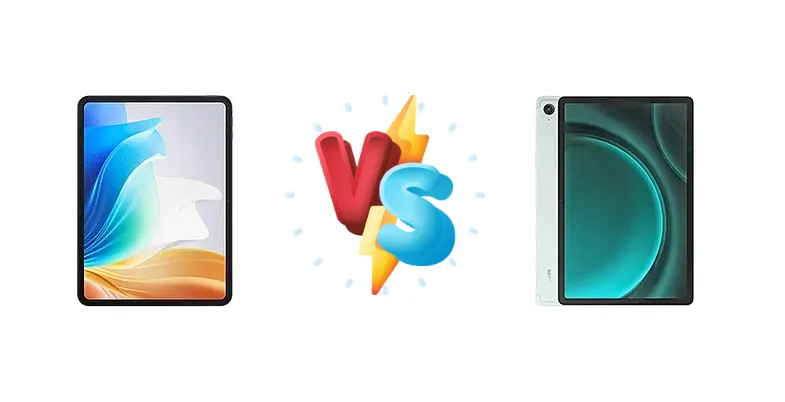
The tablet market has seen a resurgence, but finding a balance between price and performance can be tricky. The Oppo Pad Neo and Samsung Galaxy Tab S9 FE both aim to deliver a compelling Android tablet experience without breaking the bank. This comparison dives deep into their core components to determine which device offers the best value for your money, focusing on the crucial differences in chipset architecture and charging capabilities.
🏆 Quick Verdict
For the average user prioritizing overall performance and future-proofing, the Samsung Galaxy Tab S9 FE emerges as the better choice. Its Exynos 1380, built on a 5nm process, provides a noticeable performance advantage over the Oppo Pad Neo’s Helio G99, despite the Neo’s lower price point. However, the Oppo Pad Neo remains a viable option for casual users.
| Network |
|---|
| 2G bands | GSM 850 / 900 / 1800 / 1900 | GSM 850 / 900 / 1800 / 1900 |
| 3G bands | HSDPA 850 / 900 / 2100 | HSDPA 850 / 900 / 1700(AWS) / 1900 / 2100 |
| 4G bands | LTE | 1, 2, 3, 4, 5, 7, 8, 12, 13, 17, 20, 26, 28, 32, 38, 40, 41, 66 |
| 5G bands | - | 1, 3, 5, 7, 8, 20, 28, 38, 40, 41, 66, 77, 78 SA/NSA/Sub6 |
| Speed | HSPA, LTE - cellular model only | HSPA, LTE, 5G - cellular model only |
| Technology | GSM / HSPA / LTE | GSM / HSPA / LTE / 5G |
| Launch |
|---|
| Announced | 2024, January 16 | 2023, October 04 |
| Status | Available. Released 2024, January 16 | Available. Released 2023, October 16 |
| Body |
|---|
| Build | - | Glass front, aluminum back, aluminum frame |
| Dimensions | 255.1 x 188 x 6.9 mm (10.04 x 7.40 x 0.27 in) | 254.3 x 165.8 x 6.5 mm (10.01 x 6.53 x 0.26 in) |
| SIM | Nano-SIM (cellular model only) | Nano-SIM + eSIM (cellular model only) |
| Weight | 538 g (1.19 lb) | 523 g or 524 g (1.15 lb) |
| Display |
|---|
| Resolution | 1720 x 2408 pixels (~260 ppi density) | 1440 x 2304 pixels, 16:10 ratio (~249 ppi density) |
| Size | 11.4 inches, 396.6 cm2 (~82.7% screen-to-body ratio) | 10.9 inches, 344.5 cm2 (~81.7% screen-to-body ratio) |
| Type | IPS LCD, 1B colors, 90Hz, 400 nits (typ) | IPS LCD, 90Hz |
| Platform |
|---|
| CPU | Octa-core (2x2.2 GHz Cortex-A76 & 6x2.0 GHz Cortex-A55) | Octa-core (4x2.4 GHz Cortex-A78 & 4x2.0 GHz Cortex-A55) |
| Chipset | Mediatek Helio G99 (6 nm) | Exynos 1380 (5 nm) |
| GPU | Mali-G57 MC2 | Mali-G68 MP5 |
| OS | Android 13, ColorOS 13.2 | Android 13, up to 4 major Android upgrades, One UI 6 |
| Memory |
|---|
| Card slot | microSDXC | microSDXC (dedicated slot) |
| Internal | 128GB 6GB RAM, 128GB 8GB RAM | 128GB 6GB RAM, 128GB 8GB RAM, 256GB 8GB RAM |
| Main Camera |
|---|
| Features | Panorama | - |
| Single | 8 MP, f/2.0, (wide) | 8 MP, (wide) |
| Video | 1080p@30fps | 4K@30fps, 1080p@30fps |
| Selfie camera |
|---|
| Features | Panorama | - |
| Single | 8 MP, f/2.0, (wide) | 12 MP, (ultrawide) |
| Video | 1080p@30fps | Yes |
| Sound |
|---|
| 35mm jack | No | No |
| Loudspeaker | Yes, with stereo speakers (4 speakers) | Yes, with stereo speakers |
| Comms |
|---|
| Bluetooth | 5.2, A2DP, LE, aptX HD | 5.3, A2DP, LE |
| NFC | No | No |
| Positioning | GPS, GALILEO, GLONASS, BDS - cellular model only | GPS, GALILEO, GLONASS, BDS, QZSS - cellular model only |
| Radio | No | No |
| USB | USB Type-C 2.0 | USB Type-C 2.0, magnetic connector |
| WLAN | Wi-Fi 802.11 a/b/g/n/ac, dual-band | Wi-Fi 802.11 a/b/g/n/ac/6, dual-band, Wi-Fi Direct |
| Features |
|---|
| Sensors | Accelerometer, proximity (accessories only), gyro, compass | Fingerprint (side-mounted), accelerometer, gyro, compass, proximity (accessories only) |
| Battery |
|---|
| Charging | 33W wired, PD | 45W wired, QC2.0 |
| Type | 8000 mAh | Li-Po 8000 mAh |
| Misc |
|---|
| Colors | Gray | Mint, Silver, Gray, Lavender |
| Models | OPD2302, OPD2303 | SM-X510, SM-X516B |
| Price | About 240 EUR | About 300 EUR |
| SAR | - | 1.55 W/kg (body) |
| SAR EU | - | 0.59 W/kg (body) |
Oppo Pad Neo
- More affordable price point
- Decent performance for basic tasks
- PD charging compatibility
- Less powerful chipset compared to the S9 FE
- Potential for thermal throttling under sustained load
Samsung Galaxy Tab S9 FE
- Superior performance with the Exynos 1380
- Faster 45W charging with QC2.0
- More efficient 5nm chipset
- Higher price compared to the Oppo Pad Neo
- QC2.0 may require a compatible charger
Display Comparison
While both tablets likely feature LCD panels (specific panel details are missing), the core difference lies in the processing power driving them. Display quality will likely be similar, but the Exynos 1380 in the S9 FE will provide a smoother experience when navigating demanding interfaces. Bezels are likely comparable given the price points, and color accuracy will depend on software calibration, a detail not specified in the provided data.
Camera Comparison
Given the context data, a detailed camera comparison is limited. Both tablets likely feature modest camera setups geared towards video calls and casual snapshots. The absence of specific sensor details suggests neither device prioritizes photography. Any differences in image quality will likely stem from software processing rather than hardware capabilities.
Performance
The Samsung Galaxy Tab S9 FE’s Exynos 1380 (5nm) significantly outperforms the Oppo Pad Neo’s MediaTek Helio G99 (6nm). The 5nm fabrication process allows for greater transistor density and improved power efficiency, translating to better sustained performance and reduced thermal throttling. The Exynos 1380’s CPU configuration – 4x2.4 GHz Cortex-A78 & 4x2.0 GHz Cortex-A55 – is a step up from the Helio G99’s 2x2.2 GHz Cortex-A76 & 6x2.0 GHz Cortex-A55. The Cortex-A78 cores in the S9 FE offer a substantial performance boost in single-core and multi-core tasks. This difference will be most noticeable in demanding applications and games.
Battery Life
Battery life will depend heavily on usage patterns. While the exact battery capacities are unknown, the Samsung Galaxy Tab S9 FE’s 45W wired charging with QC2.0 support offers a significant advantage over the Oppo Pad Neo’s 33W wired charging with PD. Faster charging means less downtime and quicker top-ups, especially important for users on the go. The more efficient Exynos 1380 may also contribute to slightly better battery life under heavy load.
Buying Guide
Buy the Oppo Pad Neo if you need a highly affordable tablet for basic tasks like web browsing, video streaming, and light productivity. It’s ideal for users who prioritize portability and aren’t demanding gamers or power users. Buy the Samsung Galaxy Tab S9 FE if you prefer a more powerful and versatile tablet capable of handling demanding apps, multitasking, and moderate gaming. The S9 FE’s superior chipset and faster charging make it a better long-term investment for those seeking a more premium experience.
Frequently Asked Questions
❓ Does the Exynos 1380 in the Samsung Galaxy Tab S9 FE tend to overheat during extended gaming sessions?
The Exynos 1380, built on a 5nm process, is generally efficient and well-managed in terms of thermals. While it will get warm during prolonged gaming, it's less prone to significant throttling compared to the Helio G99 in the Oppo Pad Neo, which uses a larger 6nm process. Samsung’s software optimization also plays a role in managing heat effectively.
❓ Is the performance difference between the Helio G99 and Exynos 1380 noticeable for everyday tasks like browsing and video streaming?
For basic tasks like web browsing, email, and video streaming, the difference may not be immediately apparent. However, the Exynos 1380’s superior CPU architecture and processing power will result in smoother multitasking and faster app loading times, even in everyday scenarios. The difference becomes more pronounced when running demanding applications or switching between multiple apps.
❓ Can I use a standard USB-C PD charger with the Oppo Pad Neo, or do I need a specific charger?
The Oppo Pad Neo supports USB-C Power Delivery (PD), meaning you can use a standard USB-C PD charger to charge the device. However, to achieve the full 33W charging speed, ensure your charger supports the PD protocol.
❓ Does the Samsung Galaxy Tab S9 FE support DeX mode for a desktop-like experience?
Yes, the Samsung Galaxy Tab S9 FE supports Samsung DeX, allowing you to connect the tablet to an external monitor, keyboard, and mouse for a desktop-like experience. This feature enhances productivity and makes the tablet more versatile for work and creative tasks.