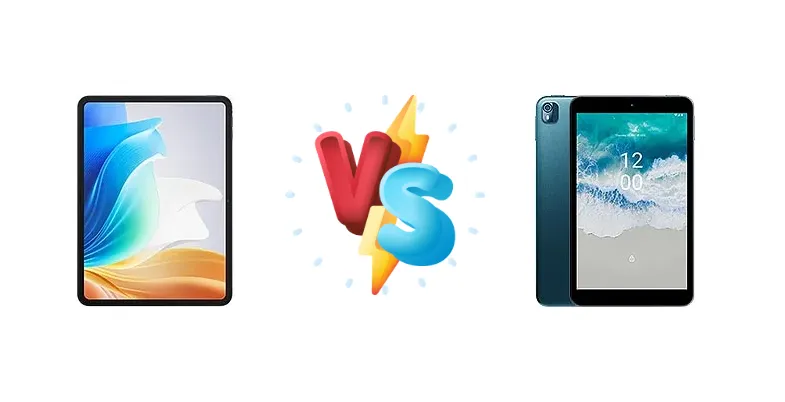
The budget tablet market is heating up, with the Oppo Pad Neo and Nokia T10 vying for attention. Both aim to deliver an affordable Android experience, but they take drastically different approaches to performance and charging. This comparison dissects the key differences between the MediaTek Helio G99-powered Oppo Pad Neo and the Unisoc T606-equipped Nokia T10, helping you determine which tablet best suits your needs.
🏆 Quick Verdict
For most users, the Oppo Pad Neo emerges as the superior choice. Its significantly more powerful MediaTek Helio G99 chipset and 33W fast charging provide a smoother, more responsive experience and quicker top-ups, justifying the likely price premium over the Nokia T10.
| Network |
|---|
| 2G bands | GSM 850 / 900 / 1800 / 1900 | GSM 850 / 900 / 1800 / 1900 |
| 3G bands | HSDPA 850 / 900 / 2100 | HSDPA 850 / 900 / 2100 |
| 4G bands | LTE | 1, 3, 5, 7, 8, 20, 28, 38, 40, 41 |
| Speed | HSPA, LTE - cellular model only | HSPA 42.2/5.76 Mbps, LTE Cat4 150/50 Mbps |
| Technology | GSM / HSPA / LTE | GSM / HSPA / LTE |
| Launch |
|---|
| Announced | 2024, January 16 | 2022, July 12 |
| Status | Available. Released 2024, January 16 | Available. Released 2022, August 20 |
| Body |
|---|
| Build | - | Glass front, plastic back, plastic frame |
| Dimensions | 255.1 x 188 x 6.9 mm (10.04 x 7.40 x 0.27 in) | 208 x 123.2 x 9 mm (8.19 x 4.85 x 0.35 in) |
| SIM | Nano-SIM (cellular model only) | Nano-SIM |
| Weight | 538 g (1.19 lb) | 375 g (13.23 oz) |
| | - | Splash resistant |
| Display |
|---|
| Resolution | 1720 x 2408 pixels (~260 ppi density) | 800 x 1280 pixels, 16:10 ratio (~189 ppi density) |
| Size | 11.4 inches, 396.6 cm2 (~82.7% screen-to-body ratio) | 8.0 inches, 185.6 cm2 (~72.4% screen-to-body ratio) |
| Type | IPS LCD, 1B colors, 90Hz, 400 nits (typ) | IPS LCD, 360 nits (typ), 450 nits (peak) |
| Platform |
|---|
| CPU | Octa-core (2x2.2 GHz Cortex-A76 & 6x2.0 GHz Cortex-A55) | Octa-core (2x1.6 GHz Cortex-A75 & 6x1.6 GHz Cortex-A55) |
| Chipset | Mediatek Helio G99 (6 nm) | Unisoc T606 (12 nm) |
| GPU | Mali-G57 MC2 | Mali-G57 MP1 |
| OS | Android 13, ColorOS 13.2 | Android 12, upgradable to Android 13 |
| Memory |
|---|
| Card slot | microSDXC | microSDXC |
| Internal | 128GB 6GB RAM, 128GB 8GB RAM | 32GB 3GB RAM, 64GB 4GB RAM |
| Main Camera |
|---|
| Features | Panorama | LED flash |
| Single | 8 MP, f/2.0, (wide) | 8 MP, 1/4.0", 1.12µm, AF |
| Video | 1080p@30fps | 1080p |
| Selfie camera |
|---|
| Features | Panorama | - |
| Single | 8 MP, f/2.0, (wide) | 2 MP, 1/5.0", 1.65µm |
| Video | 1080p@30fps | 720p |
| Sound |
|---|
| 3.5mm jack | - | Yes |
| 35mm jack | No | Yes |
| Loudspeaker | Yes, with stereo speakers (4 speakers) | Yes, with stereo speakers |
| Comms |
|---|
| Bluetooth | 5.2, A2DP, LE, aptX HD | 5.0, A2DP, LE |
| NFC | No | No |
| Positioning | GPS, GALILEO, GLONASS, BDS - cellular model only | GPS, GLONASS, GALILEO |
| Radio | No | No |
| USB | USB Type-C 2.0 | USB Type-C 2.0, OTG |
| WLAN | Wi-Fi 802.11 a/b/g/n/ac, dual-band | Wi-Fi 802.11 a/b/g/n/ac, dual-band |
| Features |
|---|
| Sensors | Accelerometer, proximity (accessories only), gyro, compass | Accelerometer, proximity |
| Battery |
|---|
| Charging | 33W wired, PD | 10W wired |
| Type | 8000 mAh | Li-Po 5250 mAh |
| Misc |
|---|
| Colors | Gray | Ocean Blue |
| Models | OPD2302, OPD2303 | TA-1503, TA-1472, TA-1462, TA-1457 |
| Price | About 240 EUR | About 160 EUR |
| SAR | - | 1.19 W/kg (body) |
| SAR EU | - | 0.27 W/kg (head) 1.57 W/kg (body) |
Oppo Pad Neo
- Significantly faster processor (Helio G99)
- 33W fast charging with PD
- More efficient 6nm process
- Better multitasking and gaming performance
- Likely higher price point
- Potentially less software update support (Oppo's track record)
Nokia T10
- More affordable price
- Clean Android experience (Nokia's strength)
- Potentially longer software update support (Nokia's promise)
- Decent battery life for basic tasks
- Slow Unisoc T606 processor
- Extremely slow 10W charging
- Limited performance for demanding apps
- Less responsive user experience
Display Comparison
Neither Oppo nor Nokia provide detailed display specs beyond resolution. However, the core difference lies in the processing power driving the display. The Helio G99 in the Oppo Pad Neo has a more capable GPU, which can translate to smoother animations and potentially better video decoding. While both likely utilize IPS LCD panels, the G99’s processing headroom suggests a more vibrant and responsive visual experience. Bezels are expected to be similar on both, targeting the budget segment.
Camera Comparison
Given the budget nature of both tablets, camera performance isn’t a primary focus. Detailed camera specs are unavailable, but it’s safe to assume both feature basic camera setups suitable for casual snapshots and video calls. Expect similar limitations in low-light conditions. Focusing on the chipset, the Helio G99’s integrated image signal processor (ISP) is more advanced than the T606’s, potentially leading to slightly better image processing, but the difference will likely be minimal.
Performance
The performance gap is the most significant differentiator. The Oppo Pad Neo’s MediaTek Helio G99, built on a 6nm process, boasts a pair of Cortex-A76 cores clocked at 2.2 GHz, paired with six Cortex-A55 cores at 2.0 GHz. This is a substantial upgrade over the Nokia T10’s Unisoc T606 (12nm), which features slower Cortex-A75 cores at 1.6 GHz and Cortex-A55 cores also at 1.6 GHz. The 6nm node of the Helio G99 offers superior power efficiency and thermal performance, meaning the Oppo Pad Neo is less likely to throttle under sustained load. This translates to smoother multitasking, faster app loading times, and a more enjoyable gaming experience. The G99’s architecture is simply more modern and capable.
Battery Life
While battery capacity isn’t specified, the Oppo Pad Neo’s 33W wired charging with Power Delivery (PD) is a game-changer. This allows for significantly faster charging times compared to the Nokia T10’s sluggish 10W charging. Even if the Nokia T10 has a slightly larger battery, the Oppo Pad Neo’s faster charging will minimize downtime. The 33W charging means a full charge can be achieved in under two hours, while the Nokia T10 will likely take over four.
Buying Guide
Buy the Oppo Pad Neo if you prioritize performance for multitasking, light gaming, and a generally snappier user experience. The faster charging is also a major benefit for those who rely on their tablet throughout the day. Buy the Nokia T10 if your primary use case is basic media consumption – reading ebooks, streaming videos – and you value affordability above all else. It’s a solid option for users who don’t demand high performance.
Frequently Asked Questions
❓ Will the Oppo Pad Neo handle demanding games like Genshin Impact or Call of Duty Mobile?
While the Helio G99 is capable, don't expect flagship-level performance. Genshin Impact will likely require low settings, and Call of Duty Mobile may experience occasional frame drops. The Oppo Pad Neo is better suited for lighter games and casual gaming sessions.
❓ Is the Nokia T10 sufficient for video streaming and web browsing?
Yes, the Nokia T10 is perfectly adequate for basic tasks like video streaming (YouTube, Netflix) and web browsing. However, expect some lag when opening multiple tabs or switching between apps. It's best suited for users who prioritize simplicity and affordability over speed.
❓ How long will it take to fully charge the Oppo Pad Neo with the 33W charger?
Based on similar devices with 33W charging, expect a full charge from 0% to 100% in approximately 90-120 minutes. This is a significant improvement over the Nokia T10's 10W charging.
❓ Does the Nokia T10 support any form of fast charging?
No, the Nokia T10 is limited to 10W wired charging. This means a full charge will take considerably longer – likely over four hours – compared to the Oppo Pad Neo.