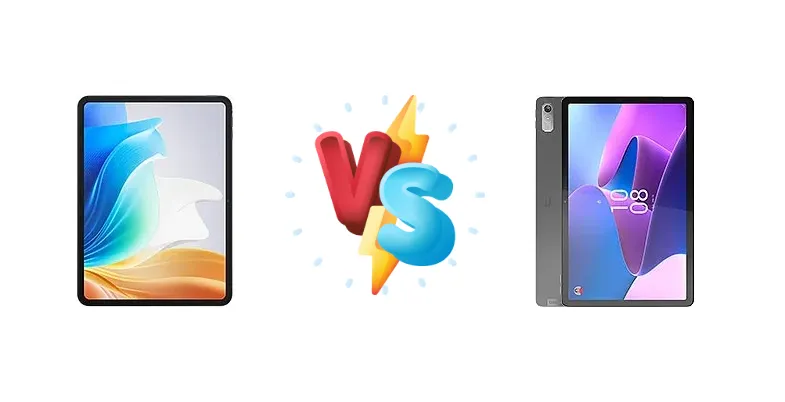
The sub-$250 tablet market is heating up, with the Oppo Pad Neo and Lenovo Tab P11 Gen 2 vying for dominance. Both devices center around the Mediatek Helio G99 chipset, promising capable performance for everyday tasks. However, the devil is in the details – from charging speeds to potential software optimizations, we dissect the key differences to determine which tablet offers the best experience.
🏆 Quick Verdict
For the average user prioritizing fast charging and a potentially cleaner software experience, the Oppo Pad Neo emerges as the winner. While both tablets share the same core processing power, the 33W charging and Oppo’s software approach give it a slight edge. However, Lenovo’s established ecosystem and potentially wider availability shouldn’t be dismissed.
| Network |
|---|
| 2G bands | GSM 850 / 900 / 1800 / 1900 | GSM 850 / 900 / 1800 / 1900 |
| 3G bands | HSDPA 850 / 900 / 2100 | HSDPA 800 / 850 / 900 / 1700(AWS) / 1900 / 2100 |
| 4G bands | LTE | 1, 2, 3, 4, 5, 7, 8, 12, 13, 18, 19, 20, 25, 26, 28, 38, 40, 41, 66 |
| Speed | HSPA, LTE - cellular model only | HSPA, LTE - cellular model only |
| Technology | GSM / HSPA / LTE | GSM / HSPA / LTE |
| Launch |
|---|
| Announced | 2024, January 16 | 2022, September 01 |
| Status | Available. Released 2024, January 16 | Available. Released 2023, January |
| Body |
|---|
| Dimensions | 255.1 x 188 x 6.9 mm (10.04 x 7.40 x 0.27 in) | 269.1 x 169.4 x 7.4 mm (10.59 x 6.67 x 0.29 in) |
| SIM | Nano-SIM (cellular model only) | Nano-SIM (cellular model only) |
| Weight | 538 g (1.19 lb) | 520 g (1.15 lb) |
| | - | Stylus support |
| Display |
|---|
| Resolution | 1720 x 2408 pixels (~260 ppi density) | 1200 x 2000 pixels, 5:3 ratio (~203 ppi density) |
| Size | 11.4 inches, 396.6 cm2 (~82.7% screen-to-body ratio) | 11.5 inches, 376.4 cm2 (~82.6% screen-to-body ratio) |
| Type | IPS LCD, 1B colors, 90Hz, 400 nits (typ) | IPS LCD, 120Hz, 400 nits (typ) |
| Platform |
|---|
| CPU | Octa-core (2x2.2 GHz Cortex-A76 & 6x2.0 GHz Cortex-A55) | Octa-core (2x2.2 GHz Cortex-A76 & 6x2.0 GHz Cortex-A55) |
| Chipset | Mediatek Helio G99 (6 nm) | Mediatek Helio G99 (6 nm) |
| GPU | Mali-G57 MC2 | Mali-G57 MC2 |
| OS | Android 13, ColorOS 13.2 | Android 12L |
| Memory |
|---|
| Card slot | microSDXC | microSDXC (dedicated slot) |
| Internal | 128GB 6GB RAM, 128GB 8GB RAM | 64GB 4GB RAM, 128GB 4GB RAM, 128GB 6GB RAM |
| Main Camera |
|---|
| Features | Panorama | LED flash |
| Single | 8 MP, f/2.0, (wide) | 13 MP, f/2.4, (wide), AF |
| Video | 1080p@30fps | 1080p@30fps |
| Selfie camera |
|---|
| Features | Panorama | - |
| Single | 8 MP, f/2.0, (wide) | 8 MP, f/2.0 |
| Video | 1080p@30fps | 1080p@30fps |
| Sound |
|---|
| 3.5mm jack | - | Yes |
| 35mm jack | No | Yes |
| Loudspeaker | Yes, with stereo speakers (4 speakers) | Yes, with stereo speakers (4 speakers) |
| Comms |
|---|
| Bluetooth | 5.2, A2DP, LE, aptX HD | 5.2, A2DP, LE |
| NFC | No | No |
| Positioning | GPS, GALILEO, GLONASS, BDS - cellular model only | GPS, GLONASS, BDS - cellular model only |
| Radio | No | No |
| USB | USB Type-C 2.0 | USB Type-C 2.0, OTG, magnetic connector |
| WLAN | Wi-Fi 802.11 a/b/g/n/ac, dual-band | Wi-Fi 802.11 a/b/g/n/ac/6e, dual-band, Wi-Fi Direct |
| Features |
|---|
| Sensors | Accelerometer, proximity (accessories only), gyro, compass | Accelerometer, gyro, proximity |
| Battery |
|---|
| Charging | 33W wired, PD | - |
| Type | 8000 mAh | Li-Po 7700 mAh |
| Misc |
|---|
| Colors | Gray | Storm Grey, Sage |
| Models | OPD2302, OPD2303 | TB350FU |
| Price | About 240 EUR | About 350 EUR |
Oppo Pad Neo
- Faster 33W charging with PD
- Potentially cleaner software experience
- Sleek and modern design (based on Oppo's aesthetic)
- Limited brand recognition in the tablet market
- Potential for less software support long-term
Lenovo Tab P11 Gen 2
- Established brand with a wider accessory ecosystem
- Potentially more robust software features
- Wider availability in some regions
- Slower charging speeds
- Lenovo's software can sometimes include bloatware
Display Comparison
Both the Oppo Pad Neo and Lenovo Tab P11 Gen 2 utilize LCD panels, a common choice in this price bracket. Without specific display specs like resolution or peak brightness, it’s difficult to definitively declare a winner. However, Oppo’s history suggests a focus on color calibration, potentially offering a more vibrant viewing experience. The absence of high refresh rate panels (90Hz or 120Hz) is expected at this price point, but the quality of the LCD panel itself will be crucial. Bezels are likely comparable, given the similar screen sizes typically found in this segment.
Camera Comparison
Camera performance is unlikely to be a deciding factor for most buyers in this segment. Both tablets will likely feature basic camera setups suitable for video calls and occasional snapshots. Without specific sensor details, it’s safe to assume image quality will be comparable. The inclusion of a dedicated night mode or advanced image processing features is unlikely. Focusing on the front-facing camera for video conferencing is more important than the rear camera's specifications.
Performance
The core of both tablets is the Mediatek Helio G99 (6 nm) chipset, paired with an Octa-core CPU configuration of 2x2.2 GHz Cortex-A76 & 6x2.0 GHz Cortex-A55. This means raw processing power will be virtually identical. Performance will be sufficient for multitasking, streaming video, and playing less demanding games. The real-world difference will likely come down to RAM management and thermal throttling. Without knowing the RAM type (LPDDR4x vs LPDDR5) or cooling solutions, it’s hard to predict which tablet will maintain peak performance for longer periods under sustained load. However, the 6nm process node of the Helio G99 is relatively efficient, minimizing the risk of significant throttling.
Battery Life
The Oppo Pad Neo’s 33W wired charging with PD support is a significant advantage over the Lenovo Tab P11 Gen 2, which typically offers slower charging speeds. While battery capacity isn’t specified, the faster charging allows for quicker top-ups, reducing downtime. A 0-100% charge on the Oppo Pad Neo will likely be considerably faster than on the Lenovo, making it more convenient for users on the go. The actual battery life will depend on usage patterns, but the faster charging is a clear win for the Oppo.
Buying Guide
Buy the Oppo Pad Neo if you need a tablet that charges quickly and you appreciate a streamlined Android experience. It’s ideal for students or casual users who want a portable device for streaming, browsing, and light productivity. Buy the Lenovo Tab P11 Gen 2 if you prefer a brand with a longer track record in the tablet space and value potential software features or accessory compatibility within the Lenovo ecosystem. It’s a solid all-rounder for families and those seeking a dependable tablet for general use.
Frequently Asked Questions
❓ Will the Helio G99 handle demanding games like Genshin Impact on these tablets?
While the Helio G99 is a capable chipset, Genshin Impact is a graphically intensive game. You'll likely need to lower the graphics settings to medium or low to achieve playable frame rates on both the Oppo Pad Neo and Lenovo Tab P11 Gen 2. Expect some frame drops during intense combat scenarios.
❓ How does the software experience differ between Oppo's ColorOS and Lenovo's Android implementation?
Oppo's ColorOS is known for its customization options and generally cleaner interface compared to some other Android skins. Lenovo's software, while functional, sometimes includes pre-installed bloatware. The Oppo Pad Neo may offer a smoother, more refined software experience out of the box, but both tablets will receive Android updates.
❓ Can I use a stylus with either of these tablets?
Neither Oppo nor Lenovo explicitly markets a stylus for these specific models. While you might be able to use a generic capacitive stylus, compatibility and features (like pressure sensitivity) are not guaranteed. These tablets are not designed with stylus input as a primary feature.