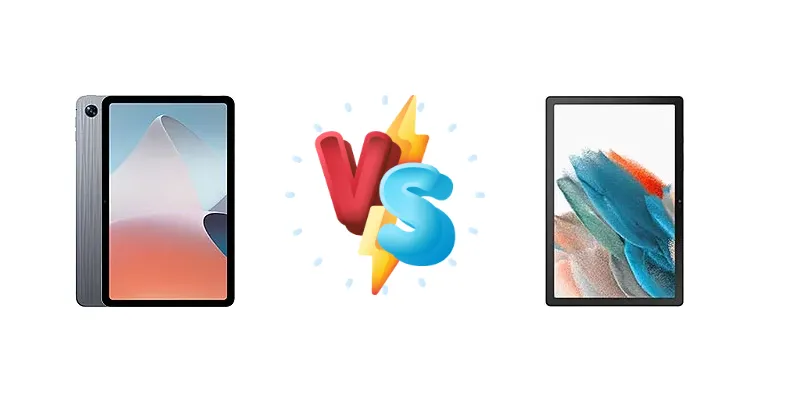
The tablet market offers a surprising number of options, especially in the budget-friendly range. Today, we're pitting two popular contenders against each other: the Oppo Pad Air and the Samsung Galaxy Tab A8. Both promise a large screen and decent performance, but which one delivers the best overall experience?
🏆 Quick Verdict
The Oppo Pad Air edges out the Galaxy Tab A8 thanks to its more powerful Snapdragon 680 chipset, brighter display, and reverse charging capability. While the Tab A8 benefits from Samsung's brand recognition and One UI, the Pad Air offers a more compelling package for the price.
| Network |
|---|
| 2G bands | N/A | GSM 850 / 900 / 1800 / 1900 |
| 3G bands | N/A | HSDPA 850 / 900 / 1700(AWS) / 1900 / 2100 |
| 4G bands | N/A | 1, 2, 3, 4, 5, 7, 8, 12, 17, 20, 28, 38, 40, 41, 66 |
| EDGE | No | - |
| GPRS | No | - |
| Speed | - | HSPA, LTE - cellular model only |
| Technology | No cellular connectivity | GSM / HSPA / LTE |
| Launch |
|---|
| Announced | 2022, May 23 | 2021, December 15 |
| Status | Available. Released 2022, June 01 | Available. Released 2022, January 17 |
| Body |
|---|
| Dimensions | 245.1 x 154.8 x 6.9 mm (9.65 x 6.09 x 0.27 in) | 246.8 x 161.9 x 6.9 mm (9.72 x 6.37 x 0.27 in) |
| SIM | No | Nano-SIM (cellular model only) |
| Weight | 440 g (15.52 oz) | 508 g (1.12 lb) |
| | Stylus support | - |
| Display |
|---|
| Resolution | 1200 x 2000 pixels, 5:3 ratio (~225 ppi density) | 1200 x 1920 pixels, 16:10 ratio (~216 ppi density) |
| Size | 10.36 inches, 305.5 cm2 (~80.5% screen-to-body ratio) | 10.5 inches, 319.7 cm2 (~80.0% screen-to-body ratio) |
| Type | IPS LCD, 1B colors, 360 nits (typ) | TFT LCD |
| Platform |
|---|
| CPU | Octa-core (4x2.4 GHz Kryo 265 Gold & 4x1.9 GHz Kryo 265 Silver) | Octa-core (2x2.0 GHz Cortex-A75 & 6x2.0 GHz Cortex-A55) |
| Chipset | Qualcomm SM6225 Snapdragon 680 4G (6 nm) | Unisoc Tiger T618 (12 nm) |
| GPU | Adreno 610 | Mali G52 MP2 |
| OS | Android 12, ColorOS 12 | Android 11, upgradable to Android 14, One UI 6 |
| Memory |
|---|
| Card slot | microSDXC | microSDXC (dedicated slot) |
| Internal | 64GB 4GB RAM, 128GB 4GB RAM, 128GB 6GB RAM | 32GB 2GB RAM, 32GB 3GB RAM, 64GB 2GB RAM, 64GB 3GB RAM, 64GB 4GB RAM, 128GB 3GB RAM, 128GB 4GB RAM |
| | UFS 2.2 | - |
| Main Camera |
|---|
| Features | Panorama | - |
| Single | 8 MP, f/2.0, AF | 8 MP, AF |
| Video | 1080p@30fps | 1080p@30fps |
| Selfie camera |
|---|
| Single | 5 MP, f/2.2 | 5 MP |
| Video | 1080p@30fps | 1080p@30fps |
| Sound |
|---|
| 3.5mm jack | No | Yes |
| 35mm jack | No | Yes |
| Loudspeaker | Yes, with stereo speakers (4 speakers) | Yes, with stereo speakers (4 speakers) |
| Comms |
|---|
| Bluetooth | 5.1, A2DP, LE, aptX HD | 5.0, A2DP, LE |
| NFC | No | No |
| Positioning | No | GPS, GLONASS, BDS, GALILEO, QZSS - cellular model only |
| Radio | No | No |
| USB | USB Type-C 2.0, OTG | USB Type-C 2.0 |
| WLAN | Wi-Fi 802.11 a/b/g/n/ac, dual-band, Wi-Fi Direct | Wi-Fi 802.11 a/b/g/n/ac, dual-band, Wi-Fi Direct |
| Features |
|---|
| Sensors | Accelerometer, gyro, compass | Accelerometer, gyro, proximity, compass |
| Battery |
|---|
| Charging | 18W wired, PD
5W reverse wired | 15W wired |
| Type | Li-Po 7100 mAh | Li-Po 7040 mAh |
| Misc |
|---|
| Colors | Gray, Silver | Gray, Silver, Pink Gold |
| Models | OPD2102, X21N2 | SM-X200, SM-X205 |
| Price | About 300 EUR | About 230 EUR |
| SAR EU | - | 0.92 W/kg (body) |
| Tests |
|---|
| Display |
Contrast ratio: 1391:1 | - |
| Loudspeaker |
-28.3 LUFS (Average)
| - |
| Performance |
AnTuTu: 249272 (v9)
GeekBench: 1661 (v5.1)
GFXBench: 7.2fps (ES 3.1 onscreen) | - |
Oppo Pad Air
- More powerful chipset (Snapdragon 680)
- Brighter display (352 nits)
- Reverse charging capability
- Sleeker design
- Potentially less refined software experience compared to Samsung's One UI
- Camera performance is average
Samsung Galaxy Tab A8 10.5 (2021)
- Samsung's One UI (familiar and user-friendly)
- Good brand recognition
- Decent battery life
- Less powerful chipset (Unisoc Tiger T618)
- Dimmer display
- No reverse charging
Display Comparison
The Oppo Pad Air boasts a significantly brighter display at 352 nits compared to the Tab A8 (estimated around 300 nits). Both offer a 10.5-inch screen, but the Pad Air's contrast ratio of 1391:1 suggests slightly better image quality. While both are LCD panels, the Oppo Pad Air's brightness gives it a noticeable advantage in outdoor use.
Camera Comparison
Camera quality isn't a primary focus for budget tablets. The Oppo Pad Air likely has an 8MP rear camera, while the Tab A8 features an 8MP rear and 5MP front camera. Both are suitable for occasional snapshots, but don't expect flagship-level performance. The Tab A8's front camera might be slightly better for video calls due to its higher resolution.
Performance
Here's where the Oppo Pad Air truly shines. The Snapdragon 680 is a more modern and powerful chipset than the Unisoc Tiger T618. Expect smoother multitasking, faster app loading times, and a generally more responsive experience on the Pad Air. The Tab A8 is adequate for basic tasks, but struggles with more demanding applications.
Battery Life
Both tablets offer a decent battery life, likely around 8-10 hours of mixed usage. The Tab A8 has a slightly larger battery capacity (7040 mAh vs 5000 mAh in the Pad Air), but the Pad Air's more efficient chipset could offset this. The Oppo Pad Air's reverse charging is a nice bonus for topping up accessories.
Buying Guide
The Oppo Pad Air is ideal for students, casual users, and those seeking a portable entertainment device with a bit more processing power. The Samsung Galaxy Tab A8 is a good choice for families, those deeply embedded in the Samsung ecosystem, and users prioritizing a familiar and user-friendly interface.
Frequently Asked Questions
❓ Which tablet is better for gaming?
The Oppo Pad Air is the better choice for gaming due to its more powerful chipset. It will handle less demanding games more smoothly.
❓ Is the Samsung Galaxy Tab A8 good for kids?
Yes, the Tab A8 is a good option for kids, especially with parental control features available through Samsung Kids. However, the Pad Air's performance might be beneficial for educational apps.