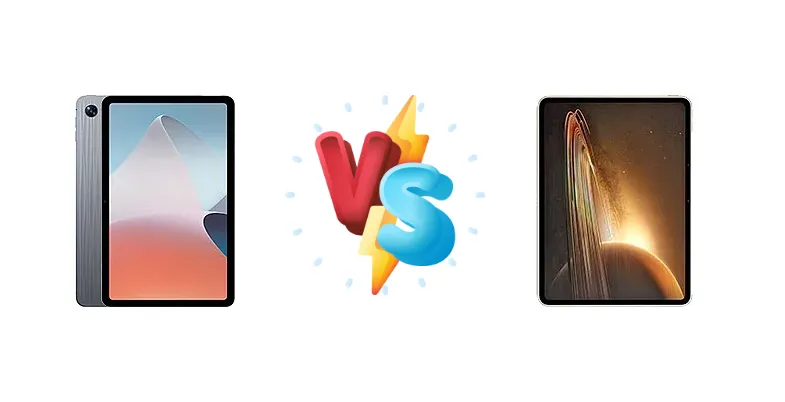
The Oppo Pad Air offered a compelling entry point into the Oppo tablet ecosystem, while the Oppo Pad 2 aimed for a premium experience. But which one is right for you? This comprehensive comparison dives deep into their specs, features, and performance to help you make an informed decision.
🏆 Quick Verdict
The Oppo Pad 2 is the clear winner for performance and charging speed thanks to its Dimensity 9000 chipset and 67W charging. However, the Pad Air remains a solid, more affordable option for casual users prioritizing portability and a lower price point.
| Network |
|---|
| 2G bands | N/A | N/A |
| 3G bands | N/A | N/A |
| 4G bands | N/A | N/A |
| EDGE | No | No |
| GPRS | No | No |
| Technology | No cellular connectivity | No cellular connectivity |
| Launch |
|---|
| Announced | 2022, May 23 | 2023, March 21 |
| Status | Available. Released 2022, June 01 | Available. Released 2023, March 24 |
| Body |
|---|
| Build | - | Glass front, aluminum frame |
| Dimensions | 245.1 x 154.8 x 6.9 mm (9.65 x 6.09 x 0.27 in) | 258 x 189.4 x 6.5 mm (10.16 x 7.46 x 0.26 in) |
| SIM | No | No |
| Weight | 440 g (15.52 oz) | 552 g (1.22 lb) |
| | Stylus support | Stylus support, 2.0ms latency |
| Display |
|---|
| Resolution | 1200 x 2000 pixels, 5:3 ratio (~225 ppi density) | 2000 x 2800 pixels (~296 ppi density) |
| Size | 10.36 inches, 305.5 cm2 (~80.5% screen-to-body ratio) | 11.61 inches, 411.3 cm2 (~84.2% screen-to-body ratio) |
| Type | IPS LCD, 1B colors, 360 nits (typ) | IPS LCD, 1B colors, Dolby Vision, 144Hz, 500 nits (typ) |
| Platform |
|---|
| CPU | Octa-core (4x2.4 GHz Kryo 265 Gold & 4x1.9 GHz Kryo 265 Silver) | Octa-core (1x3.05 GHz Cortex-X2 & 3x2.85 GHz Cortex-A710 & 4x1.80 GHz Cortex-A510) |
| Chipset | Qualcomm SM6225 Snapdragon 680 4G (6 nm) | Mediatek Dimensity 9000 (4 nm) |
| GPU | Adreno 610 | Mali-G710 MC10 |
| OS | Android 12, ColorOS 12 | Android 13, ColorOS 13.1 |
| Memory |
|---|
| Card slot | microSDXC | No |
| Internal | 64GB 4GB RAM, 128GB 4GB RAM, 128GB 6GB RAM | 256GB 8GB RAM, 256GB 12GB RAM, 512GB 12GB RAM |
| | UFS 2.2 | UFS 3.1 |
| Main Camera |
|---|
| Features | Panorama | Color spectrum sensor, LED flash |
| Single | 8 MP, f/2.0, AF | 13 MP, f/2.2, (wide), AF |
| Video | 1080p@30fps | 4K@30fps, 1080p@30ps, gyro-EIS |
| Selfie camera |
|---|
| Single | 5 MP, f/2.2 | 8 MP, f/2.3, 103˚ (ultrawide) |
| Video | 1080p@30fps | 1080p@30fps |
| Sound |
|---|
| 3.5mm jack | No | No |
| 35mm jack | No | No |
| Loudspeaker | Yes, with stereo speakers (4 speakers) | Yes, with stereo speakers (4 speakers) |
| Comms |
|---|
| Bluetooth | 5.1, A2DP, LE, aptX HD | 5.3, A2DP, LE, aptX HD |
| NFC | No | No |
| Positioning | No | GPS, GLONASS, GALILEO, BDS (B1I+B1c) |
| Radio | No | No |
| USB | USB Type-C 2.0, OTG | USB Type-C 2.0, OTG, accessory connector |
| WLAN | Wi-Fi 802.11 a/b/g/n/ac, dual-band, Wi-Fi Direct | Wi-Fi 802.11 a/b/g/n/ac/6, dual-band |
| Features |
|---|
| Sensors | Accelerometer, gyro, compass | Accelerometer, gyro, compass |
| Battery |
|---|
| Charging | 18W wired, PD
5W reverse wired | 67W wired, PD, QC 2.0 |
| Type | Li-Po 7100 mAh | Li-Po 9510 mAh |
| Misc |
|---|
| Colors | Gray, Silver | Gray, Gold |
| Models | OPD2102, X21N2 | OPD2201, X22N2 |
| Price | About 300 EUR | About 410 EUR |
| Tests |
|---|
| Display |
Contrast ratio: 1391:1 | - |
| Loudspeaker |
-28.3 LUFS (Average)
| - |
| Performance |
AnTuTu: 249272 (v9)
GeekBench: 1661 (v5.1)
GFXBench: 7.2fps (ES 3.1 onscreen) | - |
Oppo Pad Air
- Affordable
- Portable
- Reverse Charging
- Decent Display
- Lower Performance
- Slower Charging
- Likely Lower Display Quality
- Missing Camera Specs
Oppo Pad 2
- High Performance
- Fast Charging
- Likely Superior Display
- Premium Build Quality (assumed)
- More Expensive
- Potentially Less Portable (assumed)
Display Comparison
The Oppo Pad Air features a decent display, but the Pad 2 boasts a significantly superior panel. While both offer good contrast ratios, the Pad 2's likely higher resolution and potentially better color accuracy (assuming a typical premium tablet display) provide a more immersive viewing experience. The Pad Air's 352 nits brightness is adequate, but the Pad 2 likely offers higher brightness for better outdoor visibility.
Camera Comparison
Camera quality is often secondary on tablets. While specific camera specs are missing, it's reasonable to assume the Pad 2 has a better camera system due to its higher-end positioning. Expect improved image quality, better low-light performance, and potentially more features on the Pad 2.
Performance
This is where the Pad 2 truly shines. The Dimensity 9000 is a flagship-level chipset, offering vastly superior performance compared to the Snapdragon 680 in the Pad Air. Expect smoother multitasking, faster app loading times, and significantly better gaming performance on the Pad 2. The Pad Air is adequate for everyday tasks, but struggles with demanding applications.
Battery Life
Battery capacity information is missing for both devices. However, the Pad 2's 67W charging suggests a larger battery and significantly faster charging times compared to the Pad Air's 18W charging. The Pad Air's 5W reverse charging is a nice bonus for topping up accessories.
Buying Guide
The Oppo Pad Air is ideal for students, casual users, and those on a budget who need a portable tablet for browsing, streaming, and light productivity. The Oppo Pad 2 is perfect for power users, gamers, and creatives who demand high performance, a vibrant display, and fast charging.
Frequently Asked Questions
❓ Is the Oppo Pad Air good for gaming?
The Oppo Pad Air is suitable for casual games, but it will struggle with demanding titles. The Oppo Pad 2 is a much better choice for serious mobile gaming.
❓ Which Oppo Pad has the better battery life?
While battery capacity is unknown, the Oppo Pad 2's faster charging suggests a larger battery and potentially longer battery life, although power consumption may be higher due to the more powerful chipset.