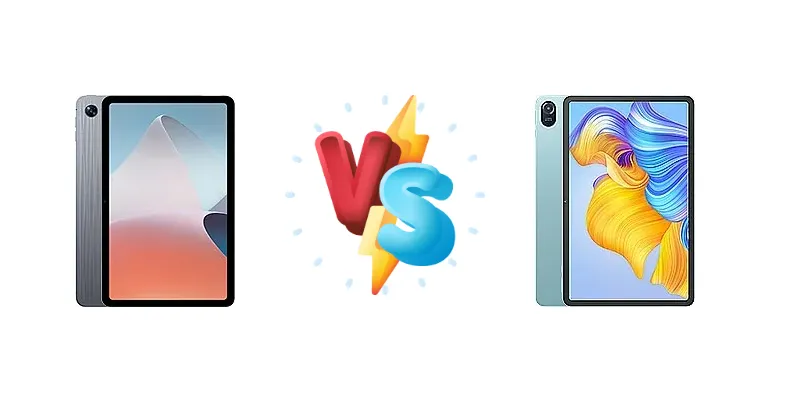
The Oppo Pad Air and Honor Pad 8 represent a growing segment of affordable Android tablets aiming to deliver a capable experience without breaking the bank. Both devices leverage the Qualcomm Snapdragon 680 chipset, but subtle differences in display quality and charging capabilities could sway your decision. This comparison dives deep into the specifics to determine which tablet offers the best overall value.
🏆 Quick Verdict
For most users, the Honor Pad 8 edges out the Oppo Pad Air. While both share the same Snapdragon 680 processor, the Honor Pad 8’s brighter display (392 nits vs 352 nits) and faster 22.5W charging provide a noticeably improved user experience, justifying a potential price premium.
| Network |
|---|
| 2G bands | N/A | N/A |
| 3G bands | N/A | N/A |
| 4G bands | N/A | N/A |
| EDGE | No | No |
| GPRS | No | No |
| Technology | No cellular connectivity | No cellular connectivity |
| Launch |
|---|
| Announced | 2022, May 23 | 2022, July 22 |
| Status | Available. Released 2022, June 01 | Available. Released 2022, July 29 |
| Body |
|---|
| Build | - | Glass front, aluminum frame, aluminum back |
| Dimensions | 245.1 x 154.8 x 6.9 mm (9.65 x 6.09 x 0.27 in) | 278.5 x 174.1 x 6.9 mm (10.96 x 6.85 x 0.27 in) |
| SIM | No | No |
| Weight | 440 g (15.52 oz) | 520 g (1.15 lb) |
| | Stylus support | Stylus support |
| Display |
|---|
| Resolution | 1200 x 2000 pixels, 5:3 ratio (~225 ppi density) | 1200 x 2000 pixels, 5:3 ratio (~194 ppi density) |
| Size | 10.36 inches, 305.5 cm2 (~80.5% screen-to-body ratio) | 12.0 inches, 409.9 cm2 (~84.5% screen-to-body ratio) |
| Type | IPS LCD, 1B colors, 360 nits (typ) | IPS LCD, 1B colors, 350 nits (typ) |
| Platform |
|---|
| CPU | Octa-core (4x2.4 GHz Kryo 265 Gold & 4x1.9 GHz Kryo 265 Silver) | Octa-core (4x2.4 GHz Kryo 265 Gold & 4x1.9 GHz Kryo 265 Silver) |
| Chipset | Qualcomm SM6225 Snapdragon 680 4G (6 nm) | Qualcomm SM6225 Snapdragon 680 4G (6 nm) |
| GPU | Adreno 610 | Adreno 610 |
| OS | Android 12, ColorOS 12 | Android 12, Magic UI 6.1 |
| Memory |
|---|
| Card slot | microSDXC | No |
| Internal | 64GB 4GB RAM, 128GB 4GB RAM, 128GB 6GB RAM | 128GB 4GB RAM, 128GB 6GB RAM, 256GB 8GB RAM |
| | UFS 2.2 | - |
| Main Camera |
|---|
| Features | Panorama | LED flash |
| Single | 8 MP, f/2.0, AF | 5 MP, f/2.2, 27mm (wide), 1/5.0", 1.12µm, AF |
| Video | 1080p@30fps | 1080p@30fps |
| Selfie camera |
|---|
| Single | 5 MP, f/2.2 | 5 MP, f/2.2, 27mm (wide), 1/5.0", 1.12µm |
| Video | 1080p@30fps | 1080p@30fps |
| Sound |
|---|
| 3.5mm jack | No | No |
| 35mm jack | No | No |
| Loudspeaker | Yes, with stereo speakers (4 speakers) | Yes, with stereo speakers (8 speakers) |
| Comms |
|---|
| Bluetooth | 5.1, A2DP, LE, aptX HD | 5.1, A2DP, LE |
| NFC | No | No |
| Positioning | No | No |
| Radio | No | No |
| USB | USB Type-C 2.0, OTG | USB Type-C, OTG |
| WLAN | Wi-Fi 802.11 a/b/g/n/ac, dual-band, Wi-Fi Direct | Wi-Fi 802.11 a/b/g/n/ac, dual-band |
| Features |
|---|
| Sensors | Accelerometer, gyro, compass | Accelerometer |
| Battery |
|---|
| Charging | 18W wired, PD
5W reverse wired | 22.5W wired |
| Type | Li-Po 7100 mAh | Li-Po 7250 mAh |
| Misc |
|---|
| Colors | Gray, Silver | Dark Blue, Gold, Mint |
| Models | OPD2102, X21N2 | HEY-W09 |
| Price | About 300 EUR | About 330 EUR |
| Tests |
|---|
| Display |
Contrast ratio: 1391:1 |
Contrast ratio: 1468:1 (nominal) |
| Loudspeaker |
-28.3 LUFS (Average)
|
-22.7 LUFS (Excellent)
|
| Performance |
AnTuTu: 249272 (v9)
GeekBench: 1661 (v5.1)
GFXBench: 7.2fps (ES 3.1 onscreen) |
AnTuTu: 279242 (v9)
GeekBench: 1545 (v5.1)
GFXBench: 7.3fps (ES 3.1 onscreen) |
Oppo Pad Air
- Potentially lower price point
- Clean and streamlined software experience (typical of Oppo)
- PD charging support
- Lower peak display brightness
- Slower 18W charging
- Limited information on RAM configuration
Honor Pad 8
- Brighter display for better outdoor visibility
- Faster 22.5W charging
- Slightly higher contrast ratio
- May be slightly more expensive
- Software experience may include more pre-installed apps
- Limited information on RAM configuration
Display Comparison
Both the Oppo Pad Air and Honor Pad 8 feature displays with similar characteristics, but the Honor Pad 8 holds a slight advantage. The Honor Pad 8 achieves a measured peak brightness of 392 nits, compared to the Oppo Pad Air’s 352 nits. This 11.4% increase in brightness translates to better visibility in brightly lit environments. Contrast ratios are also slightly better on the Honor Pad 8 at 1468:1 (nominal) versus the Oppo Pad Air’s 1391:1. While both are adequate, the Honor Pad 8’s display will offer a more vibrant and punchy image. Neither manufacturer specifies panel technology (IPS, LCD, etc.) which is typical for this price point.
Camera Comparison
Neither tablet is positioned as a photography powerhouse, and camera details are sparse. Given the target market, camera quality is unlikely to be a deciding factor. It’s safe to assume both devices feature basic camera setups suitable for video calls and occasional snapshots. Without specific sensor details, it’s impossible to definitively say which tablet offers a better camera experience.
Performance
Performance is virtually identical between the two tablets, as both are powered by the Qualcomm Snapdragon 680 4G (6 nm) chipset. The octa-core CPU configuration – 4x2.4 GHz Kryo 265 Gold & 4x1.9 GHz Kryo 265 Silver – is also the same. This means users can expect similar performance in everyday tasks, multitasking, and light gaming. The lack of 5G connectivity on either device limits their appeal to users requiring constant on-the-go data access. RAM configurations are not specified, but will likely be the primary determinant of multitasking capability. Thermal performance will likely be similar, given the relatively low power draw of the Snapdragon 680.
Battery Life
The Honor Pad 8 boasts a faster 22.5W wired charging capability, a clear advantage over the Oppo Pad Air’s 18W wired charging. While battery capacity isn’t specified for either device, the faster charging speed on the Honor Pad 8 will significantly reduce charging times, making it more convenient for users who need to quickly top up their tablet. Both devices support PD (Power Delivery) and 5W reverse wired charging, allowing them to charge other devices, albeit slowly.
Buying Guide
Buy the Oppo Pad Air if you prioritize a slightly more streamlined software experience and are on a very tight budget. It’s a solid choice for basic media consumption and light productivity. Buy the Honor Pad 8 if you value a brighter, more visible display for outdoor use and faster charging to minimize downtime. It’s better suited for users who frequently travel or rely on their tablet throughout the day.
Frequently Asked Questions
❓ Does the Snapdragon 680 in either tablet struggle with demanding games like PUBG or Genshin Impact?
The Snapdragon 680 is a capable processor for casual gaming, but it will likely struggle with graphically intensive titles like PUBG or Genshin Impact at higher settings. Expect to play these games at lower graphics settings and frame rates for a smoother experience. Both tablets will likely exhibit some thermal throttling during extended gaming sessions.
❓ What type of storage does each tablet use, and is it expandable via microSD card?
Storage type (e.g., UFS 2.2) and microSD card support are not specified in the available data. However, given the price point, it's likely both tablets utilize eMMC storage. MicroSD card support is also uncertain; checking official product listings is recommended before purchase if expandable storage is a priority.
❓ How does the software experience differ between Oppo's ColorOS and Honor's Magic UI?
Oppo's ColorOS is generally known for its cleaner interface and focus on customization, while Honor's Magic UI often includes more pre-installed apps and features. Both are based on Android, but the level of bloatware and the overall aesthetic differ. Users who prefer a minimalist experience may lean towards the Oppo Pad Air.