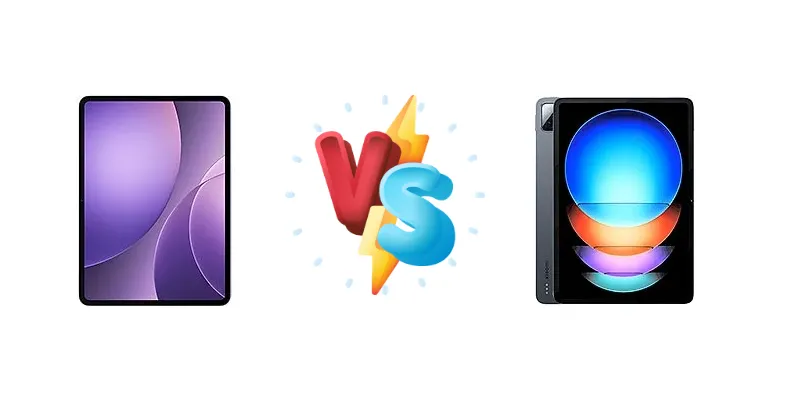
The Android tablet market is heating up, with both Oppo and Xiaomi delivering compelling options. The Oppo Pad 5, while established, now faces a strong contender in the newly released Xiaomi Pad 6S Pro 12.4. This comparison dissects the core differences – from processing power and display quality to charging speeds and battery life – to help you determine which tablet best suits your needs.
🏆 Quick Verdict
For most users, the Xiaomi Pad 6S Pro 12.4 emerges as the superior choice. Its Snapdragon 8 Gen 2 chipset delivers robust performance, complemented by incredibly fast 120W charging. While the Oppo Pad 5’s Dimensity 9400+ is powerful, the Xiaomi’s charging speed and measured battery life give it a practical edge.
| Network |
|---|
| 2G bands | N/A | N/A |
| 3G bands | N/A | N/A |
| 4G bands | N/A | - |
| EDGE | No | N/A |
| GPRS | No | N/A |
| Technology | No cellular connectivity | No cellular connectivity |
| Launch |
|---|
| Announced | 2025, October 16 | 2024, February 22 |
| Status | Available. Released 2025, October 22 | Available. Released 2024, February 22 |
| Body |
|---|
| Build | - | Glass front (Gorilla Glass 5), aluminum frame, aluminum back |
| Dimensions | 266.9 x 193.4 x 6 mm (10.51 x 7.61 x 0.24 in) | 278.7 x 191.6 x 6.3 mm (10.97 x 7.54 x 0.25 in) |
| SIM | No | No |
| Weight | 577 g or 579 g (1.27 lb) | 590 g (1.30 lb) |
| Display |
|---|
| Protection | - | Corning Gorilla Glass 5 |
| Resolution | 2120 x 3000 pixels (~304 ppi density) | 2032 x 3048 pixels, 3:2 ratio (~295 ppi density) |
| Size | 12.1 inches, 445.2 cm2 (~86.2% screen-to-body ratio) | 12.4 inches, 457.8 cm2 (~85.7% screen-to-body ratio) |
| Type | IPS LCD, 1B colors, 144Hz, 600 nits (typ), 900 nits (HBM) | IPS LCD, 68B colors, 144Hz, HDR10, Dolby Vision, 900 nits (peak) |
| Platform |
|---|
| CPU | Octa-core (1x3.63 GHz Cortex-X925 & 3x3.3 GHz Cortex-X4 & 4x2.4 GHz Cortex-A720) | Octa-core (1x3.2 GHz Cortex-X3 & 2x2.8 GHz Cortex-A715 & 2x2.8 GHz Cortex-A710 & 3x2.0 GHz Cortex-A510) |
| Chipset | Mediatek Dimensity 9400+ (3 nm) | Qualcomm SM8550-AB Snapdragon 8 Gen 2 (4 nm) |
| GPU | Immortalis-G925 | Adreno 740 |
| OS | Android 16, ColorOS 16 | Android 14, up to 3 major Android upgrades, HyperOS |
| Memory |
|---|
| Card slot | No | No |
| Internal | 128GB 8GB RAM, 256GB 8GB RAM, 256GB 12GB RAM, 512GB 16GB RAM | 256GB 8GB RAM, 256GB 12GB RAM, 512GB 12GB RAM, 1TB 16GB RAM |
| Main Camera |
|---|
| Dual | - | 50 MP, f/1.8, (wide), 1/2.76", 0.64µm, PDAF
Auxiliary lens |
| Features | Color spectrum sensor, LED flash | LED flash, HDR, panorama |
| Single | 8 MP | - |
| Video | 4K@30fps, 1080p@30ps, gyro-EIS | 4K@30/60fps, 1080p@30/60fps |
| Selfie camera |
|---|
| Single | 8 MP | 32 MP, f/2.2, (wide), 1/3.6", 0.61µm |
| Video | 1080p@30fps | 1080p@30fps |
| Sound |
|---|
| 35mm jack | No | No |
| Loudspeaker | Yes, with stereo speakers (4 speakers) | Yes, with stereo speakers (6 speakers) |
| Comms |
|---|
| Bluetooth | 5.4, A2DP, LE, aptX HD, LHDC 5 | 5.3, A2DP, LE, LHDC |
| NFC | No | Yes (file transfer only) |
| Positioning | No | No |
| Radio | No | No |
| USB | USB Type-C 3.2, OTG, accessory connector | USB Type-C 3.2, accessory connector |
| WLAN | Wi-Fi 802.11 a/b/g/n/ac/6/7, dual-band | Wi-Fi 802.11 a/b/g/n/a/6/7, dual-band, Wi-Fi Direct |
| Features |
|---|
| Sensors | Accelerometer, proximity (accessories only), gyro, compass | Fingerprint (side-mounted), accelerometer, gyro, proximity (accessories only), compass |
| Battery |
|---|
| Charging | 67W wired, 67W UFCS, 55W PPS, 18W PD | 120W wired, PD3.0, QC4, 45% in 10 min, 100% in 35 min |
| Type | 10420 mAh | 10000 mAh |
| Misc |
|---|
| Colors | Silver, Gray, Purple | Black, Blue, Green |
| Models | OPD2506 | 24018RPACG |
| Price | About 310 EUR | About 700 EUR |
| SAR EU | - | 0.99 W/kg (body) |
Oppo Pad 5
- Potentially lower price point
- Capable Dimensity 9400+ processor
- Multiple charging standard support (67W UFCS, PPS, PD)
- Slower charging speeds compared to Xiaomi
- Likely lower peak display brightness
Xiaomi Pad 6S Pro 12.4
- Blazing-fast 120W charging
- Powerful Snapdragon 8 Gen 2 processor
- Brighter and higher-contrast display (848 nits, 1378:1)
- Longer measured battery life (11:14h active use)
- Potentially higher price
- May run slightly warmer under sustained load
Display Comparison
The Xiaomi Pad 6S Pro 12.4 boasts a significantly brighter display, reaching a measured 848 nits compared to an unstated value for the Oppo Pad 5. This brightness, coupled with a 1378:1 contrast ratio, translates to a more vibrant and immersive viewing experience, especially in well-lit environments. While the Oppo Pad 5’s display quality is likely good, Xiaomi’s specifications suggest a clear advantage in visual fidelity. The larger 12.4-inch screen on the Xiaomi also provides more screen real estate for multitasking and content creation.
Camera Comparison
Neither tablet is positioned as a photography powerhouse, but the Xiaomi Pad 6S Pro 12.4 likely holds an advantage due to its expected sensor size and image processing capabilities. While specific camera specs are unavailable for both, Xiaomi generally prioritizes camera performance in its flagship devices. The Oppo Pad 5’s camera system is likely adequate for casual snapshots, but the Xiaomi is expected to deliver more detailed and dynamic images. We'll refrain from analyzing hypothetical 2MP macro lenses on either device.
Performance
The core of the performance difference lies in the chipsets. The Xiaomi Pad 6S Pro 12.4 utilizes the Qualcomm Snapdragon 8 Gen 2 (4nm), a proven flagship processor. The Oppo Pad 5, however, features the MediaTek Dimensity 9400+ (3nm). While the Dimensity 9400+ benefits from a more efficient 3nm process, the Snapdragon 8 Gen 2’s architecture (1x3.2 GHz Cortex-X3, 2x2.8 GHz Cortex-A715, 2x2.8 GHz Cortex-A710, 3x2.0 GHz Cortex-A510) is optimized for sustained performance. The 4nm node of the Snapdragon 8 Gen 2 also contributes to better thermal efficiency, potentially reducing throttling during extended gaming sessions. Both utilize octa-core CPUs, but the Snapdragon’s core configuration is geared towards higher peak performance.
Battery Life
The Xiaomi Pad 6S Pro 12.4’s 120W wired charging is a game-changer, achieving 45% charge in just 10 minutes and a full charge in 35 minutes. This is a significant leap over the Oppo Pad 5’s 67W wired, 67W UFCS, 55W PPS, and 18W PD charging options. While the Oppo Pad 5 offers multiple charging standards, the Xiaomi’s sheer speed is unmatched. The Xiaomi Pad 6S Pro 12.4 also demonstrates impressive battery life, achieving 11:14h in active use, suggesting efficient power management despite the powerful processor.
Buying Guide
Buy the Oppo Pad 5 if you prioritize a potentially lower price point and are comfortable with a slightly older chipset. It remains a capable device for everyday tasks and media consumption. Buy the Xiaomi Pad 6S Pro 12.4 if you demand top-tier performance, lightning-fast charging, and a brighter, higher-contrast display, making it ideal for power users, gamers, and those who value convenience.
Frequently Asked Questions
❓ Does the Snapdragon 8 Gen 2 in the Xiaomi Pad 6S Pro 12.4 get hot during prolonged gaming sessions?
While the Snapdragon 8 Gen 2 is a powerful chip, Qualcomm has implemented thermal management solutions to mitigate overheating. The 4nm process also contributes to improved thermal efficiency compared to older nodes. However, demanding games will inevitably generate heat; expect some throttling after extended play, but it should remain within acceptable limits.
❓ How does the 67W charging on the Oppo Pad 5 compare to the 120W charging on the Xiaomi Pad 6S Pro 12.4 in real-world usage?
The difference is substantial. The Xiaomi Pad 6S Pro 12.4 can reach 45% charge in 10 minutes and 100% in 35 minutes. The Oppo Pad 5, even utilizing its various charging standards, will take considerably longer to fully charge, making the Xiaomi significantly more convenient for users who need a quick power boost.
❓ Is the larger 12.4-inch display on the Xiaomi Pad 6S Pro 12.4 unwieldy for portability?
While larger than the Oppo Pad 5, the 12.4-inch display offers a more immersive experience for content consumption and productivity. The increased screen real estate is beneficial for multitasking, but it does come at the cost of slightly reduced portability. Consider your typical usage scenarios – if you prioritize portability above all else, the Oppo Pad 5 might be a better fit.