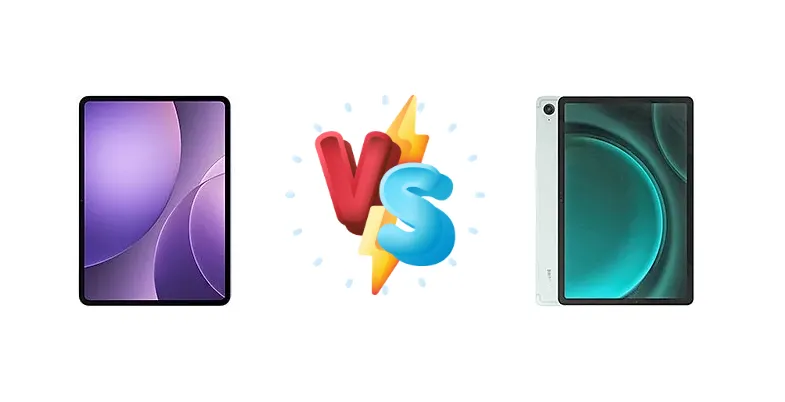
The Android tablet market is heating up, with the Oppo Pad 5 and Samsung Galaxy Tab S9 FE offering compelling options at different price points. The Pad 5, boasting a newer Mediatek Dimensity 9400+ chipset, aims for raw power, while the Tab S9 FE leverages Samsung’s ecosystem and a more established Exynos 1380 platform. This comparison dissects their key differences to help you choose the right tablet for your needs.
🏆 Quick Verdict
For users prioritizing raw performance and incredibly fast charging, the Oppo Pad 5 is the clear winner. Its Dimensity 9400+ chipset offers a significant leap in CPU and GPU capabilities over the Tab S9 FE’s Exynos 1380. However, the Tab S9 FE provides a more balanced experience with Samsung’s software and broader accessory support.
| Network |
|---|
| 2G bands | N/A | GSM 850 / 900 / 1800 / 1900 |
| 3G bands | N/A | HSDPA 850 / 900 / 1700(AWS) / 1900 / 2100 |
| 4G bands | N/A | 1, 2, 3, 4, 5, 7, 8, 12, 13, 17, 20, 26, 28, 32, 38, 40, 41, 66 |
| 5G bands | - | 1, 3, 5, 7, 8, 20, 28, 38, 40, 41, 66, 77, 78 SA/NSA/Sub6 |
| EDGE | No | - |
| GPRS | No | - |
| Speed | - | HSPA, LTE, 5G - cellular model only |
| Technology | No cellular connectivity | GSM / HSPA / LTE / 5G |
| Launch |
|---|
| Announced | 2025, October 16 | 2023, October 04 |
| Status | Available. Released 2025, October 22 | Available. Released 2023, October 16 |
| Body |
|---|
| Build | - | Glass front, aluminum back, aluminum frame |
| Dimensions | 266.9 x 193.4 x 6 mm (10.51 x 7.61 x 0.24 in) | 254.3 x 165.8 x 6.5 mm (10.01 x 6.53 x 0.26 in) |
| SIM | No | Nano-SIM + eSIM (cellular model only) |
| Weight | 577 g or 579 g (1.27 lb) | 523 g or 524 g (1.15 lb) |
| Display |
|---|
| Resolution | 2120 x 3000 pixels (~304 ppi density) | 1440 x 2304 pixels, 16:10 ratio (~249 ppi density) |
| Size | 12.1 inches, 445.2 cm2 (~86.2% screen-to-body ratio) | 10.9 inches, 344.5 cm2 (~81.7% screen-to-body ratio) |
| Type | IPS LCD, 1B colors, 144Hz, 600 nits (typ), 900 nits (HBM) | IPS LCD, 90Hz |
| Platform |
|---|
| CPU | Octa-core (1x3.63 GHz Cortex-X925 & 3x3.3 GHz Cortex-X4 & 4x2.4 GHz Cortex-A720) | Octa-core (4x2.4 GHz Cortex-A78 & 4x2.0 GHz Cortex-A55) |
| Chipset | Mediatek Dimensity 9400+ (3 nm) | Exynos 1380 (5 nm) |
| GPU | Immortalis-G925 | Mali-G68 MP5 |
| OS | Android 16, ColorOS 16 | Android 13, up to 4 major Android upgrades, One UI 6 |
| Memory |
|---|
| Card slot | No | microSDXC (dedicated slot) |
| Internal | 128GB 8GB RAM, 256GB 8GB RAM, 256GB 12GB RAM, 512GB 16GB RAM | 128GB 6GB RAM, 128GB 8GB RAM, 256GB 8GB RAM |
| Main Camera |
|---|
| Features | Color spectrum sensor, LED flash | - |
| Single | 8 MP | 8 MP, (wide) |
| Video | 4K@30fps, 1080p@30ps, gyro-EIS | 4K@30fps, 1080p@30fps |
| Selfie camera |
|---|
| Single | 8 MP | 12 MP, (ultrawide) |
| Video | 1080p@30fps | Yes |
| Sound |
|---|
| 35mm jack | No | No |
| Loudspeaker | Yes, with stereo speakers (4 speakers) | Yes, with stereo speakers |
| Comms |
|---|
| Bluetooth | 5.4, A2DP, LE, aptX HD, LHDC 5 | 5.3, A2DP, LE |
| NFC | No | No |
| Positioning | No | GPS, GALILEO, GLONASS, BDS, QZSS - cellular model only |
| Radio | No | No |
| USB | USB Type-C 3.2, OTG, accessory connector | USB Type-C 2.0, magnetic connector |
| WLAN | Wi-Fi 802.11 a/b/g/n/ac/6/7, dual-band | Wi-Fi 802.11 a/b/g/n/ac/6, dual-band, Wi-Fi Direct |
| Features |
|---|
| Sensors | Accelerometer, proximity (accessories only), gyro, compass | Fingerprint (side-mounted), accelerometer, gyro, compass, proximity (accessories only) |
| Battery |
|---|
| Charging | 67W wired, 67W UFCS, 55W PPS, 18W PD | 45W wired, QC2.0 |
| Type | 10420 mAh | Li-Po 8000 mAh |
| Misc |
|---|
| Colors | Silver, Gray, Purple | Mint, Silver, Gray, Lavender |
| Models | OPD2506 | SM-X510, SM-X516B |
| Price | About 310 EUR | About 300 EUR |
| SAR | - | 1.55 W/kg (body) |
| SAR EU | - | 0.59 W/kg (body) |
Oppo Pad 5
- Significantly faster processor with the Dimensity 9400+
- Industry-leading 67W+ fast charging support
- Potentially better gaming performance due to superior GPU
- Oppo’s software experience may not appeal to all users
- Accessory ecosystem might be less developed than Samsung’s
Samsung Galaxy Tab S9 FE
- Seamless integration with the Samsung ecosystem
- Refined and user-friendly One UI software
- Wider availability of accessories (S Pen support)
- Less powerful processor compared to the Oppo Pad 5
- Slower charging speeds (45W)
- Potentially more thermal throttling under sustained load
Display Comparison
While display specifications aren't provided, the Oppo Pad 5 is expected to have a higher refresh rate display, typical of its segment, offering smoother scrolling and animations. The Samsung Galaxy Tab S9 FE, benefiting from Samsung’s display expertise, likely delivers excellent color accuracy and viewing angles. The absence of LTPO in either device suggests both will rely on adaptive refresh rate technologies to balance smoothness and power consumption. Bezels are likely comparable, focusing on maximizing screen real estate within their respective price brackets.
Camera Comparison
Given the tablet form factor, camera performance isn't a primary focus. However, the Oppo Pad 5 is likely to feature a more competitive camera setup, potentially with a larger main sensor, to capitalize on its processing power. The Tab S9 FE’s camera is expected to be adequate for casual snapshots and video calls. The inclusion of Optical Image Stabilization (OIS) on the Oppo Pad 5, if present, would provide a significant advantage in low-light conditions. The prevalence of 2MP macro lenses on both devices suggests they are largely for marketing purposes and offer limited real-world benefit.
Performance
The core difference lies in the chipsets. The Oppo Pad 5’s Mediatek Dimensity 9400+ (3nm) is a significant upgrade over the Samsung Galaxy Tab S9 FE’s Exynos 1380 (5nm). The Dimensity 9400+ features a Cortex-X925 prime core clocked at 3.63 GHz, alongside Cortex-X4 and A720 cores, offering substantially higher single-core and multi-core performance. The 3nm process node further enhances efficiency and reduces thermal throttling. The Exynos 1380, while capable, relies on older Cortex-A78 and A55 cores. This translates to a noticeable performance gap in demanding applications and games, favoring the Oppo Pad 5. The Pad 5's likely faster LPDDR5x RAM will also contribute to snappier multitasking.
Battery Life
Battery capacity isn't specified, but the Oppo Pad 5’s charging capabilities are a standout feature. Supporting 67W wired charging, 67W UFCS, 55W PPS, and 18W PD, it can recharge significantly faster than the Tab S9 FE’s 45W wired charging with QC2.0. This means less downtime and more usage. While the Tab S9 FE might have a slightly larger battery, the Oppo Pad 5’s faster charging effectively mitigates any capacity difference. The inclusion of UFCS and PPS allows for broader compatibility with various chargers and optimized charging profiles.
Buying Guide
Buy the Oppo Pad 5 if you need a tablet for demanding tasks like gaming, video editing, or running multiple apps simultaneously, and value the fastest possible charging speeds. Buy the Samsung Galaxy Tab S9 FE if you prioritize seamless integration with the Samsung ecosystem, prefer a more refined software experience, and require broader accessory compatibility, even if it means sacrificing some raw processing power.
Frequently Asked Questions
❓ Does the Exynos 1380 in the Tab S9 FE overheat during extended gaming sessions?
The Exynos 1380 is a capable chip, but its 5nm process and less advanced core architecture mean it's more prone to thermal throttling during prolonged, demanding gaming. While it won't shut down, you may experience frame rate drops after 30-45 minutes of intense gameplay. The Oppo Pad 5's Dimensity 9400+ with its 3nm process is better equipped to handle sustained loads.
❓ What are the benefits of UFCS and PPS charging on the Oppo Pad 5?
UFCS (Universal Fast Charging Standard) and PPS (Programmable Power Supply) allow the Oppo Pad 5 to negotiate optimal charging profiles with a wider range of chargers, including those from other brands. This ensures faster and more efficient charging, minimizing heat generation and extending battery lifespan. The Tab S9 FE’s QC2.0 is less versatile in this regard.
❓ Is the S Pen compatibility of the Tab S9 FE a significant advantage for note-taking and drawing?
For users heavily invested in note-taking or digital art, the S Pen support on the Tab S9 FE is a major benefit. Samsung’s S Pen offers low latency and excellent pressure sensitivity, providing a natural writing and drawing experience. The Oppo Pad 5 doesn't have native stylus support, limiting its appeal for these use cases.