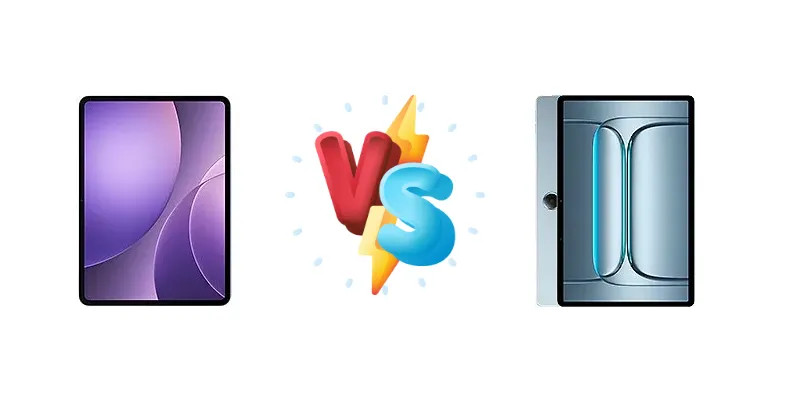
The Android tablet market is heating up, with Oppo and OnePlus offering distinct options. The Oppo Pad 5 arrived as a premium contender, while the OnePlus Pad Lite aims to deliver a solid experience at a more accessible price point. This comparison dissects the core differences – from processing power and charging speeds to overall value – to determine which tablet best suits your needs.
🏆 Quick Verdict
For users prioritizing performance and future-proofing, the Oppo Pad 5 is the clear winner. Its Dimensity 9400+ chipset offers a substantial leap in processing power. However, the OnePlus Pad Lite provides a compelling value proposition for casual users and those on a tighter budget.
| Network |
|---|
| 2G bands | N/A | GSM 850 / 900 / 1800 / 1900 - cellular model only |
| 3G bands | N/A | HSDPA 850 / 900 / 2100 - cellular model only |
| 4G bands | N/A | LTE - cellular model only |
| EDGE | No | - |
| GPRS | No | - |
| Speed | - | HSPA, LTE - cellular model only |
| Technology | No cellular connectivity | GSM / HSPA / LTE |
| Launch |
|---|
| Announced | 2025, October 16 | 2025, July 08 |
| Status | Available. Released 2025, October 22 | Available. Released 2025, August 14 |
| Body |
|---|
| Dimensions | 266.9 x 193.4 x 6 mm (10.51 x 7.61 x 0.24 in) | 254.9 x 166.5 x 7.4 mm (10.04 x 6.56 x 0.29 in) |
| SIM | No | Yes - cellular model only |
| Weight | 577 g or 579 g (1.27 lb) | 530 g (1.17 lb) |
| Display |
|---|
| Resolution | 2120 x 3000 pixels (~304 ppi density) | 1200 x 1920 pixels, 16:10 ratio (~207 ppi density) |
| Size | 12.1 inches, 445.2 cm2 (~86.2% screen-to-body ratio) | 11.0 inches, 347.5 cm2 (~81.9% screen-to-body ratio) |
| Type | IPS LCD, 1B colors, 144Hz, 600 nits (typ), 900 nits (HBM) | IPS LCD, 1B colors, 90Hz, 500 nits |
| Platform |
|---|
| CPU | Octa-core (1x3.63 GHz Cortex-X925 & 3x3.3 GHz Cortex-X4 & 4x2.4 GHz Cortex-A720) | Octa-core (2x2.2 GHz Cortex-A76 & 6x2.0 GHz Cortex-A55) |
| Chipset | Mediatek Dimensity 9400+ (3 nm) | Mediatek Helio G100 (6 nm) |
| GPU | Immortalis-G925 | Mali-G57 MC2 |
| OS | Android 16, ColorOS 16 | Android 15, OxygenOS 15 |
| Memory |
|---|
| Card slot | No | Unspecified |
| Internal | 128GB 8GB RAM, 256GB 8GB RAM, 256GB 12GB RAM, 512GB 16GB RAM | 128GB 6GB RAM, 128GB 8GB RAM |
| Main Camera |
|---|
| Features | Color spectrum sensor, LED flash | - |
| Single | 8 MP | 5 MP |
| Video | 4K@30fps, 1080p@30ps, gyro-EIS | 1080p@30fps |
| Selfie camera |
|---|
| Single | 8 MP | 5 MP |
| Video | 1080p@30fps | 1080p@30fps |
| Sound |
|---|
| 35mm jack | No | No |
| Loudspeaker | Yes, with stereo speakers (4 speakers) | Yes, with stereo speakers (4 speakers, Hi-Res audio) |
| Comms |
|---|
| Bluetooth | 5.4, A2DP, LE, aptX HD, LHDC 5 | 5.2, A2DP, LE, aptX HD |
| NFC | No | No |
| Positioning | No | GPS, (cellular model only) - unconfirmed |
| Radio | No | No |
| USB | USB Type-C 3.2, OTG, accessory connector | USB Type-C 2.0 |
| WLAN | Wi-Fi 802.11 a/b/g/n/ac/6/7, dual-band | Wi-Fi 802.11 a/b/g/n/ac, dual-band |
| Features |
|---|
| Sensors | Accelerometer, proximity (accessories only), gyro, compass | Unspecified |
| Battery |
|---|
| Charging | 67W wired, 67W UFCS, 55W PPS, 18W PD | 33W wired |
| Type | 10420 mAh | Li-Po 9340 mAh |
| Misc |
|---|
| Colors | Silver, Gray, Purple | Aero Blue |
| Models | OPD2506 | OPD2480 |
| Price | About 310 EUR | About 200 EUR |
Oppo Pad 5
- Significantly faster processor for demanding tasks
- Ultra-fast 67W charging for minimal downtime
- More future-proof due to superior chipset
- Likely higher price point
- May have a larger physical footprint
OnePlus Pad Lite
- More affordable price
- Sufficient performance for everyday tasks
- Potentially lighter and more portable
- Slower processor may struggle with demanding apps
- Slower 33W charging
- Less future-proof
Display Comparison
While both tablets likely feature LCD panels (data not provided), the core difference lies in the processing power driving them. Display specs like resolution and refresh rate are missing, but the chipset will heavily influence the smoothness of animations and responsiveness. The Oppo Pad 5’s Dimensity 9400+ will ensure a fluid experience even with graphically intensive content, while the OnePlus Pad Lite’s Helio G100 may exhibit occasional stutters under heavy load.
Camera Comparison
Given the tablet form factor, camera quality is less critical. However, the absence of detailed camera specifications suggests both tablets likely feature modest camera setups. Without sensor size or aperture information, it’s difficult to make a definitive judgment. We can assume the Oppo Pad 5, being the higher-end device, may have a slightly better camera module, but it’s unlikely to be a key purchasing factor for most users.
Performance
The performance gap is the most significant differentiator. The Oppo Pad 5’s Mediatek Dimensity 9400+ (3nm) is a flagship-class chipset featuring a Cortex-X925 prime core clocked at 3.63 GHz, alongside Cortex-X4 and Cortex-A720 cores. This architecture, built on a cutting-edge 3nm process, delivers substantial performance and efficiency gains over the OnePlus Pad Lite’s Helio G100 (6nm). The G100, with its Cortex-A76 and A55 cores, is geared towards mainstream usage, not demanding tasks. The 3nm node of the Dimensity 9400+ translates to lower heat generation and sustained performance, crucial for extended gaming sessions. The Oppo Pad 5 will handle multitasking and resource-intensive applications with ease, while the OnePlus Pad Lite may struggle with heavier workloads.
Battery Life
Battery capacity is not specified, but the charging capabilities reveal a significant difference. The Oppo Pad 5 supports a blazing-fast 67W wired charging, alongside 67W UFCS, 55W PPS, and 18W PD. This means incredibly quick top-ups, potentially going from 0-100% in under 40 minutes. The OnePlus Pad Lite, with its 33W wired charging, is considerably slower. While a larger battery on the OnePlus Pad Lite could partially offset this, the convenience of the Oppo Pad 5’s rapid charging is a major advantage for users who need to quickly replenish their battery.
Buying Guide
Buy the Oppo Pad 5 if you need a tablet capable of demanding tasks like gaming, video editing, or running multiple apps simultaneously. Its superior chipset and faster charging will significantly enhance your productivity and entertainment. Buy the OnePlus Pad Lite if you prioritize affordability and a streamlined experience for everyday tasks like browsing, streaming, and light productivity. It’s an excellent choice for students or anyone seeking a portable media consumption device.
Frequently Asked Questions
❓ Will the Helio G100 in the OnePlus Pad Lite struggle with graphically intensive games like Genshin Impact?
The Helio G100 is a capable chipset for casual gaming, but demanding titles like Genshin Impact will likely require reduced graphics settings and may still experience occasional frame drops. The Oppo Pad 5’s Dimensity 9400+ offers a much smoother gaming experience with higher graphical fidelity.
❓ How much faster is the 67W charging on the Oppo Pad 5 compared to the 33W charging on the OnePlus Pad Lite in real-world use?
The 67W charging on the Oppo Pad 5 can potentially add several hours of usage in just 15-20 minutes, while the 33W charging on the OnePlus Pad Lite will take considerably longer to achieve a similar charge level. Expect a full charge on the Oppo Pad 5 to be significantly quicker.
❓ Is the difference in chipset performance noticeable for everyday tasks like browsing and streaming video?
For basic tasks like web browsing, video streaming, and social media, the difference in chipset performance may not be immediately noticeable. However, the Oppo Pad 5 will feel more responsive and smoother when multitasking or switching between apps.