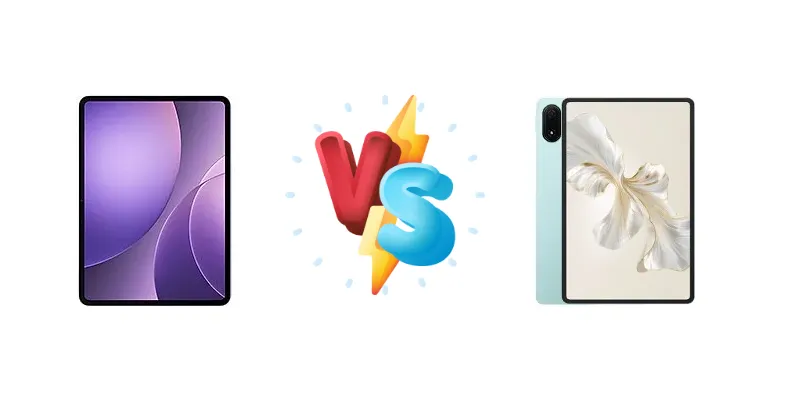
The Android tablet market is heating up, with the Oppo Pad 5 and Honor Pad 9 Pro vying for attention. The Pad 5, leveraging the newer Mediatek Dimensity 9400+ chipset, promises a significant performance leap, while the Pad 9 Pro aims to deliver a balanced experience with its Dimensity 8100 and focus on fast charging. This comparison dissects the key differences to help you choose the right tablet for your needs.
🏆 Quick Verdict
For users prioritizing raw performance and future-proofing, the Oppo Pad 5 is the clear winner. Its Dimensity 9400+ chipset offers a substantial upgrade over the Honor Pad 9 Pro’s Dimensity 8100. However, the Honor Pad 9 Pro remains a compelling option for those seeking a solid all-around experience with a focus on faster charging standards.
| Network |
|---|
| 2G bands | N/A | N/A |
| 3G bands | N/A | N/A |
| 4G bands | N/A | - |
| EDGE | No | No |
| GPRS | No | No |
| Technology | No cellular connectivity | No cellular connectivity |
| Launch |
|---|
| Announced | 2025, October 16 | 2024, July 12 |
| Status | Available. Released 2025, October 22 | Available. Released 2024, July 12 |
| Body |
|---|
| Build | - | Glass front, aluminum frame, aluminum back |
| Dimensions | 266.9 x 193.4 x 6 mm (10.51 x 7.61 x 0.24 in) | 277 x 179.9 x 6.6 mm (10.91 x 7.08 x 0.26 in) |
| SIM | No | No |
| Weight | 577 g or 579 g (1.27 lb) | 589 g (1.30 lb) |
| Display |
|---|
| Resolution | 2120 x 3000 pixels (~304 ppi density) | 1600 x 2560 pixels, 16:10 ratio (~249 ppi density) |
| Size | 12.1 inches, 445.2 cm2 (~86.2% screen-to-body ratio) | 12.1 inches, 424.5 cm2 (~85.2% screen-to-body ratio) |
| Type | IPS LCD, 1B colors, 144Hz, 600 nits (typ), 900 nits (HBM) | IPS LCD, 1B colors, 144Hz |
| Platform |
|---|
| CPU | Octa-core (1x3.63 GHz Cortex-X925 & 3x3.3 GHz Cortex-X4 & 4x2.4 GHz Cortex-A720) | Octa-core (4x2.85 GHz Cortex-A78 & 4x2.0 GHz Cortex-A55) |
| Chipset | Mediatek Dimensity 9400+ (3 nm) | Mediatek Dimensity 8100 (5 nm) |
| GPU | Immortalis-G925 | Mali-G610 MC6 |
| OS | Android 16, ColorOS 16 | Android 14, Magic OS 8.1 |
| Memory |
|---|
| Card slot | No | No |
| Internal | 128GB 8GB RAM, 256GB 8GB RAM, 256GB 12GB RAM, 512GB 16GB RAM | 256GB 12GB RAM, 256GB 8GB RAM |
| Main Camera |
|---|
| Features | Color spectrum sensor, LED flash | HDR |
| Single | 8 MP | 13 MP, f/2.0, (wide), AF |
| Video | 4K@30fps, 1080p@30ps, gyro-EIS | 4K@30fps, 1080p@30fps |
| Selfie camera |
|---|
| Single | 8 MP | 5 MP, f/2.2, (wide) |
| Video | 1080p@30fps | 1080p@30fps |
| Sound |
|---|
| 35mm jack | No | No |
| Loudspeaker | Yes, with stereo speakers (4 speakers) | Yes, with stereo speakers (8 speakers) |
| Comms |
|---|
| Bluetooth | 5.4, A2DP, LE, aptX HD, LHDC 5 | 5.2, A2DP, LE |
| NFC | No | No |
| Positioning | No | No |
| Radio | No | No |
| USB | USB Type-C 3.2, OTG, accessory connector | USB Type-C 2.0, OTG |
| WLAN | Wi-Fi 802.11 a/b/g/n/ac/6/7, dual-band | Wi-Fi 802.11 a/b/g/n/ac/6, dual-band, Wi-Fi Direct |
| Features |
|---|
| Sensors | Accelerometer, proximity (accessories only), gyro, compass | Accelerometer |
| Battery |
|---|
| Charging | 67W wired, 67W UFCS, 55W PPS, 18W PD | 35W wired |
| Type | 10420 mAh | Li-Po 10050 mAh |
| Misc |
|---|
| Colors | Silver, Gray, Purple | Sky Blue, Star Gray |
| Models | OPD2506 | - |
| Price | About 310 EUR | About 290 EUR |
Oppo Pad 5
- Significantly faster processor (Dimensity 9400+)
- Superior charging speeds (67W with multiple standards)
- Potentially better thermal management due to 3nm process
- May command a higher price
- Potential for increased power consumption under heavy load
Honor Pad 9 Pro
- More affordable price point
- Good all-around performance for everyday tasks
- Wider charging standard compatibility (PD)
- Slower processor (Dimensity 8100)
- Slower charging speeds (35W)
Display Comparison
While both tablets likely feature high-quality LCD panels (data not provided), the core difference lies in the processing power driving them. Display specs like resolution and refresh rate are assumed to be comparable within the mid-range tablet segment. The impact of the chipset on display responsiveness, particularly in fast-paced games, will be noticeable with the Oppo Pad 5.
Camera Comparison
Without specific camera sensor details, a direct comparison is limited. However, given the market positioning, it’s reasonable to assume both tablets feature similar mid-range camera setups. The image signal processor (ISP) within the Dimensity 9400+ likely offers more advanced features and processing capabilities, potentially resulting in better image quality, particularly in low-light conditions. The Honor Pad 9 Pro’s ISP will still be capable, but will lack the processing headroom of the Oppo.
Performance
The Oppo Pad 5’s Mediatek Dimensity 9400+ (3nm) represents a significant architectural leap over the Honor Pad 9 Pro’s Dimensity 8100 (5nm). The 3nm process node inherently offers better power efficiency and transistor density, translating to higher performance and reduced thermal throttling. The Dimensity 9400+'s CPU configuration – a Cortex-X925 prime core alongside three Cortex-X4 cores – is substantially more powerful than the Pad 9 Pro’s Cortex-A78 setup. This difference will be most apparent in CPU-intensive tasks like video encoding and complex calculations. The GPU within the Dimensity 9400+ will also deliver a more fluid gaming experience, especially at higher settings.
Battery Life
The Oppo Pad 5’s charging capabilities are a standout feature, supporting 67W wired charging, alongside UFCS and PPS standards for broader compatibility. This allows for significantly faster charging times compared to the Honor Pad 9 Pro’s 35W wired charging. While battery capacity isn’t specified, the faster charging of the Oppo Pad 5 mitigates the impact of a potentially smaller battery, allowing for quicker top-ups throughout the day. The Honor Pad 9 Pro’s 35W charging, while slower, is still respectable and supports widely available Power Delivery (PD) standards.
Buying Guide
Buy the Oppo Pad 5 if you need uncompromising performance for demanding tasks like video editing, gaming, or multitasking. Its advanced chipset and potential for sustained performance under load make it ideal for power users. Buy the Honor Pad 9 Pro if you prioritize a balanced experience with a focus on quick top-ups and broader charging compatibility. The 35W charging, while slower than the Oppo, supports widely available standards.
Frequently Asked Questions
❓ Does the Dimensity 9400+ in the Oppo Pad 5 generate excessive heat during prolonged gaming sessions?
The Dimensity 9400+'s 3nm process node is designed for improved thermal efficiency. While some heat generation is inevitable during intensive gaming, the Oppo Pad 5 should manage temperatures better than the Honor Pad 9 Pro, minimizing throttling and maintaining consistent performance over longer periods.
❓ Is the 35W charging on the Honor Pad 9 Pro sufficient for daily use, or will I find myself frequently needing to charge?
35W charging is a respectable speed and will provide a reasonable charge time for typical daily use. However, if you are a heavy user who frequently engages in demanding tasks like gaming or video streaming, you may find yourself needing to top up the battery more often compared to the Oppo Pad 5 with its 67W charging.
❓ What charging protocols does the Oppo Pad 5 support beyond 67W wired charging?
The Oppo Pad 5 supports 67W UFCS (Universal Fast Charging Standard) and 55W PPS (Programmable Power Supply), in addition to 18W PD (Power Delivery). This broad compatibility ensures it can fast charge with a variety of chargers and devices.