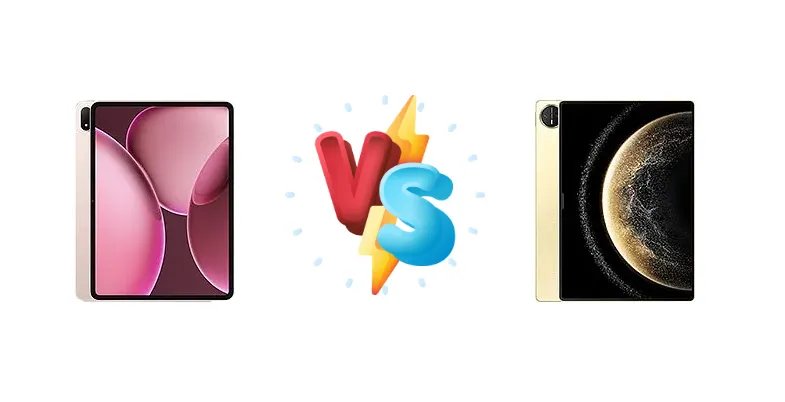
The Android tablet market is heating up, with Oppo and Huawei both vying for the premium space. The Oppo Pad 4 Pro arrives with Qualcomm’s cutting-edge Snapdragon 8 Elite, built on a 3nm process, while Huawei counters with its in-house Kirin T92. This comparison dissects these two tablets, focusing on performance, charging, and which user will benefit most from each device’s strengths.
🏆 Quick Verdict
For users prioritizing raw performance and efficiency, the Oppo Pad 4 Pro, powered by the Snapdragon 8 Elite, emerges as the winner. Its 3nm architecture promises superior thermal management and sustained performance. However, the Huawei MatePad Pro 13.2 (2025) offers a compelling package with its faster 100W charging, making it ideal for those constantly on the move.
| Network |
|---|
| 2G bands | N/A | GSM 850 / 900 / 1800 / 1900 |
| 3G bands | N/A | HSDPA 850 / 900 / 1900 / 2100 |
| 4G bands | N/A | LTE |
| EDGE | No | - |
| GPRS | No | - |
| Speed | - | HSPA, LTE - cellular model only |
| Technology | No cellular connectivity | GSM / HSPA / LTE |
| Launch |
|---|
| Announced | 2025, April 10 | 2024, November 26 |
| Status | Available. Released 2025, April 10 | Available. Released 2024, December 12 |
| Body |
|---|
| Build | Glass front, aluminum frame, aluminum back | Glass front, nylon fiber back, magnesium alloy frame |
| Dimensions | 289.6 x 209.7 x 6 mm (11.40 x 8.26 x 0.24 in) | 289.1 x 196.1 x 5.5 mm (11.38 x 7.72 x 0.22 in) |
| SIM | No | Nano-SIM (cellular model only) |
| Weight | 675 g (1.49 lb) | 580 g (Wi-FI) or 590 g (LTE) (1.28 lb) |
| Display |
|---|
| Resolution | 2400 x 3392 pixels (~315 ppi density) | 2880 x 1920 pixels, 3:2 ratio (~262 ppi density) |
| Size | 13.2 inches, 530.0 cm2 (~87.3% screen-to-body ratio) | 13.2 inches, 518.8 cm2 (~91.5% screen-to-body ratio) |
| Type | IPS LCD, 68B colors, Dolby Vision, 144Hz, 900 nits (HBM) | OLED, 1B colors, 144Hz, HDR Vivid, 1000 nits (peak) |
| Platform |
|---|
| CPU | Octa-core (2x4.32 GHz Oryon V2 Phoenix L + 6x3.53 GHz Oryon V2 Phoenix M) | Octa-core |
| Chipset | Qualcomm SM8750-AB Snapdragon 8 Elite (3 nm) | Kirin T92 |
| GPU | Adreno 830 | - |
| OS | Android 15, ColorOS 15 | Harmony OS 4.3 |
| Memory |
|---|
| Card slot | No | No |
| Internal | 256GB 8GB RAM, 256GB 12GB RAM, 512GB 12GB RAM, 512GB 16GB RAM | 256GB 12GB RAM, 512GB 12GB RAM, 1TB 16GB RAM |
| Main Camera |
|---|
| Dual | - | 50 MP, f/1.8, (wide), PDAF
8 MP, f/2.2, (ultrawide) |
| Features | Color spectrum sensor, LED flash | LED flash |
| Single | 13 MP | - |
| Video | 4K@30fps, 1080p@30ps, gyro-EIS | 4K@30fps, 1080p@30fps |
| Selfie camera |
|---|
| Single | 8 MP | 16 MP, f/2.2 |
| Video | 1080p@30fps | 1080p@30fps |
| Sound |
|---|
| 35mm jack | No | No |
| Loudspeaker | Yes, with stereo speakers (4 speakers) | Yes, with stereo speakers (6 speakers) |
| Comms |
|---|
| Bluetooth | 5.4, A2DP, LE | 5.2, A2DP, LE, L2HC |
| NFC | No | No |
| Positioning | No | GPS, GALILEO, GLONASS, BDS |
| Radio | No | No |
| USB | USB Type-C 3.2, OTG, accessory connector | USB Type-C 3.1, OTG, DisplayPort 1.2, accessory connector pins |
| WLAN | Wi-Fi 802.11 a/b/g/n/ac/6/7, dual-band | Wi-Fi 802.11 a/b/g/n/ac/6, dual-band |
| Features |
|---|
| Sensors | Accelerometer, proximity (accessories only), gyro, compass | Fingerprint (side-mounted), accelerometer, gyro, compass, proximity (accessories only) |
| Battery |
|---|
| Charging | 67W wired | 100W wired
7.5W reverse wired |
| Type | 12140 mAh | Li-Po 10100 mAh |
| Misc |
|---|
| Colors | Gray, Silver, Gold | Black, White, Gold |
| Models | OPD2409 | WEB-W00, PCE-W29 |
| Price | About 400 EUR | About 680 EUR |
Oppo Pad 4 Pro
- Superior CPU performance with Snapdragon 8 Elite
- More efficient 3nm process for better thermal management
- Potentially better image processing with Snapdragon ISP
- Slower 67W charging compared to Huawei
- Lacks reverse wireless charging
Huawei MatePad Pro 13.2 (2025)
- Ultra-fast 100W wired charging
- 7.5W reverse wired charging for topping up other devices
- Larger 13.2-inch display for enhanced productivity
- Kirin T92 chipset lacks detailed performance data
- Potentially less efficient than Snapdragon 8 Elite
Display Comparison
While specific display details are absent, the larger 13.2-inch screen of the Huawei MatePad Pro suggests a focus on media consumption and productivity. The Oppo Pad 4 Pro, likely featuring a more standard tablet size, benefits from the Snapdragon 8 Elite’s image signal processor (ISP) for potentially superior image quality when viewing content. The Snapdragon’s ISP could also translate to better video decoding capabilities. Without knowing the panel technology (LTPO, OLED, LCD) or refresh rates, it’s difficult to definitively declare a winner, but the Huawei’s larger canvas is a clear advantage for multitasking.
Camera Comparison
Given the tablet form factor, camera performance isn’t a primary concern. However, the Snapdragon 8 Elite’s ISP within the Oppo Pad 4 Pro likely provides superior image processing capabilities, potentially resulting in better photo and video quality. Without specific camera sensor details for either device, it’s difficult to make a definitive judgment. We anticipate both tablets will offer adequate cameras for video conferencing and casual snapshots, but the Oppo has a potential edge due to its chipset.
Performance
The core of this comparison lies in the chipsets. The Oppo Pad 4 Pro’s Snapdragon 8 Elite, built on a 3nm process, represents a significant leap in efficiency and performance compared to previous generations. Its octa-core CPU, featuring Oryon V2 Phoenix L and M cores clocked up to 4.32 GHz, is designed for sustained high performance. The Huawei MatePad Pro 13.2 (2025) utilizes the Kirin T92, an octa-core processor, but lacks the detailed architectural information to assess its capabilities. The 3nm node of the Snapdragon 8 Elite inherently offers better thermal efficiency, reducing the likelihood of performance throttling during extended gaming or demanding workloads. This translates to a more consistent user experience for the Oppo Pad 4 Pro.
Battery Life
The Huawei MatePad Pro 13.2 (2025) takes a clear lead in charging speed with its 100W wired charging capability. This will significantly reduce charging times compared to the Oppo Pad 4 Pro’s 67W charging. While the Oppo Pad 4 Pro’s Snapdragon 8 Elite’s 3nm process contributes to improved power efficiency, the Huawei’s faster charging is a substantial convenience factor. The Huawei also offers 7.5W reverse wired charging, allowing it to top up other devices, a feature absent in the Oppo Pad 4 Pro. The actual battery life will depend on battery capacity (not specified), but the charging advantage clearly favors the Huawei.
Buying Guide
Buy the Oppo Pad 4 Pro if you need a tablet for demanding tasks like video editing, high-end gaming, or running multiple applications simultaneously. The Snapdragon 8 Elite’s Oryon CPU cores and advanced GPU will provide a smoother, more responsive experience. Buy the Huawei MatePad Pro 13.2 (2025) if you prioritize rapid charging and all-day usability, especially if you frequently travel or find yourself away from power outlets for extended periods. The 100W charging significantly reduces downtime.
Frequently Asked Questions
❓ Will the Snapdragon 8 Elite in the Oppo Pad 4 Pro handle demanding games like Genshin Impact at high settings?
Yes, the Snapdragon 8 Elite is designed for high-end gaming. Its Oryon CPU cores and advanced GPU, combined with the 3nm process for improved thermal management, should deliver a smooth and consistent gaming experience even with graphically intensive titles like Genshin Impact at high settings.
❓ How long does it realistically take to fully charge the Huawei MatePad Pro 13.2 (2025) from 0% with the 100W charger?
While exact charging times depend on various factors, the 100W charging capability of the Huawei MatePad Pro 13.2 (2025) should allow for a full charge from 0% in approximately 30-40 minutes. This is significantly faster than the Oppo Pad 4 Pro’s 67W charging.
❓ Does the Kirin T92 in the Huawei MatePad Pro 13.2 (2025) suffer from significant thermal throttling during prolonged use?
Without detailed thermal testing data, it's difficult to definitively say. However, the Snapdragon 8 Elite’s 3nm process in the Oppo Pad 4 Pro is known for its improved thermal efficiency. The Kirin T92 may be more prone to throttling under sustained heavy loads, potentially impacting performance over extended periods.