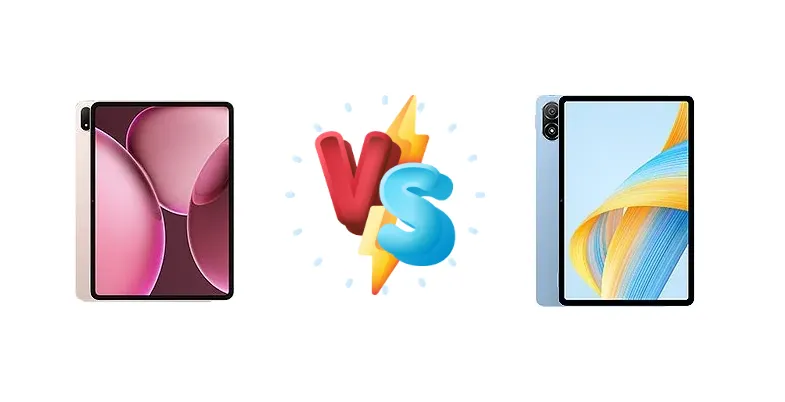
The Android tablet market is heating up, with Oppo and Honor delivering compelling options in the premium segment. The Oppo Pad 4 Pro leverages Qualcomm’s cutting-edge 3nm Snapdragon 8 Elite, while the Honor Pad V8 Pro opts for MediaTek’s proven 5nm Dimensity 8100. This comparison dissects the architectural differences and real-world implications of these chipsets, alongside battery, charging, and overall user experience.
🏆 Quick Verdict
For most users, the Oppo Pad 4 Pro emerges as the superior choice. Its Snapdragon 8 Elite, built on a 3nm process, offers a compelling blend of performance and efficiency, potentially leading to longer sustained performance and better thermal management compared to the Honor Pad V8 Pro’s Dimensity 8100.
| Network |
|---|
| 2G bands | N/A | N/A |
| 3G bands | N/A | N/A |
| 4G bands | N/A | N/A |
| EDGE | No | N/A |
| GPRS | No | N/A |
| Technology | No cellular connectivity | No cellular connectivity |
| Launch |
|---|
| Announced | 2025, April 10 | 2022, December 26 |
| Status | Available. Released 2025, April 10 | Available. Released 2022, December 30 |
| Body |
|---|
| Build | Glass front, aluminum frame, aluminum back | Glass front, aluminum frame, aluminum back or eco leather back |
| Dimensions | 289.6 x 209.7 x 6 mm (11.40 x 8.26 x 0.24 in) | 277 x 179 x 6.6 mm or 7 mm |
| SIM | No | No |
| Weight | 675 g (1.49 lb) | 589 g or 599 g (1.30 lb) |
| | - | Honor Pencil 3 (15ms latency) |
| Display |
|---|
| Resolution | 2400 x 3392 pixels (~315 ppi density) | 2560 x 1600 pixels, 16:10 ratio (~249 ppi density) |
| Size | 13.2 inches, 530.0 cm2 (~87.3% screen-to-body ratio) | 12.1 inches, 424.5 cm2 (~85.6% screen-to-body ratio) |
| Type | IPS LCD, 68B colors, Dolby Vision, 144Hz, 900 nits (HBM) | IPS LCD, 1B colors, 144Hz, 600 nits |
| | - | IMAX enhanced |
| Platform |
|---|
| CPU | Octa-core (2x4.32 GHz Oryon V2 Phoenix L + 6x3.53 GHz Oryon V2 Phoenix M) | Octa-core (4x2.85 GHz Cortex-A78 & 4x2.0 GHz Cortex-A55) |
| Chipset | Qualcomm SM8750-AB Snapdragon 8 Elite (3 nm) | Mediatek Dimensity 8100 (5 nm) |
| GPU | Adreno 830 | Mali-G610 MC6 |
| OS | Android 15, ColorOS 15 | Android 12, MagicOS 7 |
| Memory |
|---|
| Card slot | No | No |
| Internal | 256GB 8GB RAM, 256GB 12GB RAM, 512GB 12GB RAM, 512GB 16GB RAM | 128GB 8GB RAM, 256GB 8GB RAM, 256GB 12GB RAM |
| Main Camera |
|---|
| Features | Color spectrum sensor, LED flash | LED flash, HDR |
| Single | 13 MP | 13 MP, f/2.0, (wide), 1/3.0", AF |
| Video | 4K@30fps, 1080p@30ps, gyro-EIS | 4K@30fps, 1080p@30fps |
| Selfie camera |
|---|
| Single | 8 MP | 5 MP, f/2.2 |
| Video | 1080p@30fps | 1080p@30fps |
| Sound |
|---|
| 3.5mm jack | - | No |
| 35mm jack | No | No |
| Loudspeaker | Yes, with stereo speakers (4 speakers) | Yes, with stereo speakers (8 speakers) |
| | - | 24-bit/192kHz audio |
| Comms |
|---|
| Bluetooth | 5.4, A2DP, LE | 5.2, A2DP, LE |
| NFC | No | No |
| Positioning | No | GPS, GLONASS, BDS |
| Radio | No | No |
| USB | USB Type-C 3.2, OTG, accessory connector | USB Type-C, magnetic connector |
| WLAN | Wi-Fi 802.11 a/b/g/n/ac/6/7, dual-band | Wi-Fi 802.11 a/b/g/n/ac/6, dual-band |
| Features |
|---|
| Sensors | Accelerometer, proximity (accessories only), gyro, compass | Accelerometer |
| Battery |
|---|
| Charging | 67W wired | 35W wired |
| Type | 12140 mAh | Li-Po 10050 mAh |
| Misc |
|---|
| Colors | Gray, Silver, Gold | Grey, Blue, Orange |
| Models | OPD2409 | ROD-W09 |
| Price | About 400 EUR | About 350 EUR |
Oppo Pad 4 Pro
- Superior chipset performance with Snapdragon 8 Elite
- Faster 67W wired charging
- Potentially better thermal management due to 3nm process
- Price may be higher than the Honor Pad V8 Pro
- Battery capacity not specified, potential for smaller battery
Honor Pad V8 Pro
- Potentially lower price point
- Capable Dimensity 8100 processor for everyday tasks
- Solid performance for media consumption
- Slower 35W charging
- Less efficient 5nm process may lead to throttling under sustained load
Display Comparison
While both tablets likely feature high-resolution displays (data not provided), the core difference lies in the underlying processing power impacting UI responsiveness and video playback smoothness. The Snapdragon 8 Elite’s integrated GPU will likely offer superior graphics rendering capabilities. Without specific display specs, it's difficult to assess brightness or color accuracy, but both brands typically target vibrant and accurate panels in this price bracket. The absence of LTPO information suggests neither tablet dynamically adjusts refresh rates for power saving.
Camera Comparison
Without camera specifications, a direct comparison is limited. However, given the tablet form factor, camera quality is often secondary to performance and display. Both manufacturers likely employ multi-camera systems, but the image signal processor (ISP) within the Snapdragon 8 Elite may offer more advanced computational photography features. The absence of details regarding sensor sizes and lens apertures makes it impossible to determine which tablet will deliver superior image quality.
Performance
The Oppo Pad 4 Pro’s Snapdragon 8 Elite, fabricated on a 3nm process, represents a significant leap in transistor density compared to the Honor Pad V8 Pro’s 5nm Dimensity 8100. This translates to improved power efficiency and potentially higher clock speeds. The Snapdragon 8 Elite’s octa-core CPU, featuring Oryon V2 Phoenix cores, is architecturally more advanced than the Dimensity 8100’s Cortex-A78/A55 configuration. The Oryon cores are designed for higher single-core and multi-core performance, benefiting demanding applications. While the Dimensity 8100 is a capable chip, the Snapdragon 8 Elite’s architectural advantage and process node give it a clear edge in sustained performance and thermal management.
Battery Life
The Oppo Pad 4 Pro’s 67W wired charging is a substantial advantage over the Honor Pad V8 Pro’s 35W charging. This means significantly faster recharge times, minimizing downtime. While battery capacity isn’t specified, the Snapdragon 8 Elite’s superior efficiency could offset a potentially smaller battery size, resulting in comparable or even better real-world battery life. The faster charging speed of the Oppo Pad 4 Pro is a key benefit for users who rely on their tablets throughout the day.
Buying Guide
Buy the Oppo Pad 4 Pro if you prioritize sustained performance for demanding tasks like video editing or extended gaming sessions, and value the benefits of a more efficient chipset. Buy the Honor Pad V8 Pro if you’re seeking a strong performer at a potentially lower price point, and your workload doesn’t consistently push the tablet to its thermal limits. The Honor Pad V8 Pro is a good option for media consumption and lighter productivity.
Frequently Asked Questions
❓ Will the Dimensity 8100 in the Honor Pad V8 Pro overheat during prolonged gaming sessions?
The Dimensity 8100 is a capable chip, but its 5nm process is less efficient than the Snapdragon 8 Elite’s 3nm process. This means the Honor Pad V8 Pro is more likely to experience thermal throttling during extended gaming or other demanding tasks, potentially leading to reduced performance.
❓ How much faster is the 67W charging on the Oppo Pad 4 Pro compared to the 35W charging on the Honor Pad V8 Pro?
67W charging will significantly reduce recharge times. While exact 0-100% times are unavailable, expect the Oppo Pad 4 Pro to charge considerably faster – potentially shaving off 30-60 minutes compared to the Honor Pad V8 Pro, depending on battery capacity.
❓ Is the architectural difference between the Oryon V2 cores in the Snapdragon 8 Elite and the Cortex-A78 cores in the Dimensity 8100 noticeable in everyday use?
For basic tasks like web browsing and video playback, the difference may be minimal. However, when running demanding applications like video editing software or graphically intensive games, the Oryon V2 cores’ superior architecture will provide a noticeable performance boost and smoother experience.