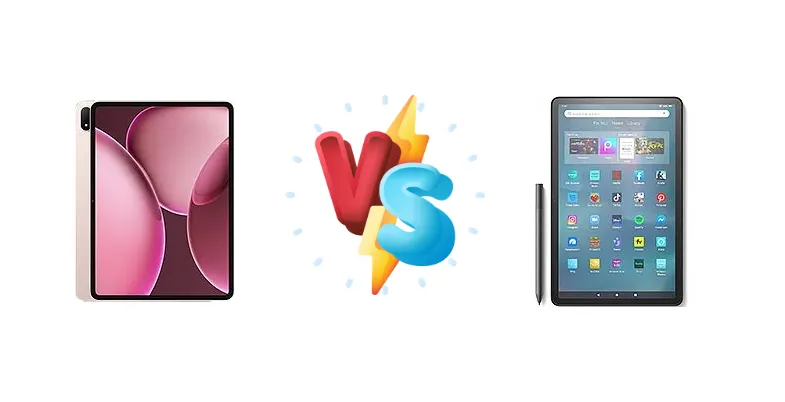
The tablet market offers a spectrum of choices, from budget-friendly media consumption devices to high-performance productivity powerhouses. The Amazon Fire Max 11 aims to deliver a solid Android experience at an accessible price, while the Oppo Pad 4 Pro targets users demanding flagship-level performance with its cutting-edge Snapdragon 8 Elite chipset. This comparison dissects the key differences to help you determine which tablet best suits your needs.
🏆 Quick Verdict
For users prioritizing performance, multitasking, and future-proofing, the Oppo Pad 4 Pro is the clear winner. Its Snapdragon 8 Elite chipset offers a substantial leap in processing power compared to the Fire Max 11’s Mediatek MT8188J. However, the Fire Max 11 remains a viable option for casual users focused on media consumption and basic tasks.
| Network |
|---|
| 2G bands | N/A | N/A |
| 3G bands | N/A | - |
| 4G bands | N/A | - |
| EDGE | No | No |
| GPRS | No | No |
| Technology | No cellular connectivity | No cellular connectivity |
| Launch |
|---|
| Announced | 2025, April 10 | 2023, May 23 |
| Status | Available. Released 2025, April 10 | Available. Released 2023, May 23 |
| Body |
|---|
| Build | Glass front, aluminum frame, aluminum back | - |
| Dimensions | 289.6 x 209.7 x 6 mm (11.40 x 8.26 x 0.24 in) | 259.1 x 163.7 x 7.5 mm (10.20 x 6.44 x 0.30 in) |
| SIM | No | No |
| Weight | 675 g (1.49 lb) | 490 g (1.08 lb) |
| Display |
|---|
| Resolution | 2400 x 3392 pixels (~315 ppi density) | 2000 x 1200 pixels, 5:3 ratio (~212 ppi density) |
| Size | 13.2 inches, 530.0 cm2 (~87.3% screen-to-body ratio) | 11.0 inches, 344.4 cm2 (~81.2% screen-to-body ratio) |
| Type | IPS LCD, 68B colors, Dolby Vision, 144Hz, 900 nits (HBM) | IPS LCD |
| Platform |
|---|
| CPU | Octa-core (2x4.32 GHz Oryon V2 Phoenix L + 6x3.53 GHz Oryon V2 Phoenix M) | Octa-core (2x2.2 GHz Cortex-A78 & 6x2.0 GHz Cortex-A55) |
| Chipset | Qualcomm SM8750-AB Snapdragon 8 Elite (3 nm) | Mediatek MT8188J |
| GPU | Adreno 830 | Mali-G57 MC2 |
| OS | Android 15, ColorOS 15 | Android 11, Fire OS 8 |
| Memory |
|---|
| Card slot | No | microSDXC (dedicated slot) |
| Internal | 256GB 8GB RAM, 256GB 12GB RAM, 512GB 12GB RAM, 512GB 16GB RAM | 64GB 4GB RAM, 128GB 4GB RAM |
| Main Camera |
|---|
| Features | Color spectrum sensor, LED flash | - |
| Single | 13 MP | 8 MP, AF |
| Video | 4K@30fps, 1080p@30ps, gyro-EIS | 1080p |
| Selfie camera |
|---|
| Single | 8 MP | 8 MP |
| Video | 1080p@30fps | 1080p |
| Sound |
|---|
| 35mm jack | No | No |
| Loudspeaker | Yes, with stereo speakers (4 speakers) | Yes, with stereo speakers |
| Comms |
|---|
| Bluetooth | 5.4, A2DP, LE | 5.3, A2DP, LE |
| NFC | No | No |
| Positioning | No | No |
| Radio | No | No |
| USB | USB Type-C 3.2, OTG, accessory connector | USB Type-C 2.0, OTG, magnetic accessory connector |
| WLAN | Wi-Fi 802.11 a/b/g/n/ac/6/7, dual-band | Wi-Fi 802.11 a/b/g/n/ac/6, dual-band |
| Features |
|---|
| Sensors | Accelerometer, proximity (accessories only), gyro, compass | Fingerprint (side-mounted), accelerometer, proximity (accessories only) |
| Battery |
|---|
| Charging | 67W wired | 15W wired |
| Type | 12140 mAh | Li-Ion |
| Misc |
|---|
| Colors | Gray, Silver, Gold | Gray |
| Models | OPD2409 | KFSNWI |
| Price | About 400 EUR | About 270 EUR |
Oppo Pad 4 Pro
- Significantly faster processor for demanding tasks
- Ultra-fast 67W charging for minimal downtime
- Likely superior display quality and color accuracy
- Higher price point
- Potentially larger file sizes due to higher resolution assets
Amazon Fire Max 11
- More affordable price
- Acceptable performance for basic tasks
- Good value for casual users
- Slower processor struggles with demanding applications
- Slow 15W charging
- Likely lower display quality
Display Comparison
While display specifications are missing for both devices, the Oppo Pad 4 Pro, positioned as a premium device, likely features a higher-resolution panel and potentially LTPO technology for adaptive refresh rates, contributing to better battery life. The Fire Max 11, being a more budget-oriented option, likely utilizes a standard LCD panel. Bezels are expected to be slimmer on the Oppo Pad 4 Pro, reflecting its higher price point. Color accuracy is also likely to be superior on the Oppo Pad 4 Pro, catering to content creators.
Camera Comparison
Given the context data, a detailed camera comparison is limited. However, Oppo generally prioritizes camera quality in its devices, suggesting the Pad 4 Pro likely features a more capable camera system than the Fire Max 11. The Fire Max 11’s camera is likely geared towards basic video calls and casual snapshots. Without specific sensor details, it’s safe to assume the Oppo Pad 4 Pro offers superior image quality and features.
Performance
The core difference lies in the chipsets. The Oppo Pad 4 Pro’s Qualcomm SM8750-AB Snapdragon 8 Elite, built on a 3nm process, represents a significant advancement over the Amazon Fire Max 11’s Mediatek MT8188J. The Snapdragon 8 Elite’s octa-core CPU, with its Oryon V2 Phoenix cores (2x4.32 GHz + 6x3.53 GHz), delivers substantially higher processing power than the Fire Max 11’s 2x2.2 GHz Cortex-A78 & 6x2.0 GHz Cortex-A55 configuration. The 3nm node translates to improved thermal efficiency, meaning the Oppo Pad 4 Pro can sustain peak performance for longer periods without throttling. This difference is critical for demanding applications and gaming.
Battery Life
Battery capacity is not specified, but the charging speeds reveal a significant disparity. The Oppo Pad 4 Pro’s 67W wired charging is dramatically faster than the Fire Max 11’s 15W charging. This means the Oppo Pad 4 Pro can replenish its battery much more quickly, minimizing downtime. While the Fire Max 11 might have a larger battery capacity, the Oppo Pad 4 Pro’s faster charging effectively mitigates any potential battery life disadvantage.
Buying Guide
Buy the Oppo Pad 4 Pro if you need a tablet for demanding tasks like video editing, gaming, or running multiple applications simultaneously. Its superior chipset and faster charging will significantly enhance your productivity. Buy the Amazon Fire Max 11 if you prefer a more affordable tablet primarily for streaming video, browsing the web, and light productivity tasks. It’s a good choice for families or users new to the Android tablet ecosystem.
Frequently Asked Questions
❓ Will the Mediatek MT8188J in the Fire Max 11 struggle with graphically intensive games like Genshin Impact?
Yes, the Mediatek MT8188J is a mid-range chipset and will likely struggle to deliver a smooth gaming experience in demanding titles like Genshin Impact. Expect lower frame rates and potential stuttering, even on lower graphics settings. The Snapdragon 8 Elite in the Oppo Pad 4 Pro is far better suited for gaming.
❓ How long does it realistically take to fully charge the Oppo Pad 4 Pro with the 67W charger?
While exact charging times depend on battery capacity (which is not specified), 67W charging typically allows a full charge from 0% to 100% in around 45-60 minutes. This is a significant advantage over the Fire Max 11’s much slower 15W charging.
❓ Is the Amazon Fire Max 11 a good choice for students taking notes and reading textbooks?
The Fire Max 11 is adequate for basic note-taking and reading, but its performance limitations might become noticeable when running multiple apps simultaneously or working with large documents. The Oppo Pad 4 Pro’s superior processing power would provide a smoother and more responsive experience for students.
❓ Does the Oppo Pad 4 Pro support stylus input for drawing or handwriting?
While not explicitly stated in the provided data, Oppo often includes stylus support in its Pad series. It's highly probable the Oppo Pad 4 Pro supports a stylus, potentially sold separately, enhancing its productivity capabilities. The Fire Max 11's stylus support is less likely and potentially limited.