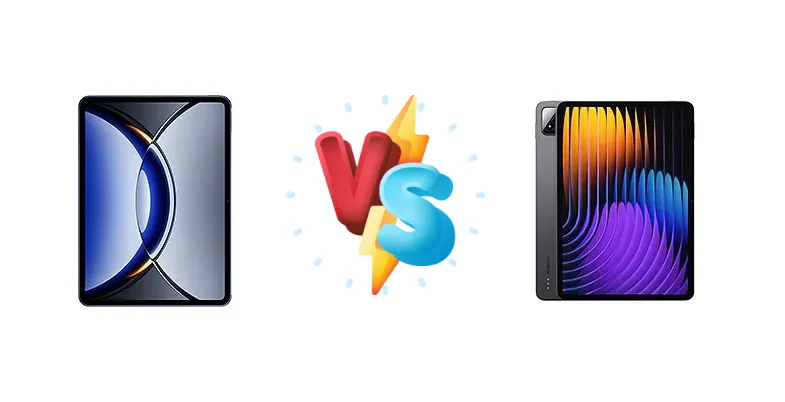
The Android tablet market is heating up, with Oppo and Xiaomi both releasing compelling contenders. The Oppo Pad 3 Pro boasts the flagship Snapdragon 8 Gen 3, while the Xiaomi Pad 7 Pro opts for the slightly less powerful, but still capable, Snapdragon 8s Gen 3. This comparison dives deep into the nuances of each device to determine which tablet delivers the best overall experience for different user needs.
🏆 Quick Verdict
For users prioritizing raw performance and future-proofing, the Oppo Pad 3 Pro is the clear winner. Its Snapdragon 8 Gen 3 chipset provides a noticeable edge in demanding tasks. However, the Xiaomi Pad 7 Pro offers excellent value with a strong chipset and impressive 10:12 hour active use battery life, making it ideal for everyday users.
| Network |
|---|
| 2G bands | N/A | N/A |
| 3G bands | N/A | N/A |
| 4G bands | N/A | - |
| EDGE | No | N/A |
| GPRS | No | N/A |
| Technology | No cellular connectivity | No cellular connectivity |
| Launch |
|---|
| Announced | 2024, October 24 | 2024, October 29 |
| Status | Available. Released 2024, October 30 | Available. Released 2024, October 29 |
| Body |
|---|
| Build | Glass front, aluminum frame, aluminum back | Glass front, aluminum frame, aluminum back |
| Dimensions | 268.7 x 195.1 x 6.5 mm (10.58 x 7.68 x 0.26 in) | 251.2 x 173.4 x 6.2 mm (9.89 x 6.83 x 0.24 in) |
| SIM | No | No |
| Weight | 586 g (1.29 lb) | 500 g (1.10 lb) |
| Display |
|---|
| Resolution | 2120 x 3000 pixels (~304 ppi density) | 2136 x 3200 pixels, 3:2 ratio (~345 ppi density) |
| Size | 12.1 inches, 445.2 cm2 (~84.9% screen-to-body ratio) | 11.2 inches, 371.5 cm2 (~85.3% screen-to-body ratio) |
| Type | IPS LCD, 68B colors, Dolby Vision, 144Hz, 900 nits (HBM) | IPS LCD, 68B colors, 144Hz, HDR10, Dolby Vision, 800 nits (peak) |
| Platform |
|---|
| CPU | 8-core (1x3.39GHz Cortex-X4 & 3x3.1GHz Cortex-A720 & 2x2.9GHz Cortex-A720 & 2x2.2GHz Cortex-A520) | Octa-core (1x3.0 GHz Cortex-X4 & 4x2.8 GHz Cortex-A720 & 3x2.0 GHz Cortex-A520) |
| Chipset | Qualcomm SM8650-AC Snapdragon 8 Gen 3 (4 nm) | Qualcomm SM8635 Snapdragon 8s Gen 3 (4 nm) |
| GPU | Adreno 750 (1 GHz) | Adreno 735 |
| OS | Android 14, ColorOS 14.1 | Android 15, HyperOS 2 |
| Memory |
|---|
| Card slot | No | No |
| Internal | 256GB 8GB RAM, 256GB 12GB RAM, 512GB 16GB RAM, 1TB 16GB RAM | 128GB 8GB RAM, 256GB 8GB RAM, 256GB 12GB RAM, 512GB 12GB RAM |
| Main Camera |
|---|
| Dual | - | 50 MP, f/1.8, (wide), 1/2.76", 0.64µm, PDAF
Auxiliary lens |
| Features | Color spectrum sensor, LED flash | LED flash, HDR, panorama |
| Single | 13 MP, f/2.2, (wide), AF | - |
| Video | 4K@30fps, 1080p@30ps, gyro-EIS | 4K@30/60fps, 1080p@30/60fps |
| Selfie camera |
|---|
| Features | - | HDR |
| Single | 8 MP, f/2.3, 103˚ (ultrawide) | 32 MP, f/2.2, 19mm (ultrawide), 1/3.6", 0.61µm |
| Video | 1080p@30fps | 1080p@30fps |
| Sound |
|---|
| 35mm jack | No | No |
| Loudspeaker | Yes, with stereo speakers (4 speakers) | Yes, with stereo speakers (4 speakers) |
| Comms |
|---|
| Bluetooth | 5.4, A2DP, LE | 5.4, A2DP, LE, LHDC 5 |
| Infrared port | - | Yes |
| NFC | No | No |
| Positioning | No | No |
| Radio | No | No |
| USB | USB Type-C 3.2, OTG, accessory connector | USB Type-C 3.2, accessory connector |
| WLAN | Wi-Fi 802.11 a/b/g/n/ac/6/7, dual-band | Wi-Fi 802.11 a/b/g/n/ac/6e/7, dual-band, Wi-Fi Direct |
| Features |
|---|
| Sensors | Accelerometer, proximity (accessories only), gyro, compass | Fingerprint (side-mounted), accelerometer, gyro, proximity, compass |
| Battery |
|---|
| Charging | 67W wired, PD, QC, UFCS | 67W wired, PD3.0, QC3+, 40% in 20 min |
| Type | 9510 mAh | 8850 mAh |
| Misc |
|---|
| Colors | Blue, Gold | Gray, Blue, Green |
| Models | OPD2401 | 24091RPADG |
| Price | About 600 EUR | About 500 EUR |
| SAR EU | - | 0.99 W/kg (body) |
Oppo Pad 3 Pro
- Superior CPU and GPU performance with Snapdragon 8 Gen 3
- Potentially better thermal management due to chipset architecture
- Faster processing for demanding applications
- Likely higher price point
- Potentially shorter battery life under heavy load
Xiaomi Pad 7 Pro
- Excellent battery life with 10:12h active use
- Fast 67W charging with 40% in 20 minutes
- Potentially more affordable price
- Slightly less powerful Snapdragon 8s Gen 3
- May exhibit more throttling under sustained load
Display Comparison
While both tablets likely feature high-quality LCD panels (data not provided), the core difference lies in the processing power driving them. Display specs like resolution and refresh rate are currently unknown, but the chipset's ability to smoothly render complex visuals is paramount. The Oppo Pad 3 Pro's Snapdragon 8 Gen 3 will ensure a fluid experience even with demanding graphical content, while the Xiaomi Pad 7 Pro's 8s Gen 3 will still deliver a very good experience, though potentially with slightly more noticeable frame drops in extreme scenarios.
Camera Comparison
Camera specifications are absent from the provided data. However, given the tablet form factor, camera quality is typically less of a priority than on smartphones. Both devices likely feature a main camera and an ultrawide lens. The Oppo Pad 3 Pro’s more powerful ISP within the Snapdragon 8 Gen 3 could offer slightly better image processing, particularly in low-light conditions, but without sensor details, a definitive comparison is impossible. We can assume both will offer adequate performance for casual photography and video calls.
Performance
The Oppo Pad 3 Pro’s Qualcomm SM8650-AC Snapdragon 8 Gen 3, built on a 4nm process, features a unique CPU configuration: 1x3.39GHz Cortex-X4 prime core, 3x3.1GHz Cortex-A720 performance cores, 2x2.9GHz Cortex-A720 cores, and 2x2.2GHz Cortex-A520 efficiency cores. This contrasts with the Xiaomi Pad 7 Pro’s Snapdragon 8s Gen 3 (SM8635) with its 1x3.0 GHz Cortex-X4, 4x2.8 GHz Cortex-A720, and 3x2.0 GHz Cortex-A520. The Oppo’s higher clock speeds and core configuration translate to a demonstrable performance advantage in CPU-bound tasks. The 4nm node shared by both chips contributes to thermal efficiency, but the 8 Gen 3’s superior architecture will likely result in sustained performance for longer periods. The impact of RAM speed (likely LPDDR5X on both) is secondary to the chipset’s inherent capabilities.
Battery Life
The Xiaomi Pad 7 Pro’s reported 10:12h active use score is a significant advantage. While the Oppo Pad 3 Pro’s battery capacity is unknown, the more powerful Snapdragon 8 Gen 3 will likely consume more power under heavy load. Both devices support 67W wired charging with PD, QC, and UFCS (Oppo) or PD3.0, QC3+ (Xiaomi). The Xiaomi Pad 7 Pro claims a 40% charge in 20 minutes, suggesting a well-optimized charging curve. The Oppo Pad 3 Pro’s charging speed is likely comparable, but the larger battery (if present) might take slightly longer to reach full capacity.
Buying Guide
Buy the Oppo Pad 3 Pro if you need uncompromising performance for gaming, video editing, or other resource-intensive applications. Its Snapdragon 8 Gen 3 will handle anything you throw at it. Buy the Xiaomi Pad 7 Pro if you prioritize all-day battery life and a balanced experience at a potentially lower price point. The Snapdragon 8s Gen 3 is still very capable for most tasks, and the 10:12 hour active use score is a significant advantage.
Frequently Asked Questions
❓ Will the Snapdragon 8s Gen 3 in the Xiaomi Pad 7 Pro struggle with graphically intensive games like Genshin Impact?
While not as powerful as the Snapdragon 8 Gen 3, the Snapdragon 8s Gen 3 is still a very capable chipset. Genshin Impact will be playable, but you may need to lower graphics settings to maintain a consistently smooth frame rate. The Xiaomi Pad 7 Pro’s thermal management will also play a role in sustained performance.
❓ How much faster is the Oppo Pad 3 Pro's Snapdragon 8 Gen 3 for video editing compared to the Xiaomi Pad 7 Pro?
The Snapdragon 8 Gen 3 offers a significant advantage in video editing, particularly with 4K and 8K footage. The faster CPU and GPU will result in quicker rendering times and smoother playback. The Oppo Pad 3 Pro is the better choice for professional or semi-professional video editors.
❓ Does the 67W charging on both tablets support reverse wireless charging?
The provided data does not specify reverse wireless charging capabilities for either device. This feature is not standard on all tablets, so it's best to check the official specifications for each model if this is a priority.