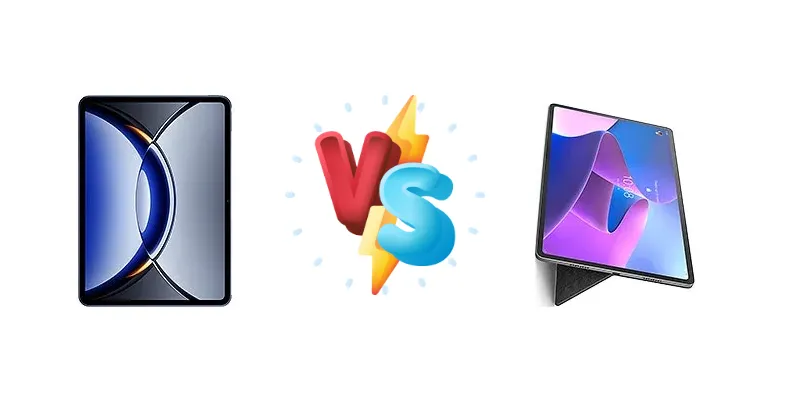
The Android tablet market is heating up, with Oppo entering the premium space with the Pad 3 Pro. This puts it directly against established players like Lenovo, and specifically, the Tab P12 Pro. We’re dissecting these two tablets, focusing on the core differences stemming from their chipsets – the cutting-edge Snapdragon 8 Gen 3 in the Oppo versus the well-regarded Snapdragon 870 in the Lenovo – to determine which offers the best experience for demanding users.
🏆 Quick Verdict
For users prioritizing raw performance and future-proofing, the Oppo Pad 3 Pro is the clear winner thanks to its Snapdragon 8 Gen 3. However, the Lenovo Tab P12 Pro remains a compelling option for those seeking a balanced experience with a proven chipset and potentially lower price point.
| Network |
|---|
| 2G bands | N/A | GSM 850 / 900 / 1800 / 1900 |
| 3G bands | N/A | HSDPA 850 / 900 / 1900 / 2100 |
| 4G bands | N/A | 1, 2, 3, 4, 5, 7, 8, 19, 20, 26, 28, 34, 38, 39, 40, 41 |
| 5G bands | - | 1, 3, 7, 8, 20, 28, 38, 41, 77, 78 SA/NSA/Sub6 |
| EDGE | No | - |
| GPRS | No | - |
| Speed | - | HSPA, LTE, 5G - cellular model only |
| Technology | No cellular connectivity | GSM / HSPA / LTE / 5G |
| Launch |
|---|
| Announced | 2024, October 24 | 2021, September 08 |
| Status | Available. Released 2024, October 30 | Available. Released 2021, November 19 |
| Body |
|---|
| Build | Glass front, aluminum frame, aluminum back | - |
| Dimensions | 268.7 x 195.1 x 6.5 mm (10.58 x 7.68 x 0.26 in) | 285.6 x 184.5 x 5.6 mm (11.24 x 7.26 x 0.22 in) |
| SIM | No | Nano-SIM (cellular model only) |
| Weight | 586 g (1.29 lb) | 565 g (1.25 lb) |
| | - | Stylus support |
| Display |
|---|
| Resolution | 2120 x 3000 pixels (~304 ppi density) | 1600 x 2560 pixels, 16:10 ratio (~240 ppi density) |
| Size | 12.1 inches, 445.2 cm2 (~84.9% screen-to-body ratio) | 12.6 inches, 460.3 cm2 (~87.4% screen-to-body ratio) |
| Type | IPS LCD, 68B colors, Dolby Vision, 144Hz, 900 nits (HBM) | AMOLED, 120Hz, HDR10+, Dolby Vision, 600 nits (HBM) |
| Platform |
|---|
| CPU | 8-core (1x3.39GHz Cortex-X4 & 3x3.1GHz Cortex-A720 & 2x2.9GHz Cortex-A720 & 2x2.2GHz Cortex-A520) | Octa-core (1x3.2 GHz Kryo 585 & 3x2.42 GHz Kryo 585 & 4x1.80 GHz Kryo 585) |
| Chipset | Qualcomm SM8650-AC Snapdragon 8 Gen 3 (4 nm) | Qualcomm SM8250-AC Snapdragon 870 5G (7 nm) |
| GPU | Adreno 750 (1 GHz) | Adreno 650 |
| OS | Android 14, ColorOS 14.1 | Android 11 |
| Memory |
|---|
| Card slot | No | microSDXC (dedicated slot) |
| Internal | 256GB 8GB RAM, 256GB 12GB RAM, 512GB 16GB RAM, 1TB 16GB RAM | 128GB 6GB RAM, 256GB 8GB RAM |
| Main Camera |
|---|
| Dual | - | 13 MP, (wide), AF
5 MP, (ultrawide) |
| Features | Color spectrum sensor, LED flash | - |
| Single | 13 MP, f/2.2, (wide), AF | - |
| Video | 4K@30fps, 1080p@30ps, gyro-EIS | 4K@30fps, 1080p@30fps |
| Selfie camera |
|---|
| Single | 8 MP, f/2.3, 103˚ (ultrawide) | 8 MP, (wide)
8 MP, IR TOF 3D, (biometrics sensor only) |
| Video | 1080p@30fps | 1080p@30fps |
| Sound |
|---|
| 3.5mm jack | - | No |
| 35mm jack | No | No |
| Loudspeaker | Yes, with stereo speakers (4 speakers) | Yes, with stereo speakers (4 speakers) |
| | - | JBL speakers |
| Comms |
|---|
| Bluetooth | 5.4, A2DP, LE | 5.2, A2DP, LE |
| NFC | No | Yes (wireless charging and data transfer only) |
| Positioning | No | GPS, GLONASS, BDS - cellular model only |
| Radio | No | Unspecified |
| USB | USB Type-C 3.2, OTG, accessory connector | USB Type-C 3.1 |
| WLAN | Wi-Fi 802.11 a/b/g/n/ac/6/7, dual-band | Wi-Fi 802.11 a/b/g/n/ac/6, dual-band, Wi-Fi Direct |
| Features |
|---|
| Sensors | Accelerometer, proximity (accessories only), gyro, compass | Fingerprint (side-mounted), accelerometer, gyro, proximity |
| Battery |
|---|
| Charging | 67W wired, PD, QC, UFCS | 45W wired, QC4 |
| Type | 9510 mAh | Li-Po 10200 mAh |
| Misc |
|---|
| Colors | Blue, Gold | Storm Grey |
| Models | OPD2401 | TB-Q706Z, TB-Q706F |
| Price | About 600 EUR | About 520 EUR |
Oppo Pad 3 Pro
- Significantly faster processor (Snapdragon 8 Gen 3)
- Faster charging (67W with multiple protocols)
- Improved thermal efficiency due to 4nm process
- Potentially higher price
- Battery life may be comparable to Lenovo despite efficiency gains
Lenovo Tab P12 Pro
- Proven performance with Snapdragon 870
- Potentially lower price point
- Well-established ecosystem and software support
- Slower processor compared to Snapdragon 8 Gen 3
- Slower charging (45W)
Display Comparison
While both tablets likely feature high-quality LCD panels (specific panel details are missing), the core difference lies in the processing power driving them. The Oppo Pad 3 Pro’s Snapdragon 8 Gen 3 will handle graphically intensive displays with ease, ensuring smooth animations and responsiveness. The Lenovo Tab P12 Pro’s Snapdragon 870 is capable, but may exhibit slight frame drops in the most demanding scenarios. We expect both to offer excellent viewing angles and color reproduction, but the Oppo has the headroom to push higher resolutions and refresh rates if the display hardware allows.
Camera Comparison
Given the tablet form factor, camera performance isn't a primary focus. However, the Oppo Pad 3 Pro, benefiting from the increased processing power of the Snapdragon 8 Gen 3, will likely offer superior image processing capabilities. This could result in better dynamic range, noise reduction, and overall image quality, even if both tablets share similar sensor configurations (which are currently unknown). The 8 Gen 3’s ISP (Image Signal Processor) is significantly more advanced than the 870’s, allowing for more sophisticated computational photography techniques.
Performance
The heart of the matter: the Snapdragon 8 Gen 3 (4nm) in the Oppo Pad 3 Pro versus the Snapdragon 870 5G (7nm) in the Lenovo Tab P12 Pro. The 8 Gen 3’s newer architecture – featuring a Cortex-X4 prime core clocked at 3.39GHz alongside improved A720 cores – delivers a substantial performance uplift over the 870’s Kryo 585 cores. This translates to faster app loading times, smoother multitasking, and significantly improved gaming performance. The 4nm process node also contributes to better thermal efficiency, potentially reducing throttling during sustained workloads. The Lenovo’s 870 remains a capable performer, but the Oppo’s chipset represents a generational leap.
Battery Life
The Oppo Pad 3 Pro’s 67W wired charging with support for PD, QC, and UFCS is a significant advantage over the Lenovo Tab P12 Pro’s 45W QC4 charging. This means the Oppo will charge much faster, minimizing downtime. While battery capacity isn’t specified for either device, the Snapdragon 8 Gen 3’s improved efficiency could offset a potentially smaller battery size in the Oppo, resulting in comparable real-world battery life. The Lenovo’s 45W charging is still respectable, but the Oppo’s 67W offers a more convenient charging experience.
Buying Guide
Buy the Oppo Pad 3 Pro if you need uncompromising performance for demanding tasks like video editing, high-end gaming, or running multiple resource-intensive apps simultaneously. Its Snapdragon 8 Gen 3 provides a significant leap in processing power. Buy the Lenovo Tab P12 Pro if you prioritize a refined, well-rounded tablet experience with excellent battery life and a proven track record, and are less concerned with having the absolute latest and greatest chipset.
Frequently Asked Questions
❓ Will the Snapdragon 8 Gen 3 in the Oppo Pad 3 Pro allow for sustained gaming at high settings without significant throttling?
The Snapdragon 8 Gen 3's 4nm process and improved thermal architecture are designed to minimize throttling. While sustained performance will still depend on the tablet's cooling solution, the Oppo Pad 3 Pro is significantly better equipped to handle long gaming sessions at high settings compared to the Lenovo Tab P12 Pro.
❓ Does the faster charging speed of the Oppo Pad 3 Pro impact battery health over the long term?
While faster charging can theoretically contribute to slightly faster battery degradation, modern charging algorithms and battery management systems mitigate this effect. The Oppo Pad 3 Pro's charging circuitry likely incorporates safeguards to protect battery health, and the convenience of faster charging generally outweighs the minimal potential impact on long-term battery life.
❓ Is the Snapdragon 870 in the Lenovo Tab P12 Pro still capable of handling demanding applications like video editing?
Yes, the Snapdragon 870 is a very capable processor and can handle video editing, especially for shorter projects or less complex edits. However, rendering times will be noticeably slower compared to the Oppo Pad 3 Pro's Snapdragon 8 Gen 3, and it may struggle with 4K or 8K footage.