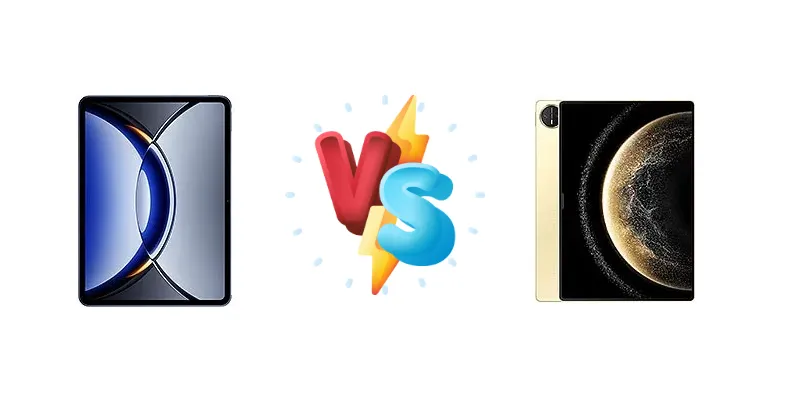
The large-screen Android tablet market is heating up, with Oppo and Huawei both vying for dominance. The Oppo Pad 3 Pro brings Qualcomm’s flagship Snapdragon 8 Gen 3 to the table, while Huawei counters with its in-house Kirin T92 chipset. This comparison dives deep into the core differences, focusing on performance, charging speeds, and the overall user experience to determine which tablet best suits your needs.
🏆 Quick Verdict
For users prioritizing raw processing power and gaming performance, the Oppo Pad 3 Pro emerges as the winner. Its Snapdragon 8 Gen 3 chipset, built on a 4nm process, offers a significant advantage. However, the Huawei MatePad Pro 13.2 (2025) impresses with its 100W charging, making it ideal for those who value minimal downtime.
| Network |
|---|
| 2G bands | N/A | GSM 850 / 900 / 1800 / 1900 |
| 3G bands | N/A | HSDPA 850 / 900 / 1900 / 2100 |
| 4G bands | N/A | LTE |
| EDGE | No | - |
| GPRS | No | - |
| Speed | - | HSPA, LTE - cellular model only |
| Technology | No cellular connectivity | GSM / HSPA / LTE |
| Launch |
|---|
| Announced | 2024, October 24 | 2024, November 26 |
| Status | Available. Released 2024, October 30 | Available. Released 2024, December 12 |
| Body |
|---|
| Build | Glass front, aluminum frame, aluminum back | Glass front, nylon fiber back, magnesium alloy frame |
| Dimensions | 268.7 x 195.1 x 6.5 mm (10.58 x 7.68 x 0.26 in) | 289.1 x 196.1 x 5.5 mm (11.38 x 7.72 x 0.22 in) |
| SIM | No | Nano-SIM (cellular model only) |
| Weight | 586 g (1.29 lb) | 580 g (Wi-FI) or 590 g (LTE) (1.28 lb) |
| Display |
|---|
| Resolution | 2120 x 3000 pixels (~304 ppi density) | 2880 x 1920 pixels, 3:2 ratio (~262 ppi density) |
| Size | 12.1 inches, 445.2 cm2 (~84.9% screen-to-body ratio) | 13.2 inches, 518.8 cm2 (~91.5% screen-to-body ratio) |
| Type | IPS LCD, 68B colors, Dolby Vision, 144Hz, 900 nits (HBM) | OLED, 1B colors, 144Hz, HDR Vivid, 1000 nits (peak) |
| Platform |
|---|
| CPU | 8-core (1x3.39GHz Cortex-X4 & 3x3.1GHz Cortex-A720 & 2x2.9GHz Cortex-A720 & 2x2.2GHz Cortex-A520) | Octa-core |
| Chipset | Qualcomm SM8650-AC Snapdragon 8 Gen 3 (4 nm) | Kirin T92 |
| GPU | Adreno 750 (1 GHz) | - |
| OS | Android 14, ColorOS 14.1 | Harmony OS 4.3 |
| Memory |
|---|
| Card slot | No | No |
| Internal | 256GB 8GB RAM, 256GB 12GB RAM, 512GB 16GB RAM, 1TB 16GB RAM | 256GB 12GB RAM, 512GB 12GB RAM, 1TB 16GB RAM |
| Main Camera |
|---|
| Dual | - | 50 MP, f/1.8, (wide), PDAF
8 MP, f/2.2, (ultrawide) |
| Features | Color spectrum sensor, LED flash | LED flash |
| Single | 13 MP, f/2.2, (wide), AF | - |
| Video | 4K@30fps, 1080p@30ps, gyro-EIS | 4K@30fps, 1080p@30fps |
| Selfie camera |
|---|
| Single | 8 MP, f/2.3, 103˚ (ultrawide) | 16 MP, f/2.2 |
| Video | 1080p@30fps | 1080p@30fps |
| Sound |
|---|
| 35mm jack | No | No |
| Loudspeaker | Yes, with stereo speakers (4 speakers) | Yes, with stereo speakers (6 speakers) |
| Comms |
|---|
| Bluetooth | 5.4, A2DP, LE | 5.2, A2DP, LE, L2HC |
| NFC | No | No |
| Positioning | No | GPS, GALILEO, GLONASS, BDS |
| Radio | No | No |
| USB | USB Type-C 3.2, OTG, accessory connector | USB Type-C 3.1, OTG, DisplayPort 1.2, accessory connector pins |
| WLAN | Wi-Fi 802.11 a/b/g/n/ac/6/7, dual-band | Wi-Fi 802.11 a/b/g/n/ac/6, dual-band |
| Features |
|---|
| Sensors | Accelerometer, proximity (accessories only), gyro, compass | Fingerprint (side-mounted), accelerometer, gyro, compass, proximity (accessories only) |
| Battery |
|---|
| Charging | 67W wired, PD, QC, UFCS | 100W wired
7.5W reverse wired |
| Type | 9510 mAh | Li-Po 10100 mAh |
| Misc |
|---|
| Colors | Blue, Gold | Black, White, Gold |
| Models | OPD2401 | WEB-W00, PCE-W29 |
| Price | About 600 EUR | About 680 EUR |
Oppo Pad 3 Pro
- Superior processing power with Snapdragon 8 Gen 3
- More efficient 4nm fabrication process
- Potentially better gaming performance
- Slower charging speed (67W)
- No reverse wireless charging
Huawei MatePad Pro 13.2 (2025)
- Ultra-fast 100W wired charging
- 7.5W reverse wired charging
- Potentially longer battery life due to optimized power management
- Less powerful Kirin T92 chipset
- May experience throttling under heavy load
Display Comparison
While both tablets likely feature high-resolution displays (specs missing), the core difference lies in the underlying processing power driving them. Display quality will be crucial, but without specific details like peak brightness or panel type (LTPO is expected on both given the price point), it's difficult to definitively declare a winner. Bezels will also play a role in the immersive experience, and we'll need hands-on testing to assess those.
Camera Comparison
Without camera specifications, a detailed comparison is impossible. However, given the tablet form factor, camera quality is less of a priority for most users. We anticipate both tablets will feature capable cameras for video conferencing and casual photography, but neither is likely to compete with flagship smartphones. The absence of detailed camera specs suggests neither device is positioning itself as a photography powerhouse.
Performance
The Oppo Pad 3 Pro’s Qualcomm Snapdragon 8 Gen 3 (4nm) is a clear advantage over the Huawei MatePad Pro 13.2’s Kirin T92. The Snapdragon 8 Gen 3’s octa-core CPU, with its Cortex-X4 prime core clocked at 3.39GHz, promises significantly faster processing speeds for demanding applications. The 4nm fabrication process also translates to improved thermal efficiency, potentially reducing throttling during prolonged gaming sessions. While the Kirin T92 is an octa-core processor, its architecture and clock speeds are unknown, making a direct comparison difficult, but it's unlikely to match the Snapdragon's raw power.
Battery Life
The Huawei MatePad Pro 13.2 (2025) takes a decisive lead in charging speed with its 100W wired charging capability, compared to the Oppo Pad 3 Pro’s 67W. This means significantly faster 0-100% charge times for the Huawei tablet. While battery capacity (mAh) is unknown for both devices, the faster charging speed of the MatePad Pro mitigates concerns about battery life for users who need to quickly replenish their power. The MatePad Pro also offers 7.5W reverse wired charging, a feature absent on the Oppo Pad 3 Pro, allowing it to charge other devices.
Buying Guide
Buy the Oppo Pad 3 Pro if you need a tablet for demanding tasks like video editing, high-end gaming, or running resource-intensive applications. Its Snapdragon 8 Gen 3 provides the horsepower for a smooth and responsive experience. Buy the Huawei MatePad Pro 13.2 (2025) if you prioritize rapid charging and extended usability, especially if you frequently use your tablet on the go and need to quickly top up the battery. The 100W charging is a game-changer for power users.
Frequently Asked Questions
❓ Will the Snapdragon 8 Gen 3 in the Oppo Pad 3 Pro handle demanding games like Genshin Impact at maximum settings?
Yes, the Snapdragon 8 Gen 3 is a flagship-level chipset designed to handle even the most graphically intensive games like Genshin Impact at maximum settings with consistently high frame rates. The 4nm process also helps to mitigate thermal throttling, ensuring sustained performance during long gaming sessions.
❓ How long does it realistically take to fully charge the Huawei MatePad Pro 13.2 (2025) from 0% with the 100W charger?
While exact charging times depend on various factors, the 100W charging capability of the Huawei MatePad Pro 13.2 (2025) should allow for a full charge from 0% in approximately 30-40 minutes. This is significantly faster than the Oppo Pad 3 Pro's 67W charging, which would likely take over an hour.
❓ Does the Kirin T92 in the Huawei MatePad Pro 13.2 (2025) support hardware-accelerated video decoding for common codecs like H.265 and VP9?
Huawei's Kirin chipsets typically include dedicated hardware for video decoding, and the T92 is expected to support H.265 (HEVC) and VP9 codecs. This ensures smooth playback of high-resolution video content without significant CPU load, improving battery life and overall performance.