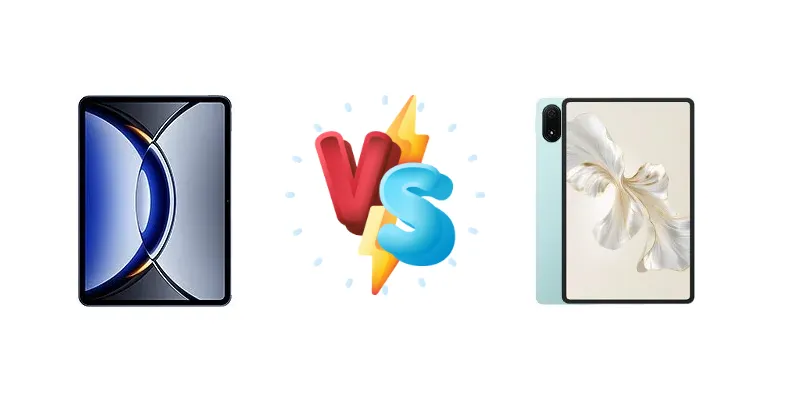
The Android tablet market is heating up, with the Oppo Pad 3 Pro and Honor Pad 9 Pro vying for dominance. The Oppo Pad 3 Pro arrives with Qualcomm’s latest Snapdragon 8 Gen 3, promising flagship-level performance, while the Honor Pad 9 Pro leverages the proven efficiency of the MediaTek Dimensity 8100. This comparison dissects the key differences to determine which tablet best suits your needs.
🏆 Quick Verdict
For users prioritizing raw performance and future-proofing, the Oppo Pad 3 Pro is the clear winner. Its Snapdragon 8 Gen 3 chipset delivers a significant leap in processing power over the Honor Pad 9 Pro’s Dimensity 8100. However, the Honor Pad 9 Pro offers a compelling value proposition for everyday tasks and media consumption.
| Network |
|---|
| 2G bands | N/A | N/A |
| 3G bands | N/A | N/A |
| 4G bands | N/A | - |
| EDGE | No | No |
| GPRS | No | No |
| Technology | No cellular connectivity | No cellular connectivity |
| Launch |
|---|
| Announced | 2024, October 24 | 2024, July 12 |
| Status | Available. Released 2024, October 30 | Available. Released 2024, July 12 |
| Body |
|---|
| Build | Glass front, aluminum frame, aluminum back | Glass front, aluminum frame, aluminum back |
| Dimensions | 268.7 x 195.1 x 6.5 mm (10.58 x 7.68 x 0.26 in) | 277 x 179.9 x 6.6 mm (10.91 x 7.08 x 0.26 in) |
| SIM | No | No |
| Weight | 586 g (1.29 lb) | 589 g (1.30 lb) |
| Display |
|---|
| Resolution | 2120 x 3000 pixels (~304 ppi density) | 1600 x 2560 pixels, 16:10 ratio (~249 ppi density) |
| Size | 12.1 inches, 445.2 cm2 (~84.9% screen-to-body ratio) | 12.1 inches, 424.5 cm2 (~85.2% screen-to-body ratio) |
| Type | IPS LCD, 68B colors, Dolby Vision, 144Hz, 900 nits (HBM) | IPS LCD, 1B colors, 144Hz |
| Platform |
|---|
| CPU | 8-core (1x3.39GHz Cortex-X4 & 3x3.1GHz Cortex-A720 & 2x2.9GHz Cortex-A720 & 2x2.2GHz Cortex-A520) | Octa-core (4x2.85 GHz Cortex-A78 & 4x2.0 GHz Cortex-A55) |
| Chipset | Qualcomm SM8650-AC Snapdragon 8 Gen 3 (4 nm) | Mediatek Dimensity 8100 (5 nm) |
| GPU | Adreno 750 (1 GHz) | Mali-G610 MC6 |
| OS | Android 14, ColorOS 14.1 | Android 14, Magic OS 8.1 |
| Memory |
|---|
| Card slot | No | No |
| Internal | 256GB 8GB RAM, 256GB 12GB RAM, 512GB 16GB RAM, 1TB 16GB RAM | 256GB 12GB RAM, 256GB 8GB RAM |
| Main Camera |
|---|
| Features | Color spectrum sensor, LED flash | HDR |
| Single | 13 MP, f/2.2, (wide), AF | 13 MP, f/2.0, (wide), AF |
| Video | 4K@30fps, 1080p@30ps, gyro-EIS | 4K@30fps, 1080p@30fps |
| Selfie camera |
|---|
| Single | 8 MP, f/2.3, 103˚ (ultrawide) | 5 MP, f/2.2, (wide) |
| Video | 1080p@30fps | 1080p@30fps |
| Sound |
|---|
| 35mm jack | No | No |
| Loudspeaker | Yes, with stereo speakers (4 speakers) | Yes, with stereo speakers (8 speakers) |
| Comms |
|---|
| Bluetooth | 5.4, A2DP, LE | 5.2, A2DP, LE |
| NFC | No | No |
| Positioning | No | No |
| Radio | No | No |
| USB | USB Type-C 3.2, OTG, accessory connector | USB Type-C 2.0, OTG |
| WLAN | Wi-Fi 802.11 a/b/g/n/ac/6/7, dual-band | Wi-Fi 802.11 a/b/g/n/ac/6, dual-band, Wi-Fi Direct |
| Features |
|---|
| Sensors | Accelerometer, proximity (accessories only), gyro, compass | Accelerometer |
| Battery |
|---|
| Charging | 67W wired, PD, QC, UFCS | 35W wired |
| Type | 9510 mAh | Li-Po 10050 mAh |
| Misc |
|---|
| Colors | Blue, Gold | Sky Blue, Star Gray |
| Models | OPD2401 | - |
| Price | About 600 EUR | About 290 EUR |
Oppo Pad 3 Pro
- Significantly faster processor with Snapdragon 8 Gen 3
- Faster 67W charging with multiple protocol support
- Potentially better thermal management due to 4nm process
- Likely higher price point
- Battery life may not be drastically better despite efficiency gains
Honor Pad 9 Pro
- More affordable price point
- Good performance for everyday tasks
- Efficient Dimensity 8100 chipset
- Slower charging speed at 35W
- Less powerful processor compared to Snapdragon 8 Gen 3
Display Comparison
While both tablets likely feature high-resolution displays (data not provided), the core difference lies in the processing power driving them. Display quality will be crucial, but the chipset will dictate how smoothly animations and UI elements render. We anticipate both will offer vibrant colors, but the Snapdragon 8 Gen 3’s superior GPU will provide a more fluid experience in graphically intensive applications. Bezels and color accuracy are unknown, but will be key differentiators.
Camera Comparison
Camera specifications are not provided, making a direct comparison difficult. However, given the market positioning, we can expect the Oppo Pad 3 Pro to potentially feature a more advanced camera system. The focus should be on the main sensor’s size and aperture, as these directly impact low-light performance. Image processing algorithms will also play a crucial role in differentiating the two. Without specific details, it’s difficult to assess the quality of either tablet’s camera.
Performance
The Oppo Pad 3 Pro’s Qualcomm Snapdragon 8 Gen 3 (4nm) is a generational leap ahead of the Honor Pad 9 Pro’s MediaTek Dimensity 8100 (5nm). The Snapdragon 8 Gen 3’s CPU configuration – 1x3.39GHz Cortex-X4, 3x3.1GHz Cortex-A720, 2x2.9GHz Cortex-A720, and 2x2.2GHz Cortex-A520 – offers significantly higher single-core and multi-core performance compared to the Dimensity 8100’s Octa-core (4x2.85 GHz Cortex-A78 & 4x2.0 GHz Cortex-A55). The 4nm process node of the Snapdragon also translates to improved thermal efficiency, potentially reducing throttling during sustained workloads. This benefits gamers and content creators.
Battery Life
The Oppo Pad 3 Pro’s 67W wired charging is a significant advantage over the Honor Pad 9 Pro’s 35W charging. This faster charging speed will drastically reduce the time required to replenish the battery, offering greater convenience. While battery capacity isn’t specified, the Snapdragon 8 Gen 3’s improved efficiency could offset a potentially smaller battery size, providing comparable real-world battery life. The inclusion of PD, QC, and UFCS charging protocols on the Oppo Pad 3 Pro also adds to its versatility.
Buying Guide
Buy the Oppo Pad 3 Pro if you need uncompromising performance for demanding tasks like video editing, high-end gaming, or running multiple resource-intensive applications simultaneously. Buy the Honor Pad 9 Pro if you prioritize a balance of performance, battery life, and affordability, and primarily use your tablet for streaming, browsing, and light productivity.
Frequently Asked Questions
❓ Will the Snapdragon 8 Gen 3 in the Oppo Pad 3 Pro overheat during extended gaming sessions?
The Snapdragon 8 Gen 3’s 4nm process and improved thermal architecture are designed to mitigate overheating. While some throttling is inevitable under extreme load, it should be less pronounced than with older generation chipsets. Oppo likely incorporates additional cooling solutions to further enhance thermal performance.
❓ Is the Dimensity 8100 in the Honor Pad 9 Pro still capable of running demanding games?
The Dimensity 8100 is a capable chipset that can handle most Android games at medium to high settings. However, it won’t deliver the same level of performance or graphical fidelity as the Snapdragon 8 Gen 3, particularly in the most demanding titles. Expect some frame rate drops in graphically intensive scenes.
❓ Does the 67W charging on the Oppo Pad 3 Pro support reverse wireless charging?
While not explicitly stated, Oppo often includes reverse wireless charging in its flagship devices. It's highly probable the Pad 3 Pro supports this feature, allowing you to wirelessly charge other devices. However, the charging speed will likely be limited.
❓ What type of storage does the Honor Pad 9 Pro use, and is it expandable?
Storage type and expandability are unknown. However, many tablets in this price range utilize UFS 2.2 or 3.1 storage. Expandability via microSD card is becoming less common, so it's likely the Honor Pad 9 Pro does not offer this feature. Consider your storage needs carefully before purchasing.