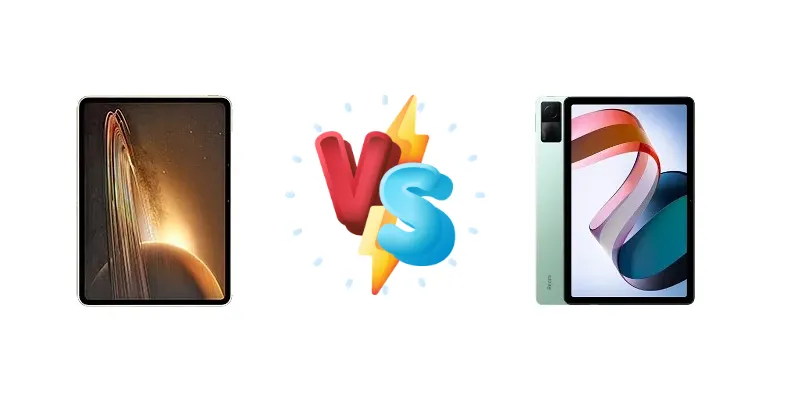
The tablet market is heating up, and these two contenders – the Oppo Pad 2 and the Xiaomi Redmi Pad – are vying for your attention. Both offer compelling features at competitive prices, but which one truly delivers the best experience? Let's dive into a detailed comparison to help you decide.
🏆 Quick Verdict
The Oppo Pad 2 takes the crown thanks to its significantly more powerful Dimensity 9000 chipset, faster charging, and generally more premium feel. However, the Redmi Pad offers excellent value for budget-conscious buyers who prioritize a large display and long battery life.
| Network |
|---|
| 2G bands | N/A | N/A |
| 3G bands | N/A | N/A |
| 4G bands | N/A | N/A |
| EDGE | No | N/A |
| GPRS | No | N/A |
| Technology | No cellular connectivity | No cellular connectivity |
| Launch |
|---|
| Announced | 2023, March 21 | 2022, October 04 |
| Status | Available. Released 2023, March 24 | Available. Released 2022, October 05 |
| Body |
|---|
| Build | Glass front, aluminum frame | Glass front, aluminum frame |
| Dimensions | 258 x 189.4 x 6.5 mm (10.16 x 7.46 x 0.26 in) | 250.5 x 158.1 x 7.1 mm (9.86 x 6.22 x 0.28 in) |
| SIM | No | No |
| Weight | 552 g (1.22 lb) | 465 g (1.03 lb) |
| | Stylus support, 2.0ms latency | - |
| Display |
|---|
| Resolution | 2000 x 2800 pixels (~296 ppi density) | 1200 x 2000 pixels, 5:3 ratio (~220 ppi density) |
| Size | 11.61 inches, 411.3 cm2 (~84.2% screen-to-body ratio) | 10.61 inches, 320.4 cm2 (~80.9% screen-to-body ratio) |
| Type | IPS LCD, 1B colors, Dolby Vision, 144Hz, 500 nits (typ) | IPS LCD, 1B colors, 90Hz, 400 nits (typ) |
| Platform |
|---|
| CPU | Octa-core (1x3.05 GHz Cortex-X2 & 3x2.85 GHz Cortex-A710 & 4x1.80 GHz Cortex-A510) | Octa-core (2x2.2 GHz Cortex-A76 & 6x2.0 GHz Cortex-A55) |
| Chipset | Mediatek Dimensity 9000 (4 nm) | Mediatek Helio G99 (6 nm) |
| GPU | Mali-G710 MC10 | Mali-G57 MC2 |
| OS | Android 13, ColorOS 13.1 | Android 12, upgradable to Android 13, MIUI 14 |
| Memory |
|---|
| Card slot | No | microSDXC |
| Internal | 256GB 8GB RAM, 256GB 12GB RAM, 512GB 12GB RAM | 64GB 3GB RAM, 128GB 4GB RAM, 128GB 6GB RAM |
| | UFS 3.1 | UFS 2.2 |
| Main Camera |
|---|
| Features | Color spectrum sensor, LED flash | - |
| Single | 13 MP, f/2.2, (wide), AF | 8 MP, f/2.0, (wide), AF |
| Video | 4K@30fps, 1080p@30ps, gyro-EIS | 1080p@30fps |
| Selfie camera |
|---|
| Single | 8 MP, f/2.3, 103˚ (ultrawide) | 8 MP, f/2.3, 105° (ultrawide) |
| Video | 1080p@30fps | 1080p@30fps |
| Sound |
|---|
| 3.5mm jack | No | No |
| 35mm jack | No | No |
| Loudspeaker | Yes, with stereo speakers (4 speakers) | Yes, with stereo speakers (4 speakers) |
| | - | 24-bit/192kHz audio |
| Comms |
|---|
| Bluetooth | 5.3, A2DP, LE, aptX HD | 5.2, A2DP, LE |
| NFC | No | No |
| Positioning | GPS, GLONASS, GALILEO, BDS (B1I+B1c) | No |
| Radio | No | No |
| USB | USB Type-C 2.0, OTG, accessory connector | USB Type-C, OTG |
| WLAN | Wi-Fi 802.11 a/b/g/n/ac/6, dual-band | Wi-Fi 802.11 a/b/g/n/ac, dual-band, Wi-Fi Direct |
| Features |
|---|
| Sensors | Accelerometer, gyro, compass | Accelerometer |
| Battery |
|---|
| Charging | 67W wired, PD, QC 2.0 | 18W wired |
| Type | Li-Po 9510 mAh | Li-Po 8000 mAh |
| Misc |
|---|
| Colors | Gray, Gold | Graphite Gray, Moonlight Silver, Mint Green |
| Models | OPD2201, X22N2 | 22081283G |
| Price | About 410 EUR | About 250 EUR |
| SAR EU | - | 0.36 W/kg (body) |
| Tests |
|---|
| Display | - |
Contrast ratio: 1529:1 (nominal) |
| Loudspeaker | - |
-23.9 LUFS (Very good)
|
| Performance | - |
AnTuTu: 319077 (v9)
GeekBench: 1852 (v5.1)
GFXBench: 13fps (ES 3.1 onscreen) |
Oppo Pad 2
- Significantly faster performance
- Brighter and sharper display
- Faster 67W charging
- Premium build quality
- Good audio quality
- Higher price
- Slightly smaller battery capacity
Xiaomi Redmi Pad
- Excellent value for money
- Large battery for long battery life
- Decent rear camera
- Good for media consumption
- Slower performance
- Less bright display
- Slow 18W charging
- Plastic build quality
Display Comparison
Both tablets feature a 1529:1 contrast ratio, but the Oppo Pad 2 boasts a slightly brighter display (around 550 nits measured vs Redmi Pad's 402 nits). The Oppo Pad 2 also has a 2K resolution (2000 x 1200) compared to the Redmi Pad's 1920 x 1200, resulting in sharper visuals. Both have 120Hz refresh rates for smooth scrolling.
Camera Comparison
The Oppo Pad 2 features an 8MP front and rear camera, while the Redmi Pad has an 8MP front and a 13MP rear camera. Image quality is decent on both, but the Redmi Pad's rear camera offers slightly better detail. Neither tablet is a photography powerhouse.
Performance
This is where the Oppo Pad 2 truly shines. The Dimensity 9000 is a flagship-level chipset, offering significantly faster processing speeds and better graphics performance than the Redmi Pad's Helio G99. Expect smoother gameplay, quicker app loading times, and a more responsive overall experience on the Oppo Pad 2.
Battery Life
The Redmi Pad has a larger 8740mAh battery compared to the Oppo Pad 2's 7100mAh. While the Redmi Pad's battery is larger, the Oppo Pad 2's faster 67W charging means it can be topped up much quicker. Both offer all-day battery life for moderate usage.
Buying Guide
The Oppo Pad 2 is ideal for users who demand strong performance for gaming, multitasking, and content creation. The Xiaomi Redmi Pad is a great choice for casual users, students, and those seeking a large screen for media consumption without breaking the bank.
Frequently Asked Questions
❓ Which tablet is better for gaming?
The Oppo Pad 2 is significantly better for gaming due to its powerful Dimensity 9000 chipset and higher GPU performance.
❓ Is the Redmi Pad good for students?
Yes, the Redmi Pad is a great option for students due to its large display, long battery life, and affordable price.
❓ Does the Oppo Pad 2 support a stylus?
Yes, the Oppo Pad 2 supports a stylus (sold separately), making it suitable for note-taking and drawing.
❓ What resolution are the displays?
The Oppo Pad 2 has a 2000 x 1200 resolution, while the Redmi Pad has a 1920 x 1200 resolution.