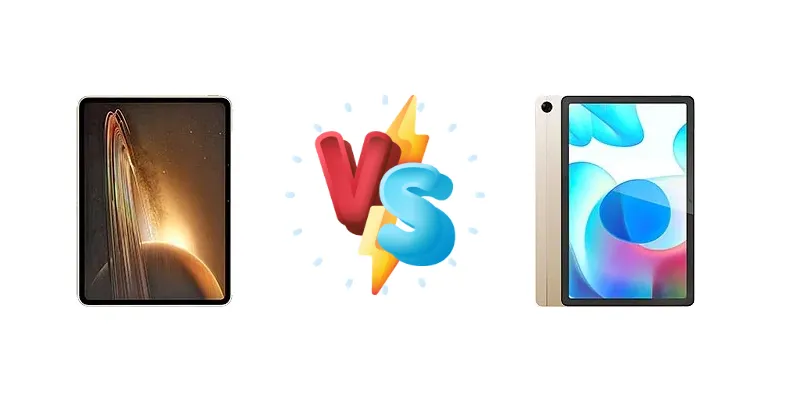
The tablet market is heating up, and these two contenders, the Oppo Pad 2 and the Realme Pad, are vying for your attention. Both offer compelling features at different price points, but which one truly delivers the best experience? Let's dive into a comprehensive comparison to help you decide.
🏆 Quick Verdict
The Oppo Pad 2 is the clear winner for performance, boasting a significantly more powerful chipset and faster charging. However, the Realme Pad offers a more budget-friendly option with a decent display and acceptable performance for everyday tasks. Choose the Pad 2 for power, the Realme Pad for value.
| Network |
|---|
| 2G bands | N/A | GSM 850 / 900 / 1800 / 1900 |
| 3G bands | N/A | HSDPA 850 / 900 / 2100 |
| 4G bands | N/A | 1, 3, 5, 7, 8, 20, 28, 38, 40, 41 |
| EDGE | No | - |
| GPRS | No | - |
| Speed | - | HSPA, LTE - cellular model only |
| Technology | No cellular connectivity | GSM / HSPA / LTE |
| Launch |
|---|
| Announced | 2023, March 21 | 2021, September 09 |
| Status | Available. Released 2023, March 24 | Available. Released 2021, September 16 |
| Body |
|---|
| Build | Glass front, aluminum frame | Glass front, aluminum frame, aluminum back |
| Dimensions | 258 x 189.4 x 6.5 mm (10.16 x 7.46 x 0.26 in) | 246.1 x 155.9 x 6.9 mm (9.69 x 6.14 x 0.27 in) |
| SIM | No | Nano-SIM (cellular model only) |
| Weight | 552 g (1.22 lb) | 440 g (15.52 oz) |
| | Stylus support, 2.0ms latency | - |
| Display |
|---|
| Resolution | 2000 x 2800 pixels (~296 ppi density) | 1200 x 2000 pixels, 5:3 ratio (~224 ppi density) |
| Size | 11.61 inches, 411.3 cm2 (~84.2% screen-to-body ratio) | 10.4 inches, 307.9 cm2 (~80.2% screen-to-body ratio) |
| Type | IPS LCD, 1B colors, Dolby Vision, 144Hz, 500 nits (typ) | IPS LCD, 360 nits (typ) |
| Platform |
|---|
| CPU | Octa-core (1x3.05 GHz Cortex-X2 & 3x2.85 GHz Cortex-A710 & 4x1.80 GHz Cortex-A510) | Octa-core (2x2.0 GHz Cortex-A75 & 6x1.8 GHz Cortex-A55) |
| Chipset | Mediatek Dimensity 9000 (4 nm) | Mediatek MT6769V/CU Helio G80 (12 nm) |
| GPU | Mali-G710 MC10 | Mali-G52 MC2 |
| OS | Android 13, ColorOS 13.1 | Android 11 |
| Memory |
|---|
| Card slot | No | microSDXC (uses shared SIM slot) |
| Internal | 256GB 8GB RAM, 256GB 12GB RAM, 512GB 12GB RAM | 32GB 3GB RAM, 64GB 4GB RAM, 128GB 6GB RAM |
| | UFS 3.1 | - |
| Main Camera |
|---|
| Features | Color spectrum sensor, LED flash | - |
| Single | 13 MP, f/2.2, (wide), AF | 8 MP |
| Video | 4K@30fps, 1080p@30ps, gyro-EIS | 1080p@30fps |
| Selfie camera |
|---|
| Single | 8 MP, f/2.3, 103˚ (ultrawide) | 8 MP, 105˚ (ultrawide) |
| Video | 1080p@30fps | 1080p@30fps |
| Sound |
|---|
| 3.5mm jack | No | Yes |
| 35mm jack | No | Yes |
| Loudspeaker | Yes, with stereo speakers (4 speakers) | Yes, with stereo speakers (4 speakers) |
| | - | 24-bit/192kHz audio |
| Comms |
|---|
| Bluetooth | 5.3, A2DP, LE, aptX HD | 5.0, A2DP, LE |
| NFC | No | No |
| Positioning | GPS, GLONASS, GALILEO, BDS (B1I+B1c) | GPS, GLONASS, BDS - cellular model only |
| Radio | No | No |
| USB | USB Type-C 2.0, OTG, accessory connector | USB Type-C 2.0, OTG |
| WLAN | Wi-Fi 802.11 a/b/g/n/ac/6, dual-band | Wi-Fi 802.11 a/b/g/n/ac, dual-band, Wi-Fi Direct |
| Features |
|---|
| Sensors | Accelerometer, gyro, compass | Accelerometer, gyro, proximity |
| Battery |
|---|
| Charging | 67W wired, PD, QC 2.0 | 18W wired
5W reverse wired |
| Type | Li-Po 9510 mAh | 7100 mAh |
| Misc |
|---|
| Colors | Gray, Gold | Gray, Gold |
| Models | OPD2201, X22N2 | RMP2102, RMP2103 |
| Price | About 410 EUR | About 160 EUR |
| Tests |
|---|
| Display | - |
Contrast ratio: 1554:1 (nominal) |
| Loudspeaker | - |
-22.4 LUFS (Excellent)
|
| Performance | - |
AnTuTu: 187913 (v8), 226474 (v9)
GeekBench: 1236 (v5.1)
GFXBench: 8.5fps (ES 3.1 onscreen) |
Oppo Pad 2
- Exceptional Performance
- Fast Charging (67W)
- Likely Superior Display Quality
- Premium Build Quality
- Higher Price
- Potentially Less Battery Life (despite fast charging)
Realme Pad
- Affordable Price
- Decent Display
- Reverse Wired Charging
- Good for Basic Tasks
- Underpowered Chipset
- Slow Charging (18W)
- Lower Display Quality
- Less Responsive
Display Comparison
The Realme Pad boasts a 1554:1 contrast ratio, while the Oppo Pad 2 likely offers a similar ratio with potentially better color accuracy and brightness due to its higher-end chipset. While both have good contrast, the Oppo Pad 2's display is expected to be more vibrant and visually appealing. The Oppo Pad 2 likely has a higher resolution display as well.
Camera Comparison
Camera quality is generally not a primary concern for tablets. However, the Oppo Pad 2's more powerful chipset likely translates to slightly better image processing and overall camera performance. Both are likely to be adequate for casual snapshots.
Performance
This is where the Oppo Pad 2 truly shines. The Dimensity 9000 is a powerhouse compared to the Helio G80. Expect significantly faster app loading times, smoother multitasking, and a much better gaming experience on the Oppo Pad 2. The Realme Pad will handle basic tasks adequately, but struggles with demanding applications.
Battery Life
While both tablets offer decent battery life, the Oppo Pad 2's 67W fast charging is a major advantage. It can be fully charged much faster than the Realme Pad's 18W charging. The Realme Pad likely has a slightly larger battery capacity, but the Oppo Pad 2's charging speed makes it the more practical choice.
Buying Guide
The Oppo Pad 2 is ideal for users who prioritize performance, gaming, and multitasking. It's a great choice for students, creatives, and anyone who wants a smooth and responsive tablet experience. The Realme Pad is best suited for casual users, students on a budget, and those who primarily consume media and browse the web.
Frequently Asked Questions
❓ Is the Oppo Pad 2 worth the extra money?
If performance and a premium experience are your priorities, then yes. The Oppo Pad 2 offers a significant upgrade over the Realme Pad in terms of speed and overall quality.
❓ Can the Realme Pad handle gaming?
It can handle some casual games, but don't expect a smooth experience with demanding titles. The Helio G80 chipset is simply not powerful enough for high-end gaming.