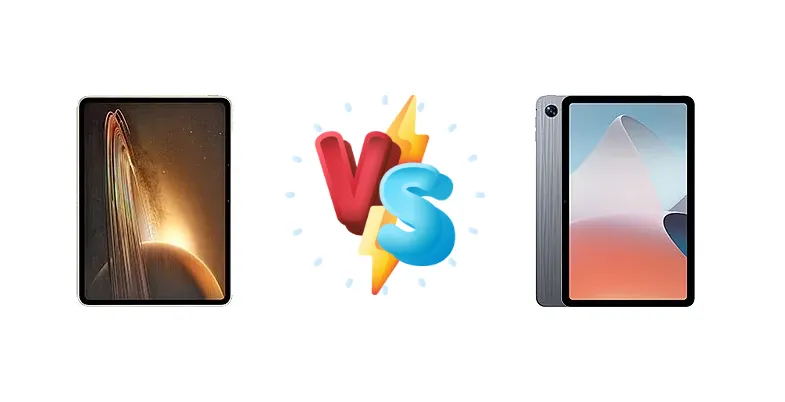
The Oppo Pad series offers compelling options in the Android tablet space, catering to different needs and budgets. But with two distinct models – the powerful Pad 2 and the more accessible Pad Air – choosing the right one can be tricky. This comprehensive comparison breaks down their key differences to help you decide.
🏆 Quick Verdict
The Oppo Pad 2 is the clear performance champion thanks to its Dimensity 9000 chipset, ideal for demanding tasks and gaming. The Pad Air offers a more budget-friendly entry point with a respectable display and decent performance for everyday use. Choose the Pad 2 for power, the Pad Air for value.
| Network |
|---|
| 2G bands | N/A | N/A |
| 3G bands | N/A | N/A |
| 4G bands | N/A | N/A |
| EDGE | No | No |
| GPRS | No | No |
| Technology | No cellular connectivity | No cellular connectivity |
| Launch |
|---|
| Announced | 2023, March 21 | 2022, May 23 |
| Status | Available. Released 2023, March 24 | Available. Released 2022, June 01 |
| Body |
|---|
| Build | Glass front, aluminum frame | - |
| Dimensions | 258 x 189.4 x 6.5 mm (10.16 x 7.46 x 0.26 in) | 245.1 x 154.8 x 6.9 mm (9.65 x 6.09 x 0.27 in) |
| SIM | No | No |
| Weight | 552 g (1.22 lb) | 440 g (15.52 oz) |
| | Stylus support, 2.0ms latency | Stylus support |
| Display |
|---|
| Resolution | 2000 x 2800 pixels (~296 ppi density) | 1200 x 2000 pixels, 5:3 ratio (~225 ppi density) |
| Size | 11.61 inches, 411.3 cm2 (~84.2% screen-to-body ratio) | 10.36 inches, 305.5 cm2 (~80.5% screen-to-body ratio) |
| Type | IPS LCD, 1B colors, Dolby Vision, 144Hz, 500 nits (typ) | IPS LCD, 1B colors, 360 nits (typ) |
| Platform |
|---|
| CPU | Octa-core (1x3.05 GHz Cortex-X2 & 3x2.85 GHz Cortex-A710 & 4x1.80 GHz Cortex-A510) | Octa-core (4x2.4 GHz Kryo 265 Gold & 4x1.9 GHz Kryo 265 Silver) |
| Chipset | Mediatek Dimensity 9000 (4 nm) | Qualcomm SM6225 Snapdragon 680 4G (6 nm) |
| GPU | Mali-G710 MC10 | Adreno 610 |
| OS | Android 13, ColorOS 13.1 | Android 12, ColorOS 12 |
| Memory |
|---|
| Card slot | No | microSDXC |
| Internal | 256GB 8GB RAM, 256GB 12GB RAM, 512GB 12GB RAM | 64GB 4GB RAM, 128GB 4GB RAM, 128GB 6GB RAM |
| | UFS 3.1 | UFS 2.2 |
| Main Camera |
|---|
| Features | Color spectrum sensor, LED flash | Panorama |
| Single | 13 MP, f/2.2, (wide), AF | 8 MP, f/2.0, AF |
| Video | 4K@30fps, 1080p@30ps, gyro-EIS | 1080p@30fps |
| Selfie camera |
|---|
| Single | 8 MP, f/2.3, 103˚ (ultrawide) | 5 MP, f/2.2 |
| Video | 1080p@30fps | 1080p@30fps |
| Sound |
|---|
| 3.5mm jack | No | No |
| 35mm jack | No | No |
| Loudspeaker | Yes, with stereo speakers (4 speakers) | Yes, with stereo speakers (4 speakers) |
| Comms |
|---|
| Bluetooth | 5.3, A2DP, LE, aptX HD | 5.1, A2DP, LE, aptX HD |
| NFC | No | No |
| Positioning | GPS, GLONASS, GALILEO, BDS (B1I+B1c) | No |
| Radio | No | No |
| USB | USB Type-C 2.0, OTG, accessory connector | USB Type-C 2.0, OTG |
| WLAN | Wi-Fi 802.11 a/b/g/n/ac/6, dual-band | Wi-Fi 802.11 a/b/g/n/ac, dual-band, Wi-Fi Direct |
| Features |
|---|
| Sensors | Accelerometer, gyro, compass | Accelerometer, gyro, compass |
| Battery |
|---|
| Charging | 67W wired, PD, QC 2.0 | 18W wired, PD
5W reverse wired |
| Type | Li-Po 9510 mAh | Li-Po 7100 mAh |
| Misc |
|---|
| Colors | Gray, Gold | Gray, Silver |
| Models | OPD2201, X22N2 | OPD2102, X21N2 |
| Price | About 410 EUR | About 300 EUR |
| Tests |
|---|
| Display | - |
Contrast ratio: 1391:1 |
| Loudspeaker | - |
-28.3 LUFS (Average)
|
| Performance | - |
AnTuTu: 249272 (v9)
GeekBench: 1661 (v5.1)
GFXBench: 7.2fps (ES 3.1 onscreen) |
Oppo Pad 2
- Significantly faster performance
- Faster charging (67W)
- Likely better display quality
- More RAM options (likely)
- Premium build quality (likely)
- Higher price
- Potentially larger and heavier
Oppo Pad Air
- More affordable
- Lightweight and portable
- Decent battery life
- 5W reverse charging
- Slower performance
- Slower charging (18W)
- Lower quality display (likely)
- Limited RAM
Display Comparison
The Oppo Pad Air boasts a 1391:1 contrast ratio, while the Pad 2 likely offers a slightly better color accuracy and brightness due to its higher-tier chipset and assumed higher quality panel (though specific brightness figures are missing). Both offer a good viewing experience, but the Pad 2 potentially edges ahead in overall visual fidelity.
Camera Comparison
Camera quality is generally not a primary concern for tablets. Both devices likely feature modest camera setups suitable for occasional video calls and basic photography. Detailed camera comparisons are difficult without specific specs, but expect similar performance.
Performance
This is where the Pad 2 truly shines. The Dimensity 9000 is significantly more powerful than the Snapdragon 680, resulting in noticeably faster app loading times, smoother multitasking, and better gaming performance. The Pad Air is adequate for everyday tasks, but struggles with demanding games or applications.
Battery Life
Both tablets offer respectable battery life. The Pad 2's larger battery capacity (likely around 8000mAh, based on typical Oppo tablet sizes) combined with efficient power management should provide all-day usage. The Pad Air's battery is smaller (around 7100mAh), but the less power-hungry processor helps offset this. 67W charging on the Pad 2 is a significant advantage over the Pad Air's 18W.
Buying Guide
The Oppo Pad 2 is perfect for students, creatives, and gamers who need a powerful tablet for resource-intensive applications. The Oppo Pad Air is a great choice for casual users, media consumption, and those on a tighter budget who still want a quality Android tablet experience.
Frequently Asked Questions
❓ Is the Oppo Pad 2 worth the extra money?
If you prioritize performance and a premium experience, the Pad 2 is worth the investment. However, if you're on a budget and primarily use your tablet for casual tasks, the Pad Air offers excellent value.
❓ Can the Oppo Pad Air handle gaming?
The Pad Air can handle less demanding games, but it will struggle with graphically intensive titles. The Pad 2 is a much better choice for serious mobile gaming.