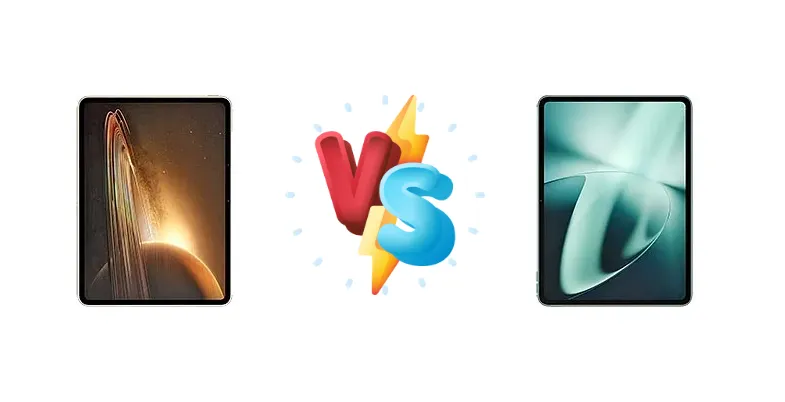
The Android tablet market is heating up, and the Oppo Pad 2 and OnePlus Pad are two strong contenders vying for your attention. Both offer impressive specs and features, but which one truly delivers the best experience? Let's dive into a detailed comparison to help you make the right choice.
🏆 Quick Verdict
The OnePlus Pad edges out the Oppo Pad 2 thanks to its superior display quality and slightly more refined software experience. While both share the same powerful Dimensity 9000 chipset, the OnePlus Pad's brighter screen and OxygenOS make it the preferred pick for most users.
| Network |
|---|
| 2G bands | N/A | N/A |
| 3G bands | N/A | N/A |
| 4G bands | N/A | N/A |
| EDGE | No | No |
| GPRS | No | No |
| Technology | No cellular connectivity | No cellular connectivity |
| Launch |
|---|
| Announced | 2023, March 21 | 2023, February 07 |
| Status | Available. Released 2023, March 24 | Available. Released 2023, April 28 |
| Body |
|---|
| Build | Glass front, aluminum frame | Glass front, aluminum back, aluminum frame |
| Dimensions | 258 x 189.4 x 6.5 mm (10.16 x 7.46 x 0.26 in) | 258 x 189.4 x 6.5 mm (10.16 x 7.46 x 0.26 in) |
| SIM | No | No |
| Weight | 552 g (1.22 lb) | 552 g (1.22 lb) |
| | Stylus support, 2.0ms latency | Stylus support |
| Display |
|---|
| Resolution | 2000 x 2800 pixels (~296 ppi density) | 2000 x 2800 pixels (~296 ppi density) |
| Size | 11.61 inches, 411.3 cm2 (~84.2% screen-to-body ratio) | 11.61 inches, 411.3 cm2 (~84.2% screen-to-body ratio) |
| Type | IPS LCD, 1B colors, Dolby Vision, 144Hz, 500 nits (typ) | IPS LCD, 1B colors, Dolby Vision, HDR10+, 144Hz, 500 nits (typ) |
| Platform |
|---|
| CPU | Octa-core (1x3.05 GHz Cortex-X2 & 3x2.85 GHz Cortex-A710 & 4x1.80 GHz Cortex-A510) | Octa-core (1x3.05 GHz Cortex-X2 & 3x2.85 GHz Cortex-A710 & 4x1.80 GHz Cortex-A510) |
| Chipset | Mediatek Dimensity 9000 (4 nm) | Mediatek Dimensity 9000 (4 nm) |
| GPU | Mali-G710 MC10 | Mali-G710 MC10 |
| OS | Android 13, ColorOS 13.1 | Android 13, upgradable to Android 15, OxygenOS 15 |
| Memory |
|---|
| Card slot | No | No |
| Internal | 256GB 8GB RAM, 256GB 12GB RAM, 512GB 12GB RAM | 128GB 8GB RAM, 256GB 12GB RAM |
| | UFS 3.1 | UFS 3.1 |
| Main Camera |
|---|
| Features | Color spectrum sensor, LED flash | LED flash |
| Single | 13 MP, f/2.2, (wide), AF | 13 MP, f/2.2, 23mm (wide) |
| Video | 4K@30fps, 1080p@30ps, gyro-EIS | 4K@30fps, 1080p@30ps, gyro-EIS |
| Selfie camera |
|---|
| Single | 8 MP, f/2.3, 103˚ (ultrawide) | 8 MP, f/2.3, (wide), 1/4.0", 1.12µm |
| Video | 1080p@30fps | 1080p@30fps |
| Sound |
|---|
| 3.5mm jack | No | No |
| 35mm jack | No | No |
| Loudspeaker | Yes, with stereo speakers (4 speakers) | Yes, with stereo speakers (4 speakers) |
| Comms |
|---|
| Bluetooth | 5.3, A2DP, LE, aptX HD | 5.3, A2DP, LE, aptX HD |
| NFC | No | No |
| Positioning | GPS, GLONASS, GALILEO, BDS (B1I+B1c) | GPS, GLONASS, GALILEO, BDS (B1+B1c) |
| Radio | No | No |
| USB | USB Type-C 2.0, OTG, accessory connector | USB Type-C 2.0, OTG, accessory connector |
| WLAN | Wi-Fi 802.11 a/b/g/n/ac/6, dual-band | Wi-Fi 802.11 a/b/g/n/ac/6, dual-band |
| Features |
|---|
| Sensors | Accelerometer, gyro, compass | Accelerometer, gyro, compass |
| Battery |
|---|
| Charging | 67W wired, PD, QC 2.0 | 67W wired |
| Type | Li-Po 9510 mAh | Li-Po 9510 mAh |
| Misc |
|---|
| Colors | Gray, Gold | Halo Green |
| Models | OPD2201, X22N2 | - |
| Price | About 410 EUR | About 500 EUR |
| Tests |
|---|
| Display | - |
Contrast ratio: 1664:1 |
| Loudspeaker | - |
-22.5 LUFS (Excellent)
|
| Performance | - |
AnTuTu: 859019 (v9)
GeekBench: 3158 (v5.1)
GFXBench: 28fps (ES 3.1 onscreen) |
Oppo Pad 2
- Powerful Dimensity 9000 chipset
- 67W fast charging
- Potentially more affordable
- Good overall performance
- Less impressive display compared to OnePlus Pad
- Software experience may not be as polished
- Camera performance is average
OnePlus Pad
- Superior display quality (brightness & contrast)
- Refined OxygenOS software
- Premium build quality
- Excellent performance
- Slightly higher price
- Camera performance is average
Display Comparison
The OnePlus Pad boasts a significantly better display. While both have similar resolutions, the OnePlus Pad's measured 442 nits brightness and 1664:1 contrast ratio surpass the Oppo Pad 2. This translates to a more vibrant and immersive viewing experience, especially in brighter environments. The Oppo Pad 2's display is still good, but noticeably less impressive.
Camera Comparison
Camera performance is often an afterthought on tablets. Both devices likely feature decent, but not exceptional, camera setups. Expect similar image quality in well-lit conditions, with both struggling in low light. Detailed camera comparisons would require more in-depth testing.
Performance
Both tablets are powered by the same Mediatek Dimensity 9000 chipset, ensuring excellent performance for gaming, multitasking, and demanding applications. Real-world performance differences are likely to be minimal, with both handling everyday tasks and graphically intensive games with ease. Software optimization might play a role in perceived smoothness.
Battery Life
Both tablets offer a large battery capacity and 67W fast charging. Battery life should be comparable, providing a full day of moderate use. The OnePlus Pad's software optimizations might contribute to slightly better battery efficiency in certain scenarios.
Buying Guide
Who should buy the Oppo Pad 2? Users seeking a solid, reliable tablet with good performance at a potentially slightly lower price point. Who should buy the OnePlus Pad? Those prioritizing a premium display, a smoother software experience, and are willing to spend a bit more for the added value.
Frequently Asked Questions
❓ Which tablet is better for gaming?
Both tablets offer excellent gaming performance thanks to the Dimensity 9000 chipset. The OnePlus Pad's superior display might provide a slightly more immersive gaming experience.
❓ Is the OnePlus Pad worth the extra cost?
If you prioritize display quality and a refined software experience, the OnePlus Pad is worth the extra investment. If you're on a tighter budget and primarily need a tablet for basic tasks, the Oppo Pad 2 is a solid alternative.