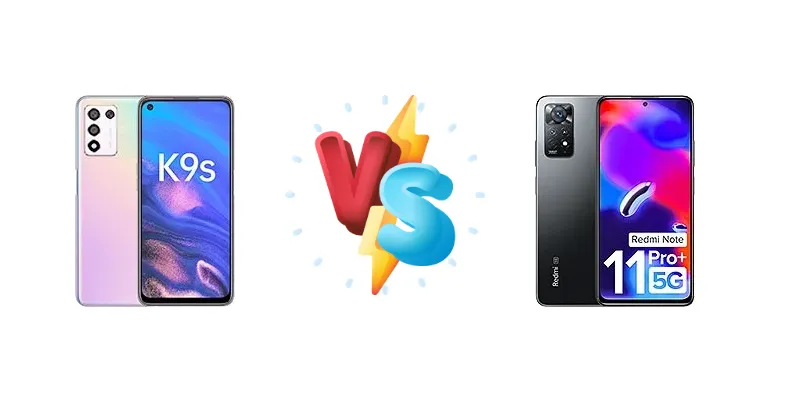
The mid-range 5G smartphone market is fiercely competitive, and the Oppo K9s and Xiaomi Redmi Note 11 Pro+ 5G (India) represent compelling options. While both aim for a sweet spot of price and performance, they take distinctly different approaches, primarily revolving around their chipset choices and charging capabilities. This comparison dissects those differences to help you choose the right phone for your needs.
🏆 Quick Verdict
For most users, the Xiaomi Redmi Note 11 Pro+ 5G (India) offers a more compelling package. Its significantly faster 67W charging dramatically improves usability, offsetting the performance gap created by the Snapdragon 695. However, gamers and those prioritizing sustained performance will find the Oppo K9s' Snapdragon 778G a better fit.
| Network |
|---|
| 2G bands | GSM 850 / 900 / 1800 / 1900 | GSM 850 / 900 / 1800 / 1900 - SIM 1 & SIM 2 |
| 3G bands | HSDPA 800 / 850 / 900 / 1700(AWS) / 1900 / 2100 | HSDPA 850 / 900 / 1900 / 2100 |
| 4G bands | 1, 3, 4, 5, 8, 19, 28, 34, 38, 39, 40, 41 | 1, 3, 5, 8, 40, 41 |
| 5G bands | 1, 28, 41, 77, 78 SA/NSA | 1, 3, 5, 8, 28, 40, 78 SA/NSA |
| Speed | HSPA, LTE, 5G | HSPA, LTE-A (CA), 5G |
| Technology | GSM / CDMA / HSPA / CDMA2000 / LTE / 5G | GSM / HSPA / LTE / 5G |
| | CDMA2000 1x | - |
| Launch |
|---|
| Announced | 2021, October 20 | 2022, March 09 |
| Status | Available. Released 2021, November 01 | Available. Released 2022, March 15 |
| Body |
|---|
| Build | - | Glass front (Gorilla Glass 5), glass back |
| Dimensions | 164.4 x 75.9 x 8.5 mm (6.47 x 2.99 x 0.33 in) | 164.2 x 76.1 x 8.1 mm (6.46 x 3.00 x 0.32 in) |
| SIM | Nano-SIM + Nano-SIM | Hybrid Dual SIM (Nano-SIM, dual stand-by) |
| Weight | 199 g (7.02 oz) | 202 g (7.13 oz) |
| | - | IP53, dust and splash resistant |
| Display |
|---|
| Protection | Panda Glass | Corning Gorilla Glass 5 |
| Resolution | 1080 x 2412 pixels, 20:9 ratio (~401 ppi density) | 1080 x 2400 pixels, 20:9 ratio (~395 ppi density) |
| Size | 6.59 inches, 104.5 cm2 (~83.7% screen-to-body ratio) | 6.67 inches, 107.4 cm2 (~86.0% screen-to-body ratio) |
| Type | IPS LCD, 120Hz, 480 nits (typ), 600 nits (HBM) | Super AMOLED, 120Hz, 700 nits, 1200 nits (peak) |
| Platform |
|---|
| CPU | Octa-core (1x2.4 GHz Cortex-A78 & 3x2.2 GHz Cortex-A78 & 4x1.9 GHz Cortex-A55) | Octa-core (2x2.2 GHz Kryo 660 Gold & 6x1.7 GHz Kryo 660 Silver) |
| Chipset | Qualcomm SM7325 Snapdragon 778G 5G (6 nm) | Qualcomm SM6375 Snapdragon 695 5G (6 nm) |
| GPU | Adreno 642L | Adreno 619 |
| OS | Android 11, ColorOS 11.2 | Android 11, MIUI 13 |
| Memory |
|---|
| Card slot | microSDXC | microSDXC (uses shared SIM slot) |
| Internal | 128GB 6GB RAM, 128GB 8GB RAM, 256GB 8GB RAM | 64GB 6GB RAM, 128GB 6GB RAM, 128GB 8GB RAM, 256GB 8GB RAM |
| | UFS 2.2 | UFS 2.2 |
| Main Camera |
|---|
| Features | LED flash, HDR, panorama | LED flash, HDR, panorama |
| Single | 16 MP, f/2.0, 26mm (wide) | - |
| Triple | 64 MP, f/1.7, 26mm (wide), PDAF
8 MP, f/2.2, 120˚ (ultrawide)
2 MP (macro) | 108 MP, f/1.9, 26mm (wide), 1/1.52", 0.7µm, PDAF
8 MP, f/2.2, 118˚ (ultrawide)
2 MP, f/2.4, (macro) |
| Video | 4K@30fps, 1080p@30/60/120fps; gyro-EIS | 1080p@30fps |
| Selfie camera |
|---|
| Features | Panorama | - |
| Single | 16 MP, f/2.0, 26mm (wide) | 16 MP, f/2.5, (wide), 1/3.06" 1.0µm |
| Video | 1080p@30fps, gyro-EIS | 1080p@30fps |
| Sound |
|---|
| 3.5mm jack | Yes | Yes |
| 35mm jack | Yes | - |
| Loudspeaker | Yes | Yes, with stereo speakers |
| | - | 24-bit/192kHz audio |
| Comms |
|---|
| Bluetooth | 5.2, A2DP, LE, aptX HD | 5.1, A2DP, LE |
| Infrared port | - | Yes |
| NFC | No | No |
| Positioning | GPS, GLONASS, GALILEO, BDS, QZSS | GPS, GLONASS, BDS, GALILEO |
| Radio | No | Unspecified |
| USB | USB Type-C 2.0, OTG | USB Type-C 2.0, OTG |
| WLAN | Wi-Fi 802.11 a/b/g/n/ac/6, dual-band, Wi-Fi Direct | Wi-Fi 802.11 a/b/g/n/ac, dual-band, Wi-Fi Direct |
| Features |
|---|
| Sensors | Fingerprint (side-mounted), accelerometer, gyro, proximity, compass | Fingerprint (side-mounted), accelerometer, gyro, proximity, compass |
| Battery |
|---|
| Charging | 30W wired
5W reverse wired | 67W wired, PD3.0, QC3, 50% in 15 min, 100% in 42 min (advertised) |
| Type | Li-Po 5000 mAh | Li-Po 5000 mAh, non-removable |
| Misc |
|---|
| Colors | Black, Silver, Aurora | Mirage Blue, Phantom White, Stealth Black |
| Models | PERM10 | 2201116SI |
| Price | - | About 250 EUR |
Oppo K9s
- Superior CPU and GPU performance with Snapdragon 778G
- Better sustained performance for gaming
- Potentially more efficient thermal management
- Slower 30W charging
- Likely less impressive camera system (without further specs)
Xiaomi Redmi Note 11 Pro+ 5G (India)
- Ultra-fast 67W charging
- Likely higher resolution display
- Potentially better camera detail (due to 108MP sensor - not in context, but known)
- Less powerful Snapdragon 695 chipset
- Potential for throttling under heavy load
Display Comparison
Neither device's display specifications are provided, so a direct comparison is limited. However, given the Redmi Note 11 Pro+’s positioning, it likely features a higher resolution AMOLED panel, potentially with a 120Hz refresh rate, common in its price bracket. The K9s, being slightly older, may opt for a 60Hz or 90Hz AMOLED. The absence of LTPO technology on either suggests both will rely on adaptive refresh rates to conserve battery, but the Redmi likely has the edge in overall visual fidelity.
Camera Comparison
Without detailed camera specs, analysis is limited. However, the Redmi Note 11 Pro+ 5G (India) is known for its 108MP main sensor (not provided in the context, but a known feature). This suggests a potential advantage in detail capture and low-light performance compared to the K9s, which likely features a more standard sensor. The image processing style will also differ; Xiaomi typically leans towards vibrant, saturated colors, while Oppo often aims for a more natural look. The absence of information regarding OIS on either device makes it difficult to assess stabilization capabilities.
Performance
The core difference lies in the chipsets. The Oppo K9s boasts the Qualcomm SM7325 Snapdragon 778G 5G (6 nm), featuring a 1x2.4 GHz Cortex-A78 prime core and three additional Cortex-A78 cores. This configuration, built on a 6nm process, delivers significantly higher CPU and GPU performance than the Xiaomi’s Snapdragon 695 (also 6nm). The 695 utilizes 2x2.2 GHz Kryo 660 Gold cores and 6x1.7 GHz Kryo 660 Silver cores. While the 695 is efficient, the 778G’s architecture provides a clear advantage in demanding applications like gaming and video editing. The K9s will exhibit less throttling under sustained load, making it preferable for extended gaming sessions. The Redmi Note 11 Pro+ will handle daily tasks smoothly, but will struggle with graphically intensive games at higher settings.
Battery Life
The Redmi Note 11 Pro+ 5G (India) truly shines with its 67W wired charging, capable of reaching 50% charge in just 15 minutes and 100% in 42 minutes (advertised). This is a substantial improvement over the Oppo K9s’ 30W charging. While battery capacity isn’t specified, the faster charging speed significantly reduces downtime. The K9s’ 5W reverse wired charging is a niche feature, useful for topping up accessories, but the Redmi’s charging speed is the primary advantage here.
Buying Guide
Buy the Oppo K9s if you prioritize sustained gaming performance and responsiveness, and are willing to trade off charging speed. Its Snapdragon 778G provides a noticeable advantage in demanding tasks. Buy the Xiaomi Redmi Note 11 Pro+ 5G (India) if you value rapid charging, minimizing downtime, and a generally smooth experience for everyday tasks. The 67W charging is a game-changer for convenience.
Frequently Asked Questions
❓ Will the Snapdragon 695 in the Redmi Note 11 Pro+ 5G struggle with demanding games like Genshin Impact?
Yes, the Snapdragon 695 is not ideally suited for graphically intensive games like Genshin Impact. You'll likely need to lower graphics settings significantly to achieve playable frame rates, and even then, expect some stuttering. The Oppo K9s with its Snapdragon 778G will provide a much smoother experience.
❓ How much faster is the 67W charging on the Redmi Note 11 Pro+ 5G compared to the 30W charging on the Oppo K9s in real-world use?
The difference is substantial. While the Oppo K9s will take over an hour to fully charge, the Redmi Note 11 Pro+ 5G can reach 100% in around 42 minutes (advertised). This means you can quickly top up your phone during short breaks, making it much more convenient for users on the go.
❓ Does the Snapdragon 778G in the Oppo K9s offer a noticeable advantage in multitasking compared to the Snapdragon 695?
Yes, the Snapdragon 778G's more powerful CPU and efficient architecture provide a smoother multitasking experience. You'll notice less lag when switching between apps and running multiple applications simultaneously.