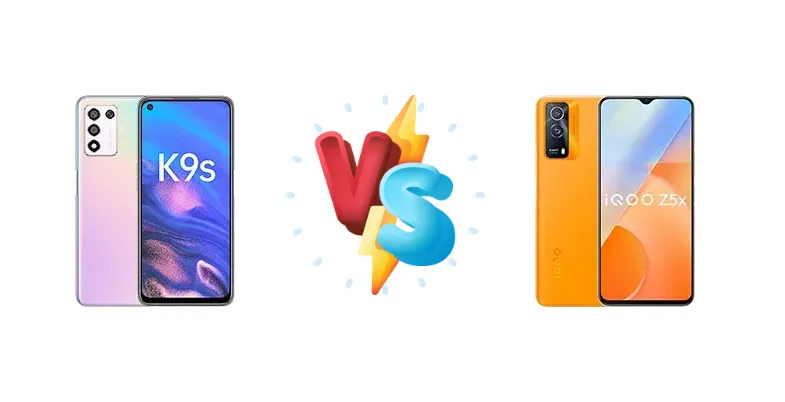
The Oppo K9s and vivo iQOO Z5x represent compelling options in the increasingly competitive mid-range smartphone market. Both devices aim to deliver a strong performance-to-price ratio, but they achieve this through different approaches – the K9s leveraging Qualcomm’s Snapdragon 778G 5G, while the Z5x opts for MediaTek’s Dimensity 900. This comparison will dissect their key differences to help you determine which phone best suits your needs.
🏆 Quick Verdict
For most users, the Oppo K9s emerges as the stronger choice. Its Snapdragon 778G 5G chipset offers a more refined and consistently powerful experience, particularly in sustained workloads like gaming. While the iQOO Z5x boasts faster 44W charging, the K9s’ overall performance edge and established Qualcomm optimization give it the win.
| Network |
|---|
| 2G bands | GSM 850 / 900 / 1800 / 1900 | GSM 850 / 900 / 1800 / 1900 |
| 3G bands | HSDPA 800 / 850 / 900 / 1700(AWS) / 1900 / 2100 | HSDPA 850 / 900 / 1700(AWS) / 2100 |
| 4G bands | 1, 3, 4, 5, 8, 19, 28, 34, 38, 39, 40, 41 | 1, 3, 4, 5, 8, 28, 34, 38, 39, 40, 41 |
| 5G bands | 1, 28, 41, 77, 78 SA/NSA | 1, 3, 28, 41, 77, 78 SA/NSA |
| Speed | HSPA, LTE, 5G | HSPA, LTE, 5G |
| Technology | GSM / CDMA / HSPA / CDMA2000 / LTE / 5G | GSM / CDMA / HSPA / CDMA2000 / LTE / 5G |
| | CDMA2000 1x | CDMA2000 1x |
| Launch |
|---|
| Announced | 2021, October 20 | 2021, October 20 |
| Status | Available. Released 2021, November 01 | Available. Released 2021, November 01 |
| Body |
|---|
| Build | - | Glass front, plastic frame, plastic back |
| Dimensions | 164.4 x 75.9 x 8.5 mm (6.47 x 2.99 x 0.33 in) | 164 x 75.3 x 8.5 mm (6.46 x 2.96 x 0.33 in) |
| SIM | Nano-SIM + Nano-SIM | Nano-SIM + Nano-SIM |
| Weight | 199 g (7.02 oz) | 189 g (6.67 oz) |
| Display |
|---|
| Protection | Panda Glass | - |
| Resolution | 1080 x 2412 pixels, 20:9 ratio (~401 ppi density) | 1080 x 2408 pixels, 20:9 ratio (~401 ppi density) |
| Size | 6.59 inches, 104.5 cm2 (~83.7% screen-to-body ratio) | 6.58 inches, 104.3 cm2 (~84.5% screen-to-body ratio) |
| Type | IPS LCD, 120Hz, 480 nits (typ), 600 nits (HBM) | IPS LCD, 120Hz |
| Platform |
|---|
| CPU | Octa-core (1x2.4 GHz Cortex-A78 & 3x2.2 GHz Cortex-A78 & 4x1.9 GHz Cortex-A55) | Octa-core (2x2.4 GHz Cortex-A78 & 6x2.0 GHz Cortex-A55) |
| Chipset | Qualcomm SM7325 Snapdragon 778G 5G (6 nm) | Mediatek Dimensity 900 (6 nm) |
| GPU | Adreno 642L | Mali-G68 MC4 |
| OS | Android 11, ColorOS 11.2 | Android 11, OriginOS 1.0 for iQOO |
| Memory |
|---|
| Card slot | microSDXC | No |
| Internal | 128GB 6GB RAM, 128GB 8GB RAM, 256GB 8GB RAM | 128GB 6GB RAM, 128GB 8GB RAM, 256GB 8GB RAM |
| | UFS 2.2 | - |
| Main Camera |
|---|
| Dual | - | 50 MP, f/1.8, 26mm (wide), PDAF
2 MP (macro) |
| Features | LED flash, HDR, panorama | LED flash, HDR, panorama |
| Single | 16 MP, f/2.0, 26mm (wide) | 8 MP, f/2.0, (wide) |
| Triple | 64 MP, f/1.7, 26mm (wide), PDAF
8 MP, f/2.2, 120˚ (ultrawide)
2 MP (macro) | - |
| Video | 4K@30fps, 1080p@30/60/120fps; gyro-EIS | 4K@30fps, 1080p@30/60fps, gyro-EIS |
| Selfie camera |
|---|
| Features | Panorama | - |
| Single | 16 MP, f/2.0, 26mm (wide) | 8 MP, f/2.0, (wide) |
| Video | 1080p@30fps, gyro-EIS | 1080p@30fps |
| Sound |
|---|
| 3.5mm jack | Yes | Yes |
| 35mm jack | Yes | Yes |
| Loudspeaker | Yes | Yes |
| Comms |
|---|
| Bluetooth | 5.2, A2DP, LE, aptX HD | 5.2, A2DP, LE, aptX HD |
| NFC | No | No |
| Positioning | GPS, GLONASS, GALILEO, BDS, QZSS | GPS, GLONASS, GALILEO, BDS, QZSS |
| Radio | No | No |
| USB | USB Type-C 2.0, OTG | USB Type-C, OTG |
| WLAN | Wi-Fi 802.11 a/b/g/n/ac/6, dual-band, Wi-Fi Direct | Wi-Fi 802.11 a/b/g/n/ac/6, dual-band, Wi-Fi Direct |
| Features |
|---|
| Sensors | Fingerprint (side-mounted), accelerometer, gyro, proximity, compass | Fingerprint (side-mounted), accelerometer, gyro, proximity, compass |
| Battery |
|---|
| Charging | 30W wired
5W reverse wired | 44W wired, 70% in 38 min |
| Type | Li-Po 5000 mAh | 5000 mAh |
| Misc |
|---|
| Colors | Black, Silver, Aurora | Black, Orange, Silver |
| Models | PERM10 | - |
| Price | - | About 220 EUR |
Oppo K9s
- Stronger overall performance with Snapdragon 778G 5G
- Potentially better image processing due to Qualcomm ISP
- Established Snapdragon optimization for gaming
- Slower 30W charging compared to iQOO Z5x
- Display specs unknown, potential for average LCD panel
vivo iQOO Z5x
- Faster 44W charging with 70% in 38 minutes
- Dimensity 900 offers good efficiency for everyday tasks
- Competitive price point
- Dimensity 900 may struggle with sustained high performance
- Potentially less refined image processing compared to Snapdragon
Display Comparison
Neither device’s display specifications are provided, so a direct comparison is limited. However, given their price points, we can expect both to feature LCD panels with 60Hz or 90Hz refresh rates. The absence of LTPO technology suggests neither will offer adaptive refresh rates for power saving. Bezels are likely to be similar, and color accuracy will depend on software calibration, a known strength of both Oppo and vivo. The display will likely be a differentiating factor based on subjective viewing experience rather than raw specs.
Camera Comparison
Without detailed camera specifications, a precise comparison is difficult. However, both brands typically focus on main sensor quality in this price bracket. We can assume both phones will feature multi-camera setups, but the quality of the supporting lenses (ultrawide, macro, depth) is likely to be modest. The Snapdragon 778G’s ISP (Image Signal Processor) is generally regarded as more advanced, potentially leading to better image processing, dynamic range, and low-light performance on the K9s. The absence of OIS information suggests neither phone will have optical image stabilization.
Performance
The core difference lies in the chipsets. The Oppo K9s’ Snapdragon 778G 5G (6nm) utilizes a 1x2.4 GHz Cortex-A78 prime core, complemented by 3x2.2 GHz Cortex-A78 cores and 4x1.9 GHz Cortex-A55 efficiency cores. This configuration, built on a 6nm process, provides a strong balance of performance and efficiency. The iQOO Z5x’s Dimensity 900 (also 6nm) features 2x2.4 GHz Cortex-A78 cores and 6x2.0 GHz Cortex-A55 cores. While the prime core speeds are identical, the Snapdragon 778G’s additional performance cores and superior GPU generally translate to better sustained performance, especially in graphically intensive games. The K9s is likely to exhibit less thermal throttling under prolonged load.
Battery Life
The iQOO Z5x’s 44W wired charging is a clear advantage, promising a 70% charge in just 38 minutes. The Oppo K9s’ 30W charging is slower, though still respectable. While battery capacity isn’t specified, the faster charging of the Z5x will be more noticeable for users who frequently need to top up their phones quickly. However, the Snapdragon 778G’s efficiency may offset the Z5x’s charging speed advantage for users with moderate usage patterns.
Buying Guide
Buy the Oppo K9s if you prioritize consistent performance for gaming and demanding applications, and value the established optimization of the Snapdragon platform. Buy the vivo iQOO Z5x if rapid charging is your absolute top priority, and you primarily engage in lighter tasks like social media and streaming, where the Dimensity 900’s efficiency can shine.
Frequently Asked Questions
❓ Will the Dimensity 900 in the iQOO Z5x overheat during prolonged gaming sessions?
The Dimensity 900 is a capable chip, but it's less adept at sustained high performance compared to the Snapdragon 778G. Expect some thermal throttling during extended gaming, potentially leading to frame rate drops. The iQOO Z5x may be better suited for shorter gaming bursts or less demanding titles.
❓ How much of a real-world difference will the 44W charging make on the iQOO Z5x?
The 44W charging on the iQOO Z5x is a significant advantage for users who frequently need to quickly top up their battery. Reaching 70% charge in 38 minutes is considerably faster than the Oppo K9s’ 30W charging. This is particularly beneficial for those with busy lifestyles or who often find themselves with low battery levels.
❓ Is the Snapdragon 778G in the Oppo K9s powerful enough for demanding games like Genshin Impact or PUBG?
Yes, the Snapdragon 778G is well-equipped to handle demanding games like Genshin Impact and PUBG. While you may not be able to max out all settings, you can expect a smooth and enjoyable gaming experience at medium to high settings. The 778G’s superior thermal management will also help maintain consistent performance over longer gaming sessions.