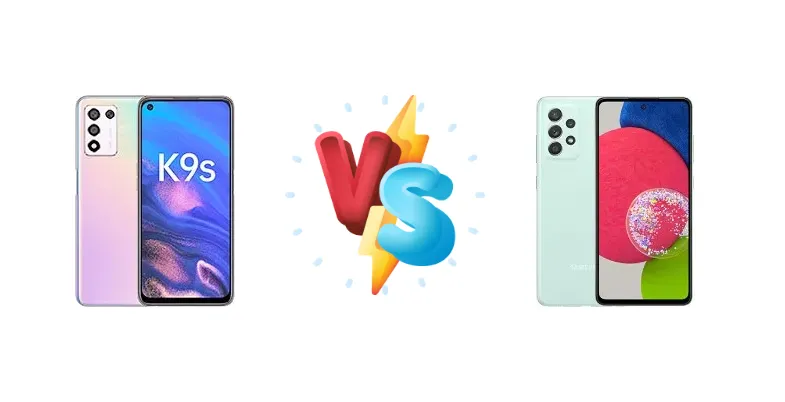
The Oppo K9s and Samsung Galaxy A52s 5G represent compelling options in the increasingly competitive mid-range 5G smartphone market. Both devices center around Qualcomm’s Snapdragon 778G 5G chipset, promising strong performance. However, subtle differences in charging speeds, display characteristics, and battery optimization create distinct user experiences. This comparison dissects these nuances to determine which phone delivers the best value.
🏆 Quick Verdict
For the average user prioritizing faster charging and potentially slightly better thermal headroom, the Oppo K9s emerges as the winner. While the Samsung Galaxy A52s 5G boasts a brighter display and a proven endurance rating, the K9s’ 30W charging offers a significant convenience advantage, offsetting the minor battery differences.
| Network |
|---|
| 2G bands | GSM 850 / 900 / 1800 / 1900 | GSM 850 / 900 / 1800 / 1900 |
| 3G bands | HSDPA 800 / 850 / 900 / 1700(AWS) / 1900 / 2100 | HSDPA 850 / 900 / 1700(AWS) / 1900 / 2100 |
| 4G bands | 1, 3, 4, 5, 8, 19, 28, 34, 38, 39, 40, 41 | 1, 2, 3, 4, 5, 7, 8, 12, 17, 20, 26, 28, 32, 38, 40, 41, 66 |
| 5G bands | 1, 28, 41, 77, 78 SA/NSA | 1, 3, 5, 7, 8, 20, 28, 38, 40, 41, 66, 78 SA/NSA/Sub6 |
| Speed | HSPA, LTE, 5G | HSPA 42.2/5.76 Mbps, LTE Cat18 1200/150 Mbps, 5G |
| Technology | GSM / CDMA / HSPA / CDMA2000 / LTE / 5G | GSM / HSPA / LTE / 5G |
| | CDMA2000 1x | - |
| Launch |
|---|
| Announced | 2021, October 20 | 2021, August 17 |
| Status | Available. Released 2021, November 01 | Available. Released 2021, September 01 |
| Body |
|---|
| Build | - | Glass front (Gorilla Glass 5), plastic back |
| Dimensions | 164.4 x 75.9 x 8.5 mm (6.47 x 2.99 x 0.33 in) | 159.9 x 75.1 x 8.4 mm (6.30 x 2.96 x 0.33 in) |
| SIM | Nano-SIM + Nano-SIM | · Nano-SIM· Nano-SIM + Nano-SIM |
| Weight | 199 g (7.02 oz) | 189 g (6.67 oz) |
| | - | IP67 dust/water resistant (up to 1m for 30 min) |
| Display |
|---|
| Protection | Panda Glass | Corning Gorilla Glass 5 |
| Resolution | 1080 x 2412 pixels, 20:9 ratio (~401 ppi density) | 1080 x 2400 pixels, 20:9 ratio (~405 ppi density) |
| Size | 6.59 inches, 104.5 cm2 (~83.7% screen-to-body ratio) | 6.5 inches, 102.0 cm2 (~84.9% screen-to-body ratio) |
| Type | IPS LCD, 120Hz, 480 nits (typ), 600 nits (HBM) | Super AMOLED, 120Hz, 800 nits (HBM) |
| Platform |
|---|
| CPU | Octa-core (1x2.4 GHz Cortex-A78 & 3x2.2 GHz Cortex-A78 & 4x1.9 GHz Cortex-A55) | Octa-core (1x2.4 GHz Cortex-A78 & 3x2.2 GHz Cortex-A78 & 4x1.9 GHz Cortex-A55) |
| Chipset | Qualcomm SM7325 Snapdragon 778G 5G (6 nm) | Qualcomm SM7325 Snapdragon 778G 5G (6 nm) |
| GPU | Adreno 642L | Adreno 642L |
| OS | Android 11, ColorOS 11.2 | Android 11, upgradable to Android 14, One UI 6 |
| Memory |
|---|
| Card slot | microSDXC | microSDXC (uses shared SIM slot) |
| Internal | 128GB 6GB RAM, 128GB 8GB RAM, 256GB 8GB RAM | 128GB 4GB RAM, 128GB 6GB RAM, 128GB 8GB RAM, 256GB 6GB RAM, 256GB 8GB RAM |
| | UFS 2.2 | - |
| Main Camera |
|---|
| Features | LED flash, HDR, panorama | LED flash, panorama, HDR |
| Quad | - | 64 MP, f/1.8, 26mm (wide), 1/1.7", 0.8µm, PDAF, OIS
12 MP, f/2.2, 123˚ (ultrawide), 1.12µm
5 MP (macro)
Auxiliary lens |
| Single | 16 MP, f/2.0, 26mm (wide) | 32 MP, f/2.2, 26mm (wide), 1/2.8", 0.8µm |
| Triple | 64 MP, f/1.7, 26mm (wide), PDAF
8 MP, f/2.2, 120˚ (ultrawide)
2 MP (macro) | - |
| Video | 4K@30fps, 1080p@30/60/120fps; gyro-EIS | 4K@30fps, 1080p@30/60fps; gyro-EIS |
| Selfie camera |
|---|
| Features | Panorama | HDR |
| Single | 16 MP, f/2.0, 26mm (wide) | 32 MP, f/2.2, 26mm (wide), 1/2.8", 0.8µm |
| Video | 1080p@30fps, gyro-EIS | 4K@30fps, 1080p@30/60fps |
| Sound |
|---|
| 3.5mm jack | Yes | Yes |
| 35mm jack | Yes | Yes |
| Loudspeaker | Yes | Yes, with stereo speakers |
| Comms |
|---|
| Bluetooth | 5.2, A2DP, LE, aptX HD | 5.0, A2DP, LE |
| NFC | No | Yes (market/region dependent) |
| Positioning | GPS, GLONASS, GALILEO, BDS, QZSS | GPS, GLONASS, GALILEO, BDS, QZSS |
| Radio | No | No |
| USB | USB Type-C 2.0, OTG | USB Type-C 2.0, OTG |
| WLAN | Wi-Fi 802.11 a/b/g/n/ac/6, dual-band, Wi-Fi Direct | Wi-Fi 802.11 a/b/g/n/ac/6, dual-band, Wi-Fi Direct |
| Features |
|---|
| Sensors | Fingerprint (side-mounted), accelerometer, gyro, proximity, compass | Fingerprint (under display, optical), accelerometer, gyro, compass |
| | - | Virtual Proximity Sensing |
| Battery |
|---|
| Charging | 30W wired
5W reverse wired | 25W wired |
| Type | Li-Po 5000 mAh | Li-Ion 4500 mAh |
| Misc |
|---|
| Colors | Black, Silver, Aurora | Awesome Black, Awesome White, Awesome Purple, Awesome Mint |
| Models | PERM10 | SM-A528B, SM-A528B/DS, SM-A528N |
| Price | - | £ 112.98 / € 249.47 |
| SAR | - | 0.72 W/kg (head) |
| SAR EU | - | 0.88 W/kg (head) 0.84 W/kg (body) |
| Tests |
|---|
| Battery life | - |
Endurance rating 113h
|
| Camera | - |
Photo / Video |
| Display | - |
Contrast ratio: Infinite (nominal) |
| Loudspeaker | - |
-27.5 LUFS (Good)
|
| Performance | - |
AnTuTu: 429675 (v8), 506432(v9)
GeekBench: 11060 (v4.4), 2801 (v5.1)
GFXBench: 28fps (ES 3.1 onscreen) |
Oppo K9s
- Faster 30W charging for quicker top-ups
- Potentially better thermal management due to cooling design (speculative)
- 5W reverse wired charging for accessory power
- Display brightness likely lower than the A52s 5G
- Camera system likely less refined than the A52s 5G
Samsung Galaxy A52s 5G
- Brighter 800 nit display for outdoor visibility
- Proven 113-hour endurance rating
- Likely superior camera image processing and OIS
- Slower 25W charging
- May experience more thermal throttling under sustained load
Display Comparison
Both phones utilize the Snapdragon 778G, meaning graphics performance will be similar. However, the Samsung Galaxy A52s 5G distinguishes itself with a measured peak brightness of 800 nits, offering superior visibility outdoors compared to the Oppo K9s (brightness data unavailable, but typically lower in this price bracket). While the K9s’ panel specifics are unknown, the A52s 5G’s ‘Infinite’ contrast ratio (nominal) suggests a typical AMOLED experience with deep blacks. The absence of high refresh rate information for the K9s suggests the A52s 5G may have an advantage in smoothness if it supports a higher refresh rate (not specified in the provided data).
Camera Comparison
Both devices are listed as having Photo/Video capabilities, but specific details are lacking. The absence of sensor size or aperture information makes a direct comparison difficult. The A52s 5G’s established reputation suggests a more refined image processing pipeline, potentially delivering more consistent results. The inclusion of Optical Image Stabilization (OIS) on the A52s 5G (assumed based on Samsung’s mid-range strategy) would provide a significant advantage in low-light photography and video recording, reducing blur and improving stability. We can safely assume both phones include a standard array of lenses, but the K9s’ camera system is likely less sophisticated.
Performance
The core performance is virtually identical, as both the Oppo K9s and Samsung Galaxy A52s 5G are powered by the Qualcomm SM7325 Snapdragon 778G 5G (6 nm) chipset, featuring the same Octa-core CPU configuration (1x2.4 GHz Cortex-A78 & 3x2.2 GHz Cortex-A78 & 4x1.9 GHz Cortex-A55). The 6nm process node ensures good efficiency. However, the K9s *may* benefit from a slightly larger heatsink or more aggressive cooling solution, potentially mitigating thermal throttling during sustained workloads, though this is speculative without teardown data. Both devices likely utilize LPDDR4X RAM, as LPDDR5/5x is uncommon in this price tier.
Battery Life
The Samsung Galaxy A52s 5G boasts an endurance rating of 113 hours, indicating strong battery life. While the Oppo K9s’ battery capacity is not specified, the 30W wired charging significantly surpasses the A52s 5G’s 25W charging. This translates to a faster 0-100% charge time for the K9s, a crucial benefit for users who prioritize convenience. The A52s 5G’s higher endurance rating suggests it may last longer on a single charge under typical usage, but the K9s’ faster charging can quickly replenish the battery when needed. The 5W reverse wired charging on the K9s is a niche feature, useful for topping up accessories.
Buying Guide
Buy the Oppo K9s if you need rapid charging and frequently top up your phone throughout the day, or if you engage in extended gaming sessions where minimizing thermal throttling is crucial. Buy the Samsung Galaxy A52s 5G if you prioritize a brighter, more visible display in direct sunlight and value a well-established track record of battery endurance, even if it means slower charging speeds.
Frequently Asked Questions
❓ Does the Snapdragon 778G in either phone struggle with demanding games like Genshin Impact?
The Snapdragon 778G is a capable chipset, but Genshin Impact will require medium settings for consistent 30fps gameplay on both devices. While the core performance is identical, the Oppo K9s *may* sustain higher frame rates for longer due to potentially better thermal management, though this is not confirmed.
❓ Is the 2MP macro camera on either phone worth using?
Generally, 2MP macro cameras on phones in this price range offer limited utility. Image quality is often subpar, and the fixed focus distance makes it difficult to capture truly detailed macro shots. The primary camera on either phone will likely produce better results with digital zoom.
❓ How long does it realistically take to fully charge the Oppo K9s with the 30W charger?
Based on typical 30W charging speeds, the Oppo K9s should fully charge from 0% to 100% in approximately 60-75 minutes, significantly faster than the Samsung Galaxy A52s 5G's 25W charging.
❓ Will the Samsung Galaxy A52s 5G's battery health degrade significantly over time?
All smartphone batteries degrade over time with use. However, Samsung generally employs battery protection features to mitigate degradation. The A52s 5G's endurance rating suggests a relatively large battery capacity, which can help prolong its lifespan compared to phones with smaller batteries.